

This is a hard thing to describe in a second language, and an easy thing to be talked out of. Nothing is swollen, nothing looks broken, and the pain lasts a fraction of a second — usually as you let go of a bite rather than while you chew. It sounds too small to be worth an appointment. That description is in fact close to a diagnosis on its own.
Why does a tooth hurt only when I bite down?
A cracked tooth is still in one piece. The crack lets the segments either side of it flex apart very slightly under load and spring back when the load comes off, and that movement irritates the pulp — the nerve inside the tooth. The pain is therefore sharp, brief and tied to pressure rather than present all the time.
Two details separate it from decay. Pain on release, the jolt as you unclench rather than as you bite down, points to a crack, as does cold sensitivity in one specific tooth that stops the moment the cold is gone. Decay reaching the pulp gives a duller ache that lingers and does not depend on biting.
Can a crack be seen on an X-ray?
Frequently not. A crack running front to back through a molar is edge-on to a dental X-ray, and a fine one leaves nothing for the image to record. Cracked teeth are usually confirmed in the chair instead, by reproducing the symptom on a single cusp — another case on this site was diagnosed with a bite stick after two X-rays showed nothing.
This one was more visible. Apart from some crowding of the front teeth, the mouth looked unremarkable on examination. The X-ray showed a line as fine as a thread running from beneath the gold inlay in the lower right second molar down to the pulp: intact outside, split inside.
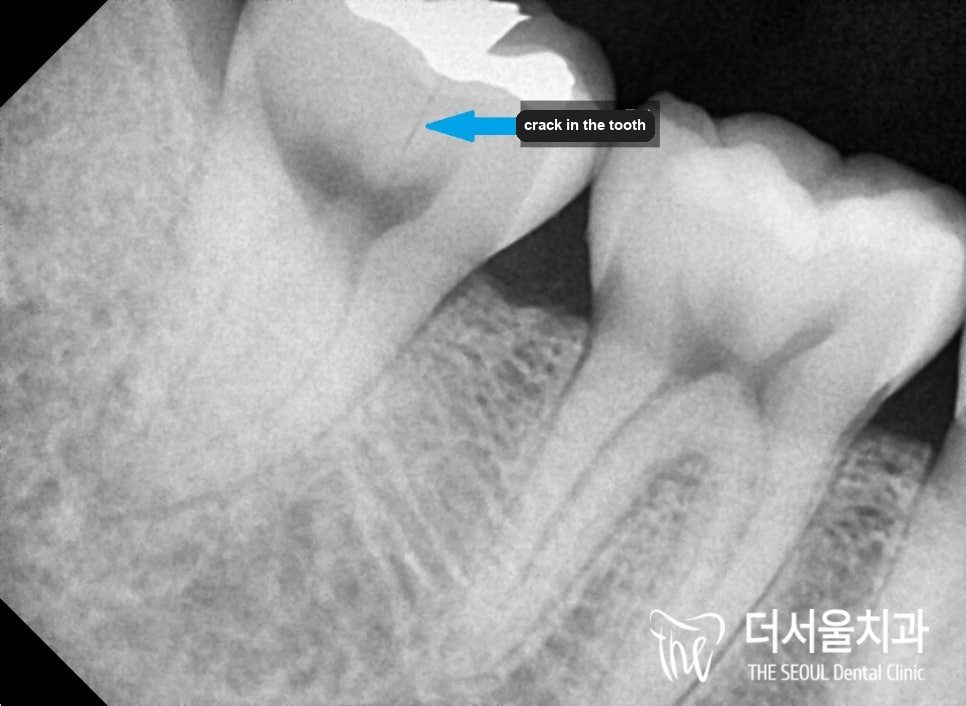
Why do teeth crack underneath a gold inlay?
A restoration and the tooth around it share every chewing load, and something has to give first. Composite resin wears and can debond. Ceramic is hard but brittle, and chips. Gold does neither — it deforms very slightly rather than fracturing, which is why inlays made of it last for decades. Where the restoration does not fail, the load is absorbed by the tooth around it instead, and in a molar under heavy or repeated force that is where the crack eventually appears.
This is why our preference for large cavities in molars is a bonded resin or ceramic restoration. Gold is not a poor material; a failed restoration is simply a far easier problem than a split tooth.
How is a cracked molar treated?
Three depths, three different answers.
- Shallow, with no symptoms. The cracked area is smoothed and restored, or a crown is fitted to hold the tooth together so the crack does not open further under load.
- Deep, or into the pulp, with pain. A pulp that a crack has reached does not recover, so root canal treatment comes first, then a core to rebuild the missing internal structure, then a crown.
- Below the gum line, into the root. A tooth cannot be held together at that depth and is not restorable. It is extracted and the space replaced, usually with an implant.
The classification only moves in one direction. Left alone, a crack in the first category becomes one in the second, and one in the second becomes one in the third, because the force that opened it is applied several hundred times a day.
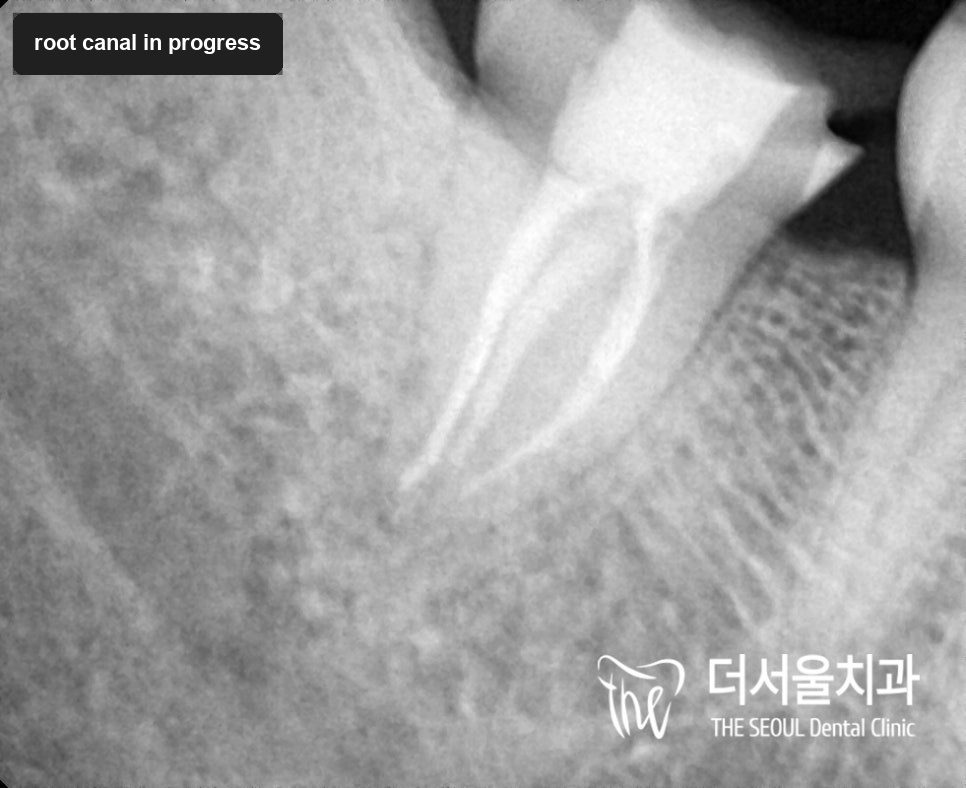
What did treatment involve for this tooth?
This tooth was in the second category, so it needed root canal treatment before anything could be built on it. Treatment ran from 1 July to 3 August 2022 — about five weeks — in four stages.
Root canal treatment. The pulp is removed, the canals cleaned and disinfected, and the space sealed. How many appointments that takes depends on the shape of the canals, and it is the part of the schedule that varies most.
The core. A root-treated molar is hollow, with too little tooth left for a crown to grip. A core build-up fills that space and rebuilds the shape a crown needs; where very little tooth survives above the gum, a post is set into a canal to hold the core.
The temporary crown. The tooth is shaped, an impression taken, and a temporary worn while the crown is made. The temporary is where the bite is settled: a crown has to meet the opposing tooth at the same instant the teeth either side of it do, and one that contacts early takes more force than it was built for.
Fitting the zirconia crown. The permanent crown is made to that settled bite, then checked the same way before cementing — biting on marking paper, adjusting wherever contact is heavy, checking again. A lower second molar takes the highest chewing forces in the mouth, which is what the material has to survive.
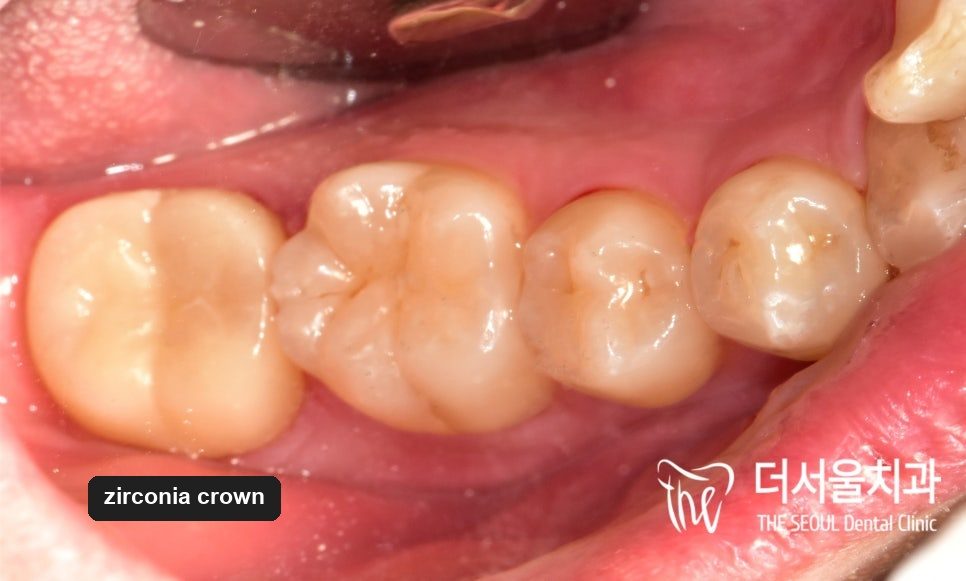
What stops the same thing happening again?
A crown holds a cracked tooth together; it does not remove the crack. The tooth underneath still has a split in it, and the crown’s job is to stop the two parts flexing apart. That is why the aftercare is part of the treatment and not an appendix to it.
Three things load a molar hard enough to matter: hard foods such as ice, bones and nuts; tough foods needing sustained force; and clenching or grinding, which does most of its damage at night when there is no reflex to stop it. Where grinding is the driver it has to be managed in its own right, usually with a night guard.
Which symptoms are worth an examination?
Three, and any one of them on its own is enough:
- a sharp jolt at the moment you release a bite, in one identifiable tooth;
- cold sensitivity confined to a single tooth that already carries a filling, inlay or crown;
- a molar you have started avoiding without having decided to.
None of these needs to be seen the same day. What they change is which of the three categories above still applies to the tooth.
Frequently asked questions
Does the crown make the crack go away?
No. The crack stays in the tooth underneath. A crown encircles the tooth so the cracked segments cannot flex apart under load, which is what stops both the symptoms and the crack extending.
Can a cracked tooth be saved without root canal treatment?
Yes, where the crack has not reached the pulp. A shallow crack can be smoothed and restored, or crowned to hold the tooth together. Depth decides this rather than how much it hurts.
Should I have old gold inlays replaced before they cause trouble?
Not as a matter of routine. An inlay sealed at its margins, with no symptoms and no decay beneath it on X-ray, is left alone. The reasons to act are symptoms in that tooth, a margin that has lifted or worn, or decay visible under the edge.
What does treating a cracked molar cost in Korea?
Root canal treatment is covered by Korea’s national health insurance, so that part is inexpensive for insured patients. Visitors without Korean insurance pay the uninsured rate for it instead. The zirconia crown is not covered for anyone and is charged separately. Our fees are on the pricing page.
How long does the whole sequence take?
About five weeks here. The variable part is the root canal treatment, which needs more appointments where canals are curved or hard to disinfect. The crown stage is a preparation appointment, one to two weeks in a temporary, then a fit appointment.
Read more: crowns and veneers · root canal treatment · pricing