
The same treatment costs different amounts at different clinics, and patients reasonably want to know why. The answer is not that one of them is cheating you.
Why does the same filling take different amounts of work?
Non-covered dental treatment is priced by each clinic individually. There is no national tariff for it, and each practice sets its own fees.
Underneath that, the treatment itself varies more than the name suggests: the material used, how much of it is needed, and how many steps the particular case requires. Two fillings described identically can be different amounts of work.
So a low price is not evidence of a conscientious clinic, and a high one is not evidence of overtreatment. Price alone does not tell you which you are dealing with.
What a clinic can reasonably be asked for is a clear explanation of what is being done and why. Ours are published on the pricing page rather than quoted on request.
How is decay between teeth found?
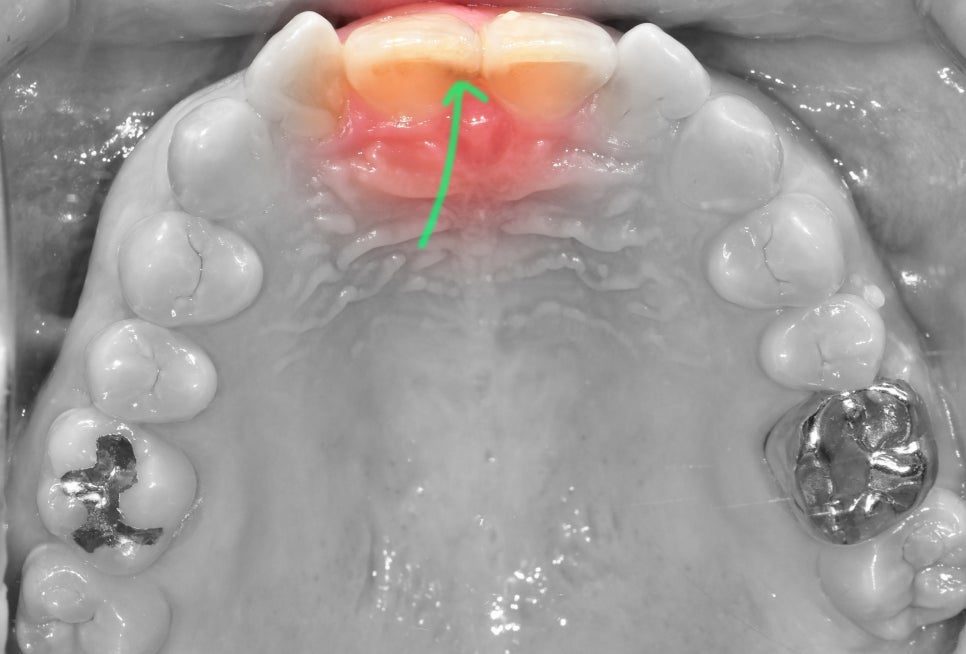
The decay here was found during a routine examination, sitting between the two upper central incisors.
This is proximal caries — decay on the surface where two teeth touch. It is genuinely difficult to detect. A dentist who does not look carefully can miss it, which means a patient has essentially no chance of noticing it themselves.
It is usually found either once symptoms appear or during a thorough examination. That combination — hidden, painless, progressing — is why it is worth having someone look for it periodically rather than waiting to feel something.
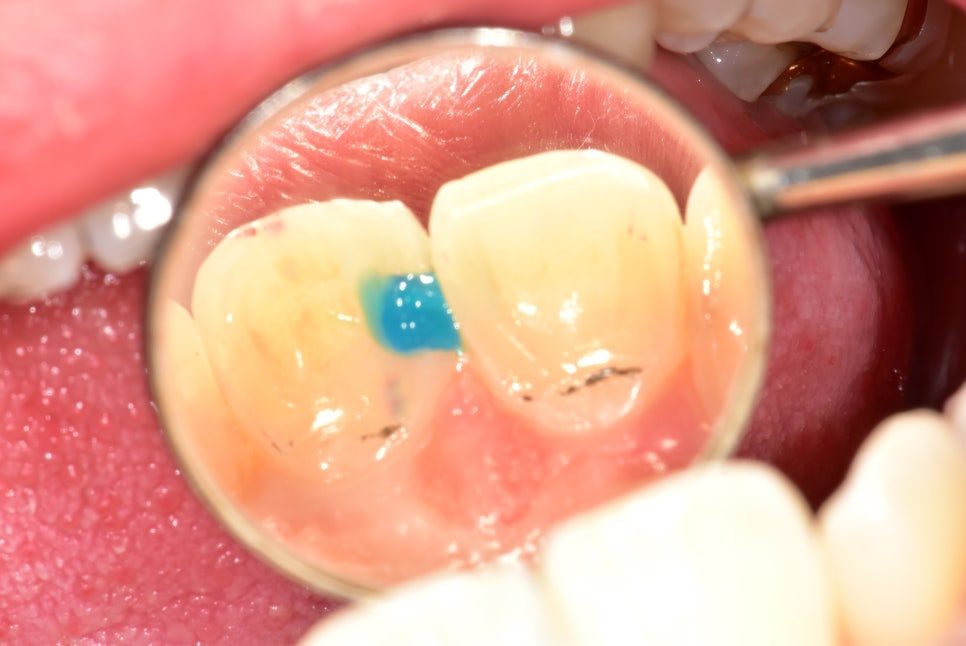
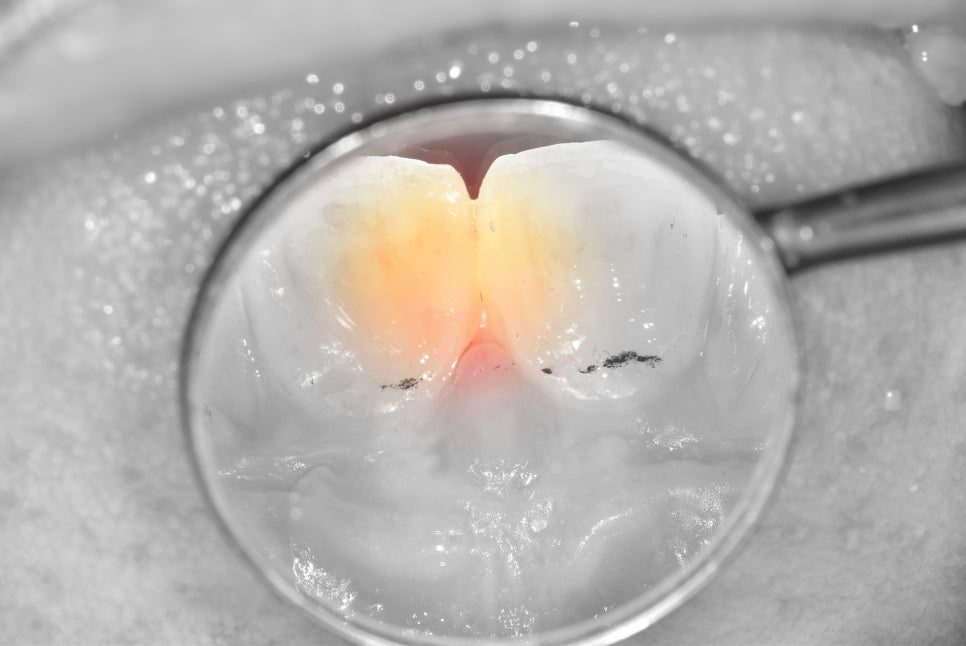
Viewed from the palatal side the decay was visible there too. The extent, though, was limited: not enough to require a veneer or a crown. A resin filling would resolve it.
Why is composite resin used for fillings?
Before it sets, composite resin flows. That makes it straightforward to place into the exact shape of the cavity and seal it.
It is then hardened with a curing light — light curing, the method used in most clinics.
What are the four steps of a resin filling?
1. Establish the size of the decay
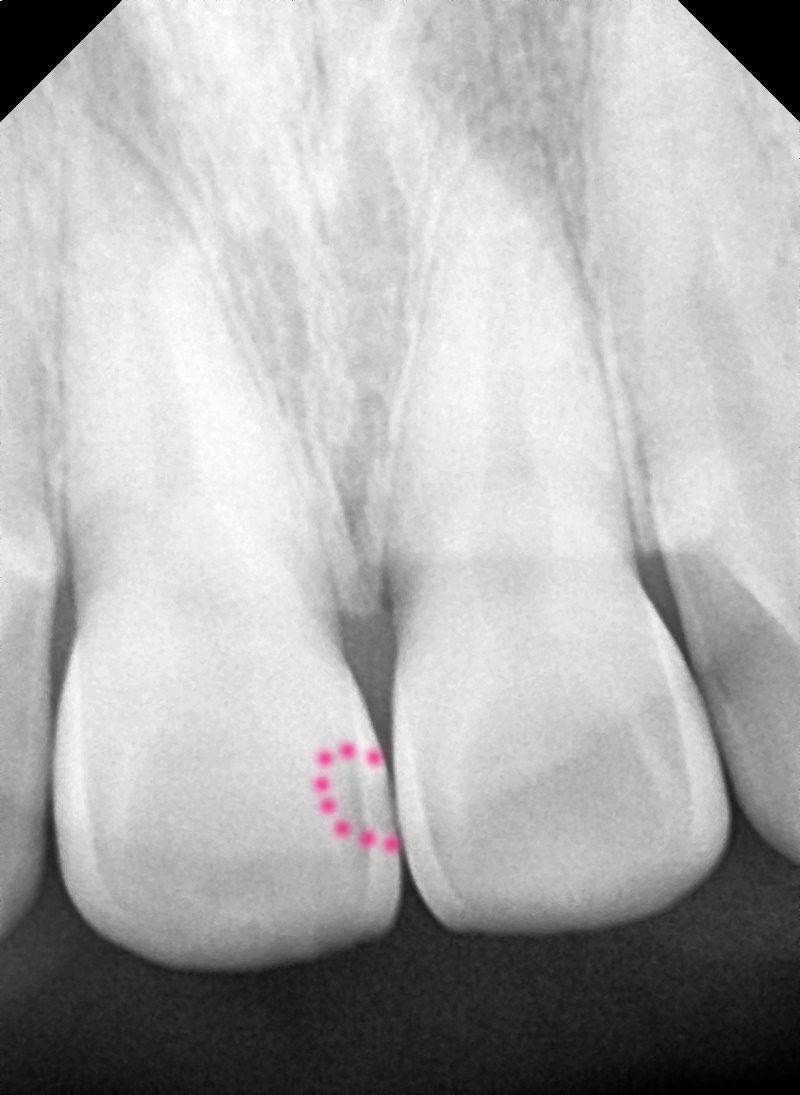
A radiograph is taken, because the decay is almost always larger than it looks. Decay does not spread readily through enamel, but once it reaches the softer dentine underneath it widens out and undermines the surface from below.
2. Remove the decay
Only as much tooth as the decay occupies. Nothing sound is cut away to make access more convenient. This step is where a filling is either conservative or not.
3. Etch the surface
This is the step that decides how long the filling lasts, and the one nobody explains.
Composite resin bonds to the tooth via an adhesive — unlike glass ionomer, which chemically bonds on its own. The problem is that cutting away decay leaves a smooth surface, and adhesive on a smooth surface holds poorly.
Etching applies an acid gel that microscopically roughens the enamel and dentine, greatly increasing the surface area available to bond to. The adhesive then keys into that texture.
Skip it or rush it and the filling still looks correct on the day. It comes away sooner.
4. Place and finish
The resin is built up to reproduce the tooth’s original contour, then the surface is polished.
Polishing is not cosmetic either. A rough surface picks up staining and, worse, holds plaque at the margin — which is how secondary caries starts underneath a filling that was placed correctly.
Treatment date: 6 December 2022. One appointment.
What should I ask before agreeing to a filling?
Most of what determines whether a filling lasts — how much sound tooth was preserved, whether the surface was properly prepared, how well the margin was finished — is invisible in the finished result and absent from any price list.
That is not an argument for paying more. It is an argument for asking what is being done, and for treating a figure with no explanation attached as incomplete information rather than as a bargain.
Frequently asked questions
Why do dental prices vary so much between clinics?
Non-covered treatment is priced by each clinic individually, and the treatment itself varies — material, quantity, and the number of steps a particular case needs. Price on its own does not indicate quality in either direction.
What is proximal caries?
Decay on the surface where two teeth touch. It is hidden from view and from a toothbrush, and it is painless until it is well advanced, so it is usually found on examination or radiograph rather than noticed.
Why is my cavity bigger than it looked?
Because decay spreads slowly through hard enamel and then widens once it reaches the softer dentine underneath. What is visible on the surface is often the narrow end of it.
What is etching, and does it matter?
An acid gel that roughens the tooth surface microscopically so the bonding agent has more to grip. It matters a great deal for how long the filling stays put, and it is invisible in the finished result — which is precisely why it is worth knowing about.
Can a filling between front teeth be done in one visit?
Yes, where the decay has not reached the nerve. Composite resin is placed and cured in the mouth, so removal of the decay and the restoration happen in the same appointment.
Read more: cavities and fillings · pricing · crowns and veneers