
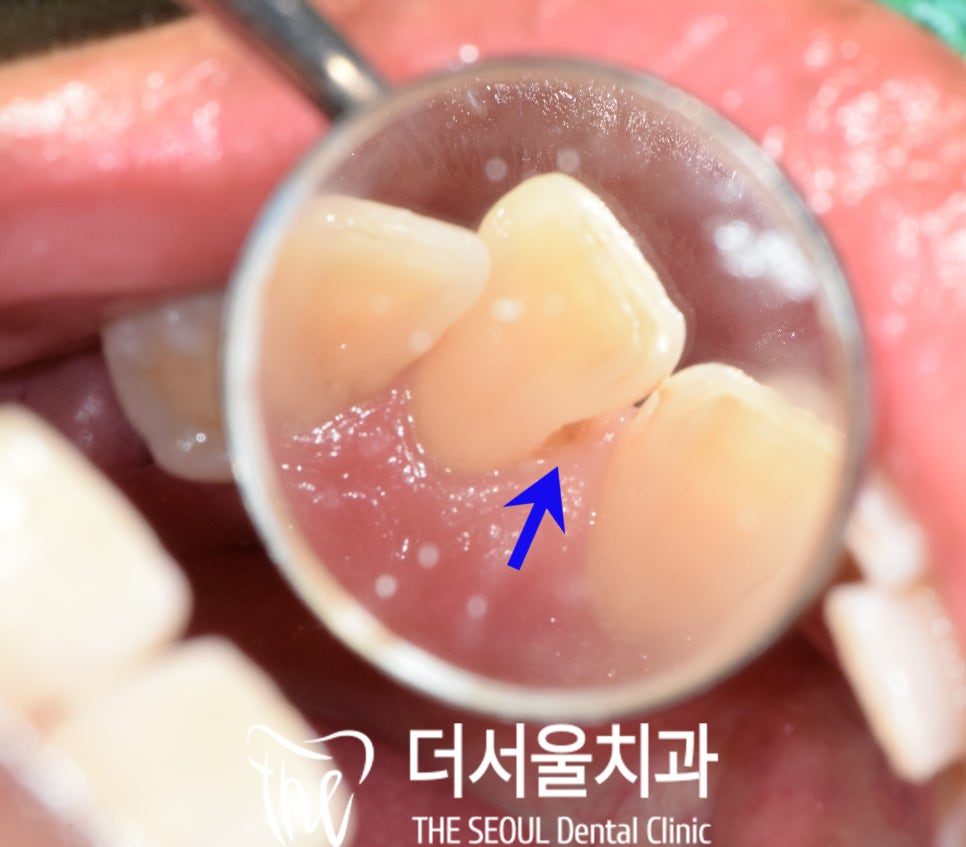
Decay between the two upper front teeth shows up as a dark shadow before it causes any pain. It is one of the more technically awkward places to restore — and one of the few that can still be finished in a single visit.
What the patient noticed
The complaint was appearance: a cavity between the front teeth that had become visible.
Seen from the front, decay sat on the adjoining surfaces of the two central incisors, showing through the enamel as a dark patch. Front teeth do relatively little of the chewing; their function is largely how they look when you speak and smile, which is why decay in this position gets noticed early even though it is painless at this stage.
What did the X-ray show?
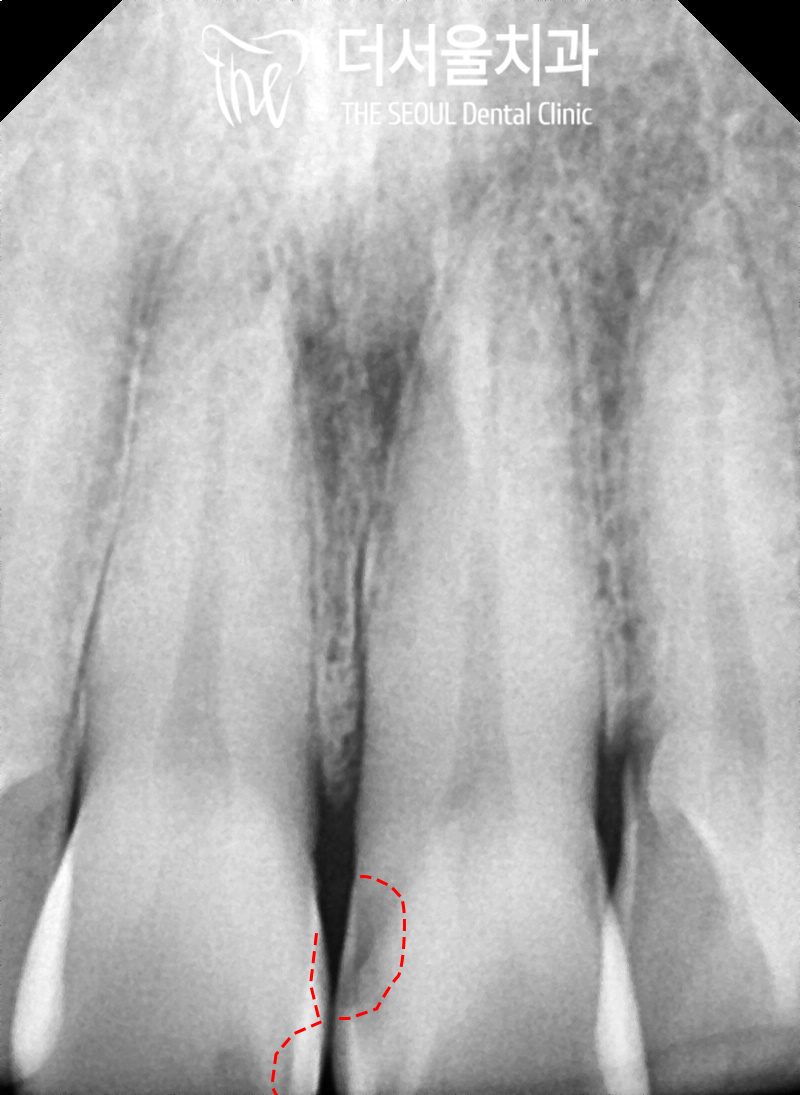
Viewed from another angle, the decay did not stop at the front. It ran through to the palatal surface — the side facing the roof of the mouth.
That matters for the treatment plan: both surfaces have to be restored, not just the one that is visible.
A periapical X-ray established how deep it went. The finding that determined everything else: the decay had not reached the pulp, the nerve tissue inside the tooth. Root canal treatment was therefore not needed, and the tooth could be restored with a filling.
Why is a front tooth cavity harder to fill?
Decay of this extent on a front tooth is normally restored with composite resin. The complication is where it sits.
Because the decay is on the surface between two teeth, instrument access is limited — there is very little room to work in. The decay has to be removed without irritating the pulp beneath it. And when the resin is placed, the junction between material and tooth has to finish flush; a ledge at that margin traps plaque and becomes the next cavity.
Most of the work is also carried out indirectly, viewed in a mirror rather than looked at straight on.
How is the filling actually done?
Composite resin sets in the mouth, so the whole restoration is completed in one appointment.
- The decay is removed. Only the weakened tooth structure is cut away, and the approach is generally made from the palatal side so that the visible front surface is preserved as far as possible.
- The surface is prepared. Acid etching followed by a bonding agent creates the surface the resin will adhere to.
- A clear matrix strip is placed between the teeth. This keeps the two teeth separate as the resin is built up — without it the material bridges the gap and fuses them together, and separating them afterwards is a great deal harder than preventing it.
- The resin is placed and shaded. Several shades are blended to match the surrounding natural tooth, rather than a single shade taken off a chart.
- The restoration is shaped and polished, and the bite is checked.
The result
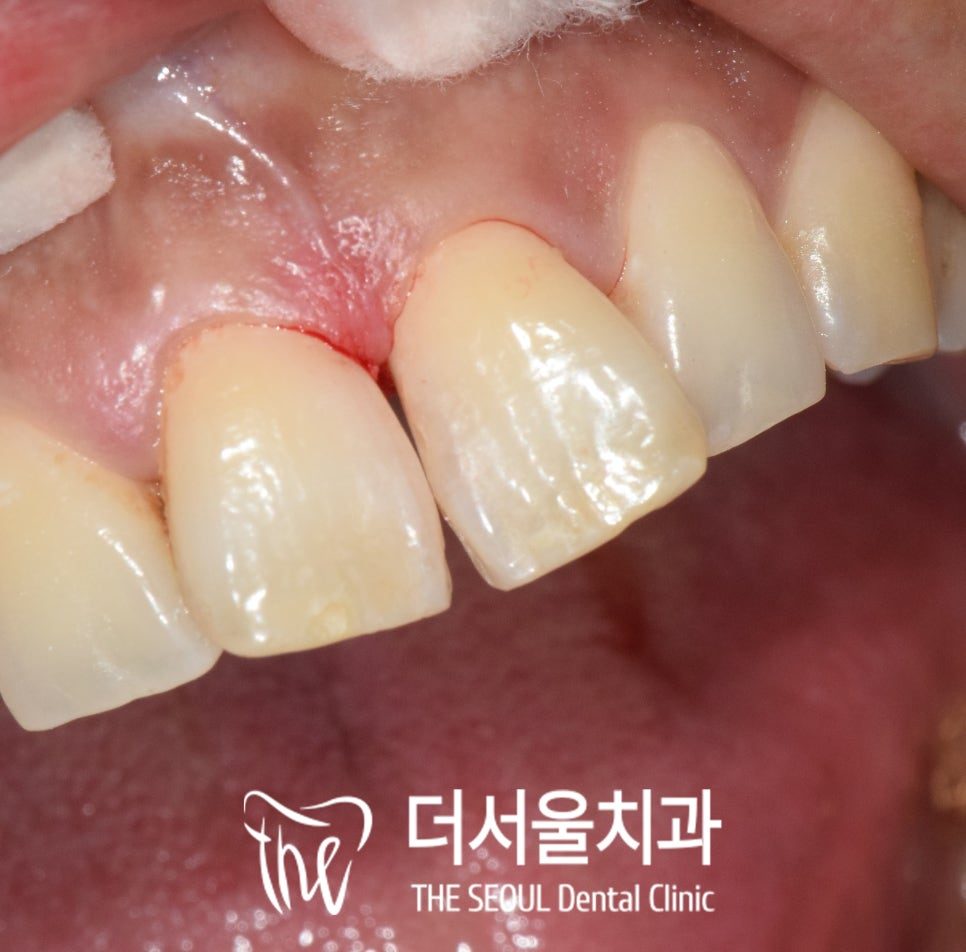
The decay between the central incisors was restored, and the palatal surface — which nobody sees — was finished to the same standard, because that is the surface where a poorly finished margin causes the next problem.
Treatment date: 19 January 2024. One appointment.
What happens if it is left untreated?
The reason to deal with this early is not appearance, even though appearance is what brings people in. Decay between teeth is invisible to a toothbrush and progresses in a place you cannot inspect. Caught while it is confined to enamel and dentine, it is a single-visit filling. Left until it reaches the pulp, it becomes root canal treatment and a crown.
The gap between those two outcomes is months, and the only reliable way to find it in time is examination, because it will not hurt on its own.
Frequently asked questions
Can a front tooth cavity be filled in one visit?
Usually yes, where the decay has not reached the nerve. Composite resin sets in the mouth, so removal of the decay and the restoration happen in the same appointment. If the nerve is involved, root canal treatment is needed first and the timeline changes.
Will the filling be visible?
Composite resin is shade-matched to the surrounding tooth, and several shades are usually blended rather than one used flat. On front teeth the access is also generally made from the palatal side where possible, so the visible enamel surface is disturbed as little as possible.
Why does decay between teeth get missed?
Because a toothbrush cannot reach that surface and neither can a direct visual check. It is typically found either on an X-ray or once it has spread far enough to show as a shadow through the enamel — which, on front teeth, is what most people notice first.
Do I need an X-ray for a cavity I can already see?
Yes. What you can see is the extent on the surface. The X-ray establishes the depth, and depth is what decides between a filling and root canal treatment.
How long does a composite filling on a front tooth last?
It depends on the size of the restoration, the bite and maintenance. Composite is not permanent — it can discolour at the margins over time and needs periodic checking — but for decay of this extent it is the appropriate treatment, and it preserves far more natural tooth than a crown would.
Read more: cavities and fillings · crowns and veneers · root canal treatment