
Most people arrive at root canal treatment the same way: decay left alone until it hurts. This case had gone a step further, and it raises a question clinics do not often write about — what happens when the patient wants the tooth kept and the dentist does not think it will last.
Why do teeth end up needing root canal treatment?
Decay found early is straightforward to deal with. What tends to happen instead is that it is left until something feels wrong, and by then the nerve is usually involved.
Root canal treatment is not a single appointment. It normally takes three or four visits, and the sequence runs:
- Remove the decay.
- Clean and disinfect the canal system inside the roots.
- Seal the canals with filling material.
- Prepare the tooth to receive a crown.
- Fit a temporary crown.
- Review after five to seven days.
- Fit the final crown — zirconia, ceramic or PFM.
Costs vary with how many canals the tooth has and what the crown is made of; our published fees are on the pricing page.
What was wrong with this tooth?
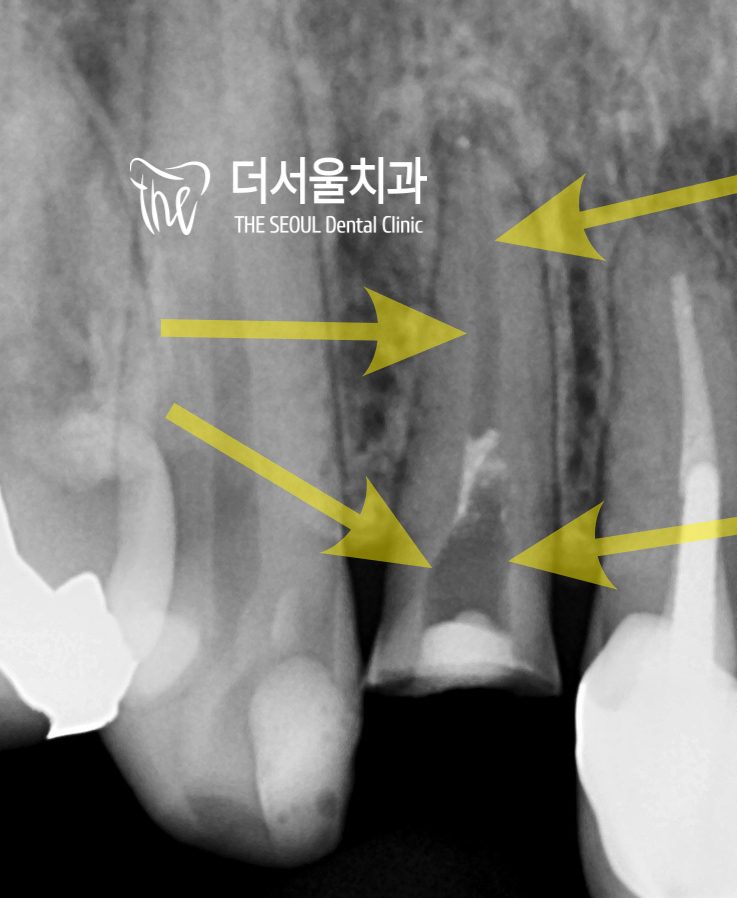
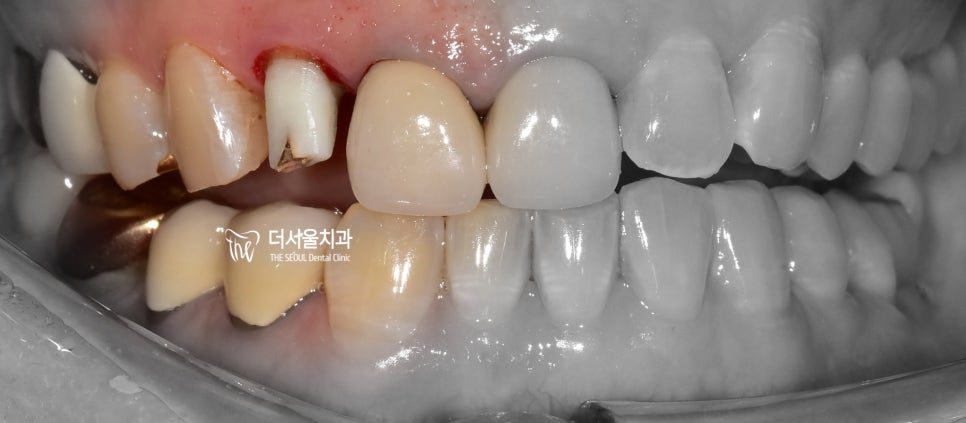
A front tooth had fractured at the crown portion. It had been root treated in the past, and renewed decay had weakened it until it broke.
Seen from the front there was an obvious gap. There was also pain.
Three findings stacked up:
- The tooth had already been root treated, so this would be retreatment rather than a first attempt.
- The crown portion was gone, so a post and core would be needed — an artificial post cemented into the root to give a new crown something to attach to.
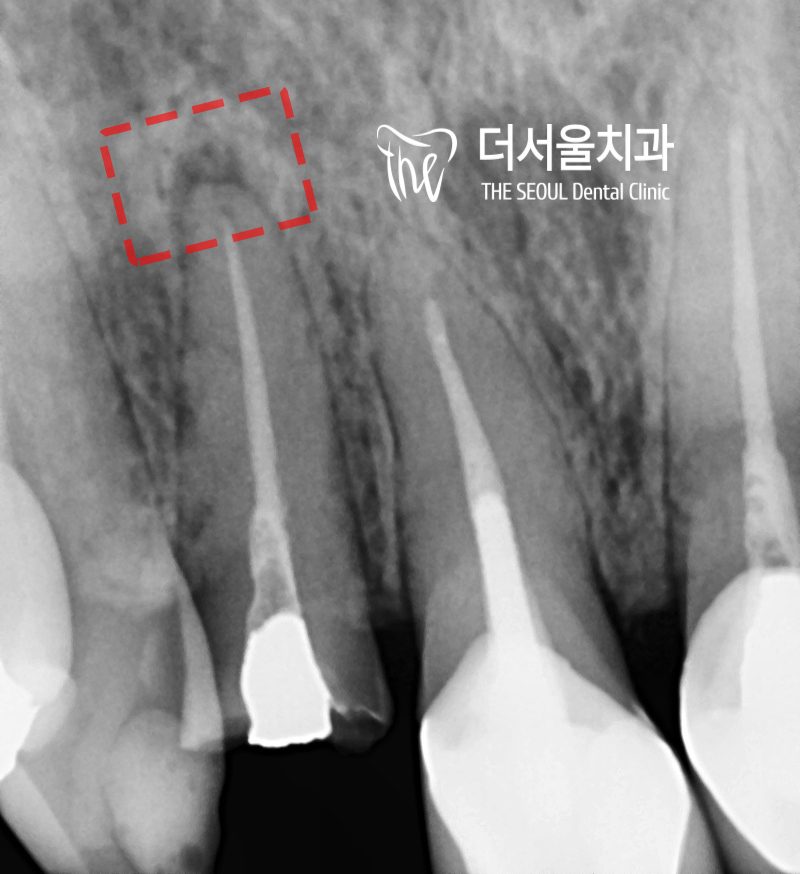
- An apical lesion was present: infection at the root tip.
Who decides whether to keep the tooth?
The patient did not want the tooth removed and asked for it to be saved.
The clinical assessment pointed the other way. With existing infection, no remaining crown structure, and a canal system that had already been treated once, the prognosis for retreatment was not good. Replacing the tooth with an implant would have had the better odds of not needing further work later.
How that was resolved is worth stating, because it is the general principle rather than a one-off:
The treatment plan follows what the patient decides. The dentist’s obligation is to make sure the decision is informed — to set out the likely problems and the possible complications of the chosen route, clearly, before it starts.
Keeping a natural tooth is a legitimate priority. It is not the dentist’s place to overrule it, and it is very much the dentist’s place to make sure it is chosen with the risks understood rather than by default.
What does retreatment involve?
The existing filling material and restoration were removed completely — retreatment cannot begin until the canal is back to bare walls.
The canal system was then cleaned out and disinfected. This is the stage the outcome depends on, and it is carried out under magnification where needed: a difference of a tenth or two of a millimetre in how thoroughly a canal is cleaned changes the result.
The canals were resealed, and a post was placed and built up with core material to reconstruct enough tooth structure to hold a crown.
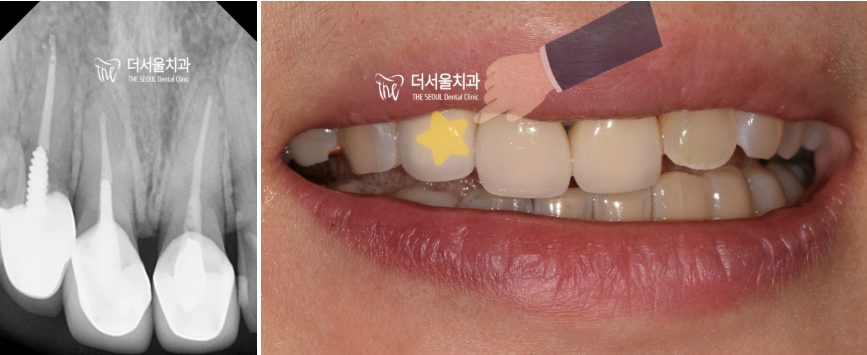
A temporary crown was worn for five to seven days and the tooth reviewed. With no pain and nothing unusual, the final crown was made in the material agreed at consultation and fitted.
At completion the apical lesion had resolved, and because it was a front tooth the crown was made to match its neighbours.
Treatment ran from 2 April 2020 to 3 June 2020.
Could this have been avoided?
This tooth was saved, and the alternative was better on paper. Both of those are true, and the point of the case is that the second one did not have to override the first.
What would have avoided the choice altogether is examination before the pain started. Root canal treatment involves anaesthetic, several visits and a crown; catching decay at the stage before it is a fraction of the time, the cost and the risk.
Frequently asked questions
Can a tooth be root treated twice?
Yes — that is retreatment. The existing filling material is removed, the canal system is cleaned and disinfected again, and it is resealed. The prognosis is generally less favourable than for a first treatment, particularly where infection is present at the root tip.
What is a post and core?
Where the visible part of the tooth has broken away, a post is cemented into the root canal and built up with core material to create enough structure for a crown to attach to. It rebuilds the foundation, not the tooth’s strength.
Should I save the tooth or have an implant?
It depends on how much sound tooth remains, whether infection is present, and whether it has been treated before. Where the odds favour an implant, we will say so — and if you would rather keep the natural tooth, the plan follows that, with the risks set out first.
How many visits does root canal treatment take?
Usually three or four, plus the crown. Retreatment can take longer, since the previous filling material has to be removed before anything else can be done.
Does an infection at the root tip always mean extraction?
No. An apical lesion frequently resolves once the canal system has been properly cleaned and sealed, as it did here. It does make the prognosis less certain, which is why it should be part of the conversation before treatment rather than a surprise during it.
Read more: root canal treatment · crowns and veneers · dental implants