
Brackets and wires make brushing genuinely difficult, and decay that develops during orthodontic treatment is often only discovered when the brackets come off. This case adds a complication: a bonded retainer sitting directly over the affected surfaces.
What the patient presented with
The patient had completed fixed orthodontic treatment elsewhere and came in distressed by how much decay had appeared afterwards.
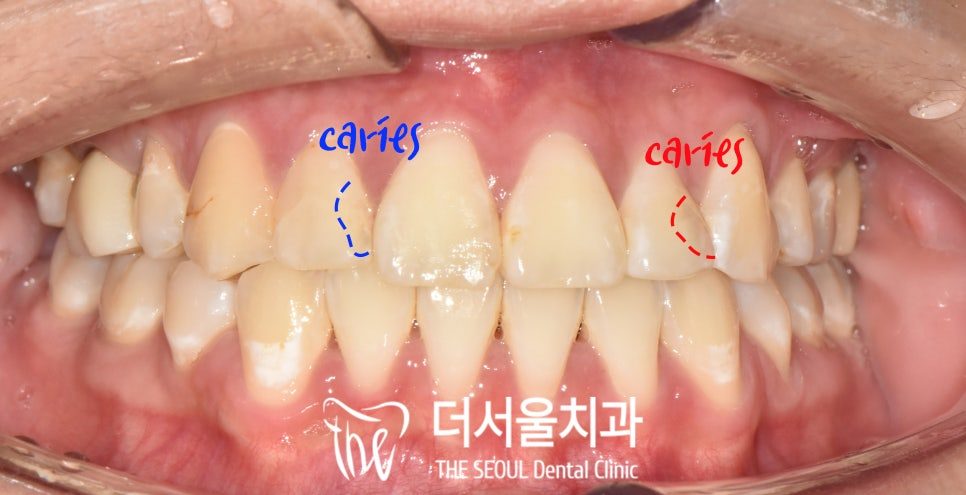
Brackets are bonded directly onto the teeth, which makes them hard to clean around. Once the brackets came off, there was widespread white spot demineralisation across the tooth surfaces, and decay in several places.
The intraoral examination found a fixed retainer bonded to the tongue-side surfaces of the front teeth — standard after orthodontic treatment, to hold the corrected alignment. Dark decay was visible between and around it.
What did the X-rays show that the eye missed?
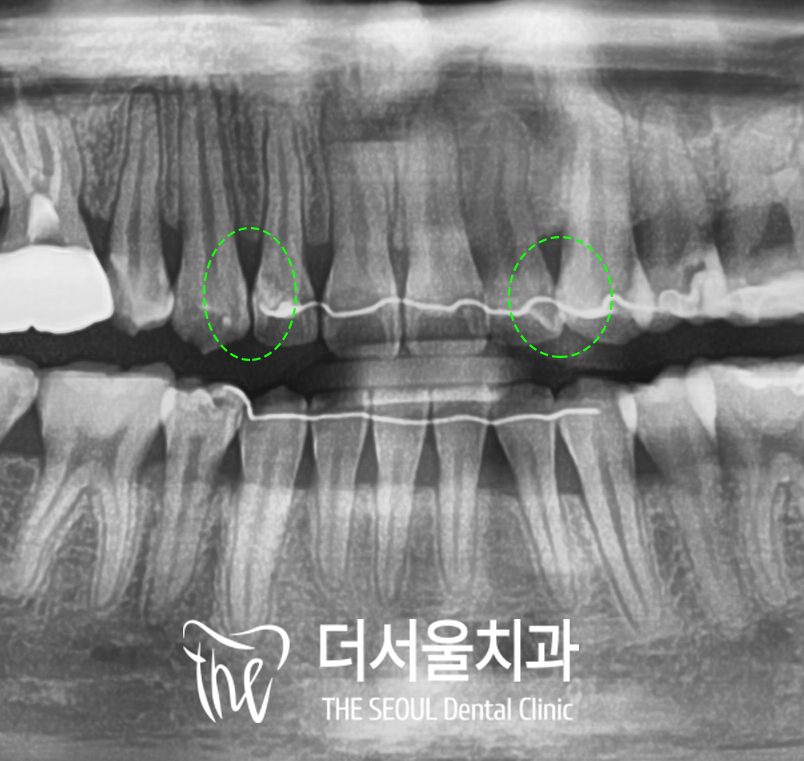
The decay had progressed deeper than the visual examination suggested.
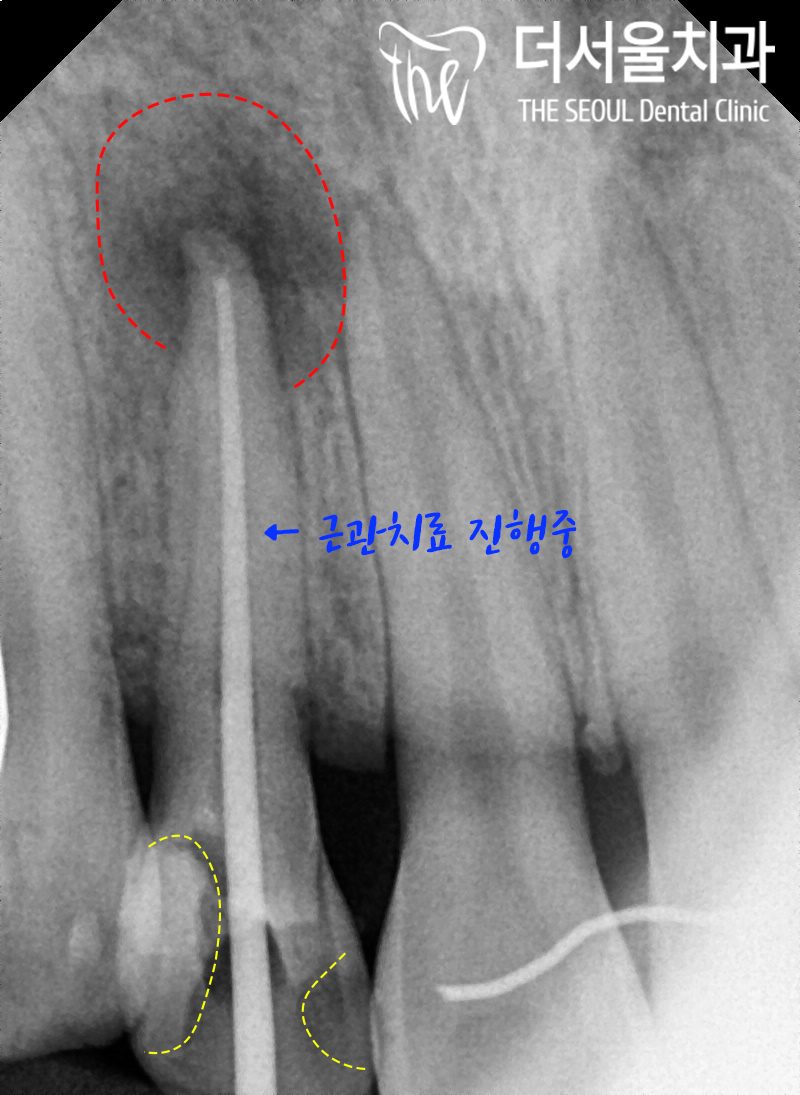
On tooth #12 — the upper right lateral incisor — the decay had reached the nerve. A periapical view from a different angle showed an apical lesion, an abscess at the root tip. Saliva and bacteria had reached the pulp, the nerve tissue had died, and pulp necrosis had followed.
The tooth opposite it, #22, had decay that had not reached the pulp.
Same patient, same cause, two teeth that needed quite different treatment. Depth is what separates them.
Can decay be filled in a single visit?
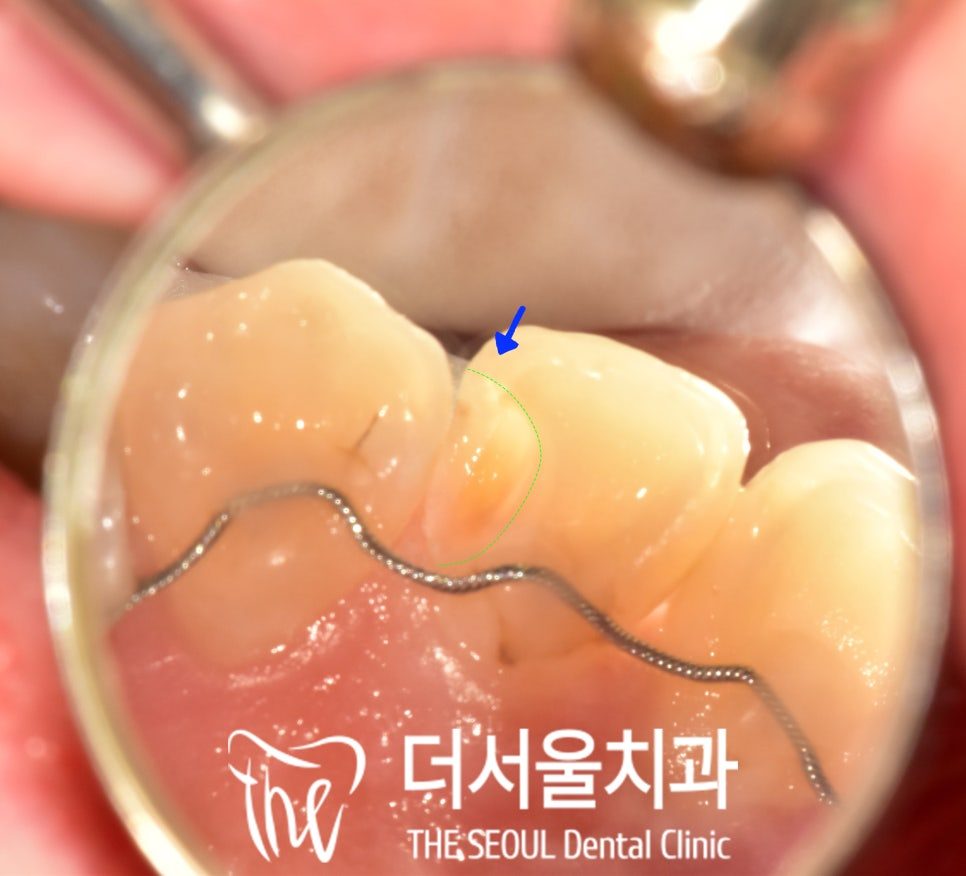
Because the decay had not reached the pulp, this tooth was restorable with composite resin in a single appointment.
There was one thing to check first. Had the decay extended down to the bonded retainer, the whole retainer would have had to be removed to reach it — a considerably larger job. It sat just above the retainer, so only the decayed portion was removed and filled, and the retainer stayed in place.
The natural tooth structure was preserved and only the decay taken out. Afterwards the bite was checked with articulating paper for any point taking excessive lateral force, and the surface was checked with the tongue for roughness or an unnatural contour — both of which patients notice constantly if they are missed.
What happens when decay reaches the nerve?
The tooth on the other side needed a different approach because the pulp had already died.
The infected pulp was removed and the interior disinfected, which stops the abscess at the root tip from enlarging. Root canal treatment on a front tooth typically takes one or two appointments, after which the canal is sealed with gutta-percha.
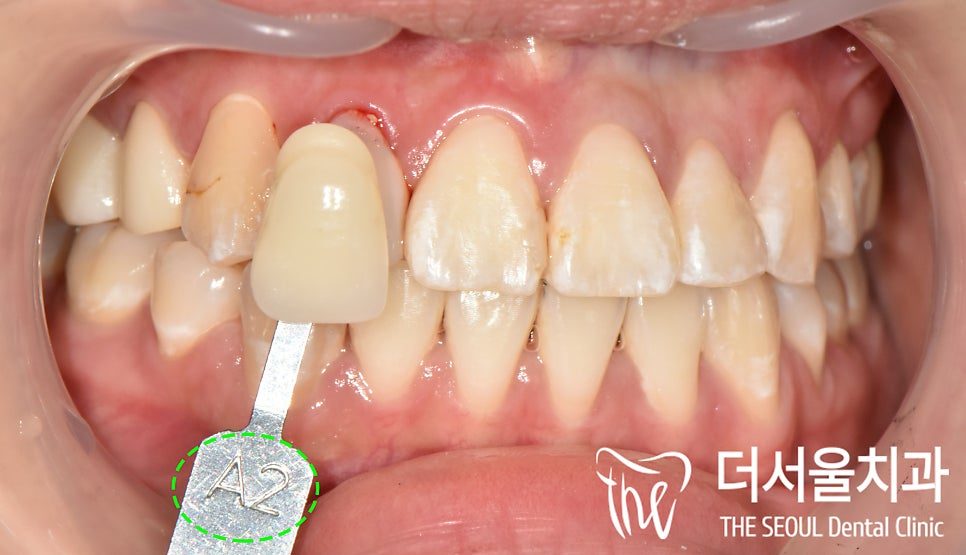
Then the crown. Shade selection for a front tooth is done with the patient in front of a mirror rather than decided for them — what looks like the closest match to a dentist and what the patient perceives as natural are not always the same shade, and the patient is the one who has to live with it.
On the finished result the crowned tooth is hard to distinguish from its neighbours when smiling.
Timing matters with a fixed retainer
Most people wear a removable or fixed retainer after orthodontic treatment to hold the teeth in position.
The practical problem is that decay under a bonded retainer may require the wire to be removed before it can be treated, and then re-bonded afterwards — more time and more cost than treating the same decay before the retainer goes on.
So the useful step is to check for and treat decay before a fixed retainer is bonded, not after. This patient was fortunate that the lesion sat above the wire.
How do I clean my teeth with braces on?
While appliances are on, plaque control around the brackets is difficult and flossing is awkward enough that many people simply stop.
At each visit here, brushing technique is demonstrated directly, along with how to floss around a wire rather than giving up on it. It is unglamorous, and it is the single thing that most affects what the teeth look like when the brackets come off.
How long did the treatment take?
Treatment ran from early March to early April 2023 — about four weeks, covering a same-day filling on one tooth and root canal treatment plus a crown on the other.
The point worth taking away
Decay does not resolve on its own; it has to be physically removed. That makes monitoring during orthodontic treatment, and treating at the right moment, more important than it looks.
If you are choosing where to have orthodontic treatment, it is worth asking who is watching the rest of your mouth while your teeth are being moved. Alignment is one measure of success. It is not the only one.
Frequently asked questions
Why do I get cavities during orthodontic treatment?
Brackets and wires are bonded to the tooth surface and create places a toothbrush does not reach. Plaque sits there, and demineralisation and decay follow. It is a cleaning-access problem rather than anything about the treatment itself.
Can a cavity be treated with my fixed retainer still on?
Often yes, if the decay sits clear of the bonded wire — as it did on one tooth here. If the decay extends to or under the wire, the retainer usually has to come off and be re-bonded afterwards, which adds time and cost.
What are the white marks on my teeth after braces?
Demineralisation — early loss of mineral from the enamel surface where plaque sat against the tooth. It is the stage before a cavity. Caught early it can sometimes be managed without drilling, so have it assessed rather than assuming it is permanent staining.
Why did one tooth need only a filling and the other a crown?
Depth. On one tooth the decay stopped short of the nerve, so the decayed portion was removed and filled. On the other it had reached the pulp and the nerve had died, which requires root canal treatment, and a root-treated front tooth then needs a crown to protect it.
How do you match a crown to my other front teeth?
Shade is chosen with you at the mirror, not decided for you. What reads as the closest match differs between people, and on a front tooth you are the one who sees it every day.
Read more: cavities and fillings · root canal treatment · braces