
Root canal treatment removes the nerve. That resolves the pain — and it also removes the mechanism that would have told you when something went wrong afterwards.
The problem with a tooth that cannot feel
If you have had a decayed tooth root treated and crowned, and you clean thoroughly, it can serve for many years without difficulty.
The complication is that the canal has been removed, so the tooth has no sensation. Where decay develops again underneath the crown, there is no early discomfort to prompt a visit. By the time anything is noticed, the problem has usually spread into the surrounding tissue.
That is the sequence this case followed: decay under a crown, extraction, implant.
What did the examination find?
The patient came in with significant pain, and the site was one that had been root treated some years earlier.
Because a restoration covered it, the actual state of the tooth could not be assessed from outside. The crown was removed to allow a direct examination.
Underneath, the tooth had decayed extensively — blackened and no longer usable. Extraction followed by an implant was the appropriate treatment.
What did the planning scan reveal?
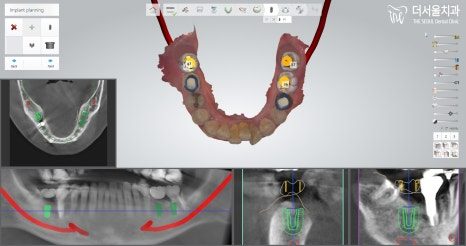
A computer analysis program was used to plan the placement position and angle before surgery.
Two findings came out of that planning:
- Bone loss was present, since some teeth had been missing for a considerable time
- At the #37 site — the lower left second molar — bone had been lost specifically to inflammation at the root, so that site would need the infection cleared and then bone grafting before it could hold a fixture
Those two are worth distinguishing. Bone lost to disuse and bone lost to infection are not the same problem: the second requires the infection dealt with first, or the graft is placed into a site that is still actively breaking down.
What happens during implant surgery?
Points requiring care were checked individually before surgery, and placement proceeded.
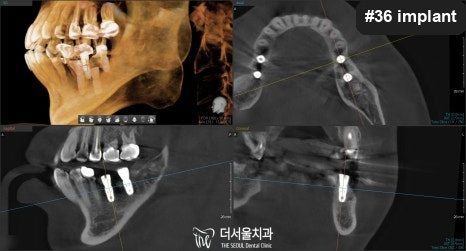
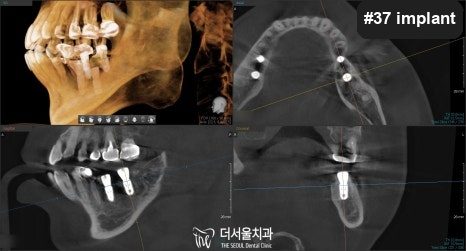
After the fixtures were placed, a 3D CT scan confirmed each was seated as planned and none was misplaced.
Running the simulation first is what makes that verification usually uneventful — the fixtures go close to where they were planned to go. It also allows a minimally invasive approach, with fewer appointments and a smaller incision than an unplanned placement would require, which generally means an easier recovery.
What was the final result?
Two decayed teeth were extracted, and together with the sites that were already empty, four implants were placed.
With the restorations fitted, the upper and lower teeth met properly again across the arch.
Because grafting had been carried out, careful use was advised in the early period, along with regular check-ups and consistent cleaning thereafter.
Timeline
Treatment ran from March to early November 2021 — about eight months. The bone graft is what makes this longer than a straightforward multiple-implant case: grafted bone has to consolidate before a fixture can be loaded.
How do I stop decay under a crown?
The chain here is worth stating plainly, because each link is preventable:
Poor cleaning after root canal treatment → decay under the crown, with no pain to signal it → extraction → and if inflammation has reached the bone, a graft as well as an implant.
Since the tooth cannot warn you, something else has to. That means thorough cleaning around crown margins and regular check-ups and scaling — not because the crown is fragile, but because you have no other way of knowing.
Frequently asked questions
Can a tooth decay under a crown?
Yes, at the margin where crown meets tooth. It is a common reason crowned teeth are eventually lost, and it is difficult to see from outside — sometimes the crown has to come off for the tooth to be properly assessed.
Why does a root-treated tooth not hurt when it decays?
Because the nerve has been removed, so the tooth cannot signal. That is why root-treated teeth need check-ups more rather than less — the warning system that would normally bring you in is gone.
Do I need a bone graft as well as an implant?
Only where bone has been lost. In this case one site needed grafting because inflammation at the root had destroyed bone; the others did not. It is established by imaging before surgery, site by site.
How long does treatment take with a bone graft?
Longer than without — around eight months for this case. Grafted bone has to consolidate before the fixture can carry a restoration, and that interval is biological rather than a scheduling matter.
Does digital planning make surgery less uncomfortable?
It generally allows a smaller incision and fewer appointments, which most patients find easier to recover from. How you experience it still depends on the extent of the surgery and on your own sensitivity.
Read more: digital guided implants · root canal treatment · bone grafting and sinus lift