
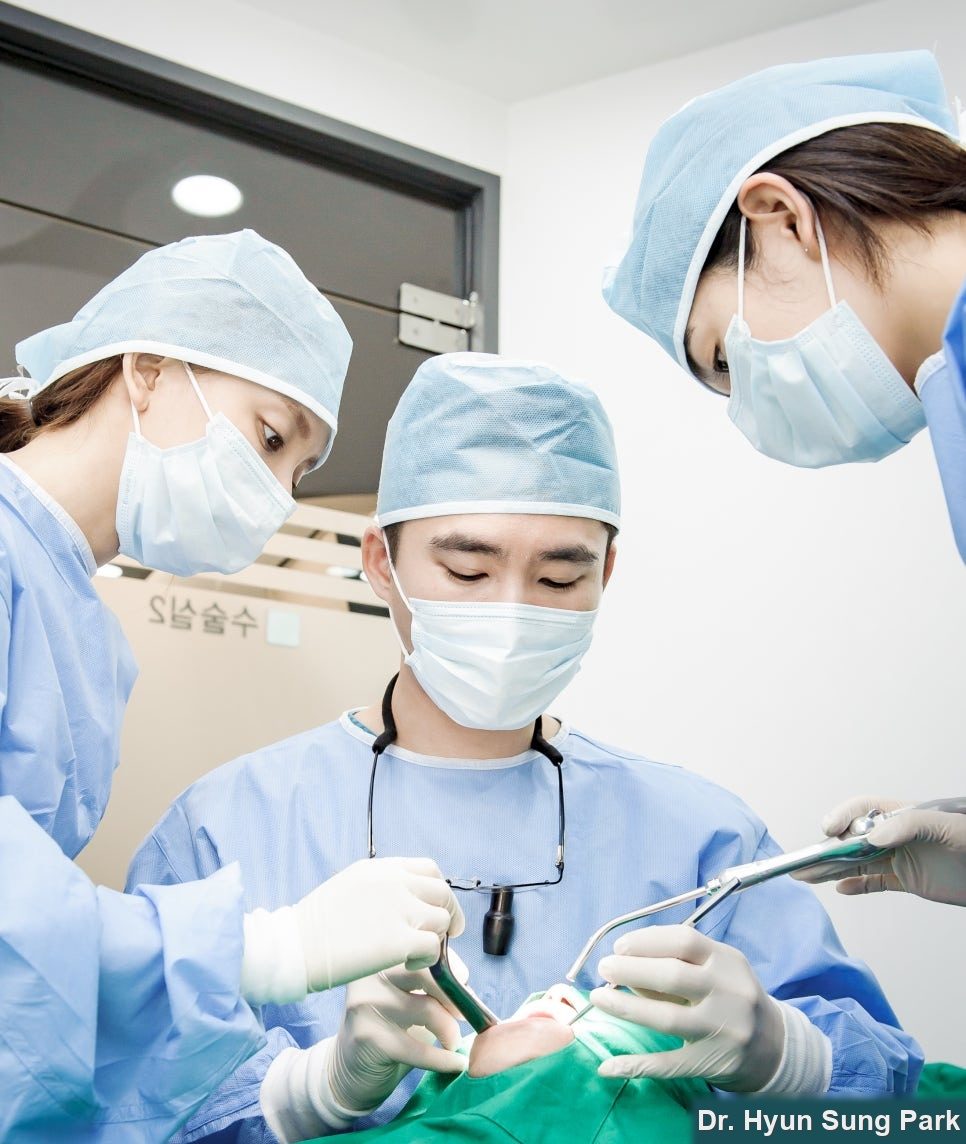
A front tooth that has already been treated should settle down. When it stays loose and slowly gets worse instead, something underneath is still active — and in this case it was extensive decay reaching well below the gum line.
Why does a treated front tooth keep getting looser?
Mobility in a front tooth has several possible causes: gum disease that has destroyed the supporting bone, a fracture running into the root, or decay that has spread far enough to undermine the tooth. When a tooth has been treated before and the looseness returns anyway, it usually means the original problem was never fully removed, or a new one has developed alongside it.
What matters clinically is not the looseness itself but how much sound tooth and bone are left underneath. That is what decides whether the tooth can be kept.
What the examination found
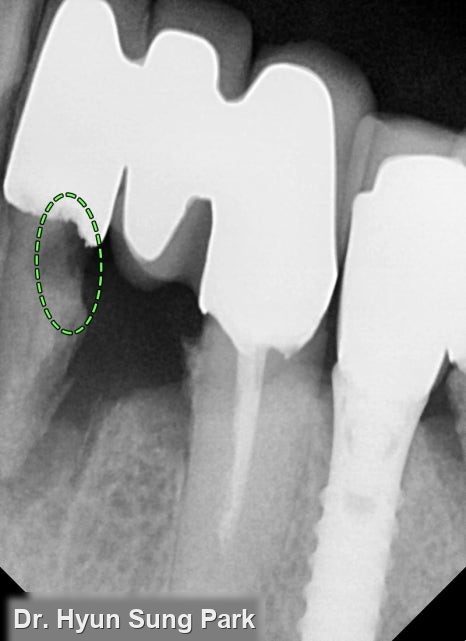
The patient came in because of ongoing discomfort in the upper front teeth. An oral examination found problems that were not limited to one tooth:
- Decay affecting teeth from the molars through to the front teeth
- On the upper right, a tooth whose crown had fractured away, leaving only the root in the bone — a retained root
- Widespread gum inflammation across the front section
- A missing tooth on the lower right
Multiple decayed teeth, extensive gum inflammation and a retained root together usually mean the discomfort has been building for a long time. Cases like this need a plan that deals with the whole mouth rather than one tooth at a time.
A CT scan showed that bone in the front region was adequate, which meant extraction and immediate implant placement in the same appointment were possible. Because the area to be treated was wide and the appointment would be long, the treatment was carried out under conscious sedation.
What is conscious sedation, and what is it not?
Conscious sedation uses medication to bring you into a relaxed, drowsy state in which you can still respond to simple instructions. It is not general anaesthesia: you are not unconscious, and you are not intubated or ventilated.
The commonly used medications are midazolam and ketamine. Both have a well-established safety record and take effect quickly, which is why they are used for surgical dental appointments such as implant placement. Local anaesthetic is still given at the surgical site — sedation manages tension and awareness, not the surgical anaesthesia itself.
Most people remember the appointment only vaguely afterwards, which is the main reason patients ask for it: a long procedure is easier to face when the memory of it is hazy.
Extraction and immediate placement
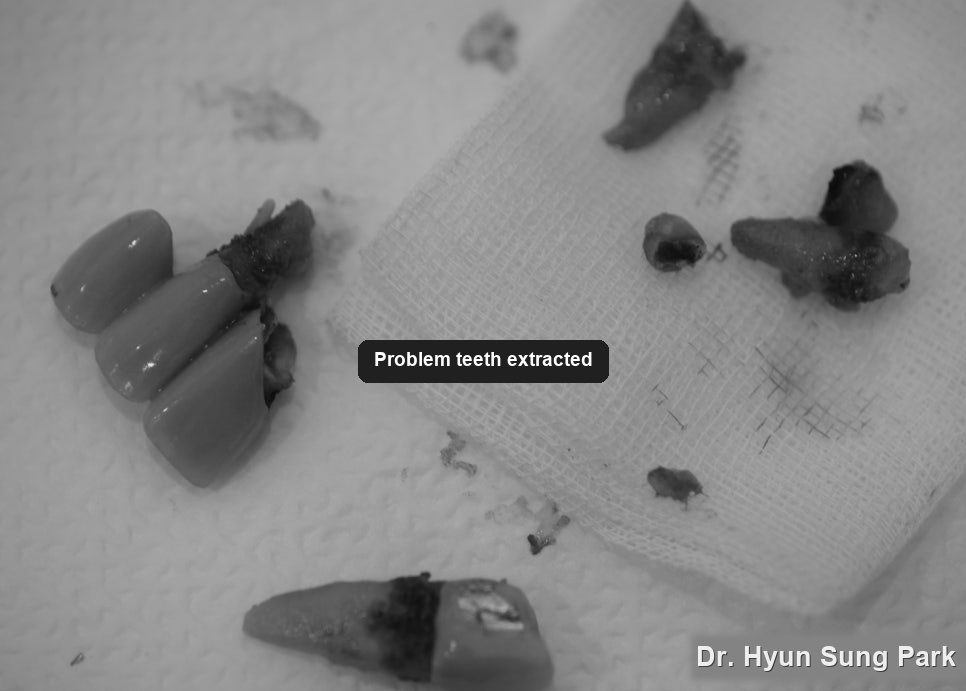
Once sedation was established, the mobile front tooth was extracted. With the tooth out, the extent of the decay and the inflammatory tissue that had been hidden below the gum became directly visible. The socket was thoroughly cleaned so that infected tissue was removed rather than left to sit under a new implant.
Cleaning the site properly at this stage matters more than it might appear. A fixture placed into a socket that still holds infected tissue starts at a disadvantage that no later step recovers.
Planning the placement digitally
Before surgery, an intraoral scan of the mouth was combined with the CT data, which carries the information about bone. Together these allow the final restoration to be positioned virtually first, and the fixture position to be worked backwards from it.
The fixture position and angle were then set against the bone and gum anatomy, a surgical guide was designed around them, and the guide was 3D printed for use during the operation. Several fixtures were placed through that guide in the planned positions.
The area treated was wide, so the appointment ran longer than an average implant case. Sedation and guided placement together are what made a session of that length workable.
The final restoration
After allowing time for osseointegration — the fixtures bonding to bone — a bridge-type restoration spanning the treated teeth was fitted. Three things were considered in making it:
- Appearance. Shape and shade were matched to the neighbouring teeth so the restoration does not read as an obvious replacement.
- Cleanability. The restoration was designed so the patient can actually clean around and under it at home.
- Function. Front teeth affect speech and facial expression as well as appearance, so the height and width of the restoration were adjusted carefully.
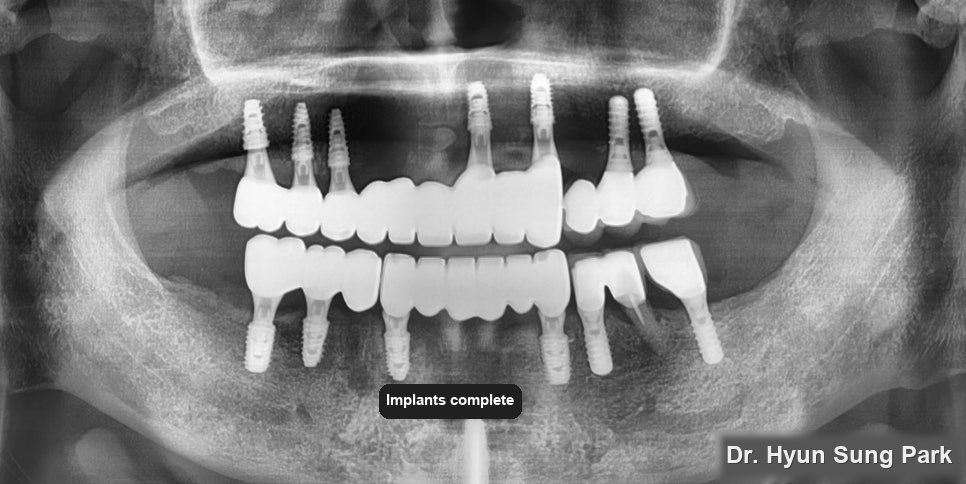
Aftercare
How long an implant restoration lasts depends heavily on what happens after it is fitted:
- Where gaps between teeth are wider, use an interdental brush or a water flosser to clean between them properly
- Have a check-up every three to six months so any problem is found while it is still small
- Avoid smoking and alcohol for at least two weeks after surgery, while the early bonding to bone is establishing
What precautions does sedation require?
- You must not eat or drink beforehand — the appointment is carried out on an empty stomach
- Do not drive on the day of treatment
- Discomfort is normal as the local anaesthetic wears off; take the medication you are prescribed
- Any allergy history or cardiovascular condition must be disclosed in advance, before sedation is planned
Timeline
Treatment ran from early January to early June 2025 — about five months from extraction and placement to the final bridge. The long middle stage is bone healing and cannot be shortened by booking appointments closer together. If you are travelling from overseas, raise your travel dates at the first consultation so the stages can be arranged around either a second trip or an extended stay.
Frequently asked questions
Will I be asleep during sedation?
Not in the sense of general anaesthesia. You stay able to respond to simple instructions, but you are relaxed and your memory of the appointment afterwards is usually vague. It is closer to a deep drowsiness than to being unconscious.
Can an implant be placed the same day a tooth is taken out?
Sometimes. It depends on how much bone surrounds the socket and whether infection can be fully cleaned out at that appointment. A CT scan before surgery is what answers this — it is not a decision that can be made from an examination alone.
Why use a surgical guide instead of placing the implant freehand?
A guide carries the plan made on the CT and scan data into the mouth, so the fixture goes where it was planned rather than where it can be judged by eye during surgery. It is particularly useful in the front of the mouth, where the position of the fixture determines how the visible restoration will sit.
Is a front tooth implant harder than a molar implant?
It is demanding in a different way. The bone at the front is thinner and the aesthetic tolerance is much smaller, because any discrepancy is visible when you speak or smile. Molars carry more chewing load but are easier to hide.
How long should I stay in Korea for treatment like this?
Surgery and the final restoration are separated by several months of healing, so most overseas patients plan two visits rather than one long stay. Tell us your dates at the consultation and we will set out what can be completed on each trip.
Read more: digital guided implants · dental implants overview · crowns and veneers