
A patient who had had an implant placed five years earlier came back to have the tooth next to it done. The clinical question was not the new implant. It was whether the two crowns should be separate.
Why did the neighbouring tooth need replacing?
The lower right second molar had been implanted five years previously. The tooth in front of it — the first molar — had been root treated and crowned, but the situation underneath had not held up, and it was now to be extracted and replaced with an implant.
What did the panoramic X-ray miss?
A panoramic image was taken after the extraction. At a glance the site did not look particularly problematic.
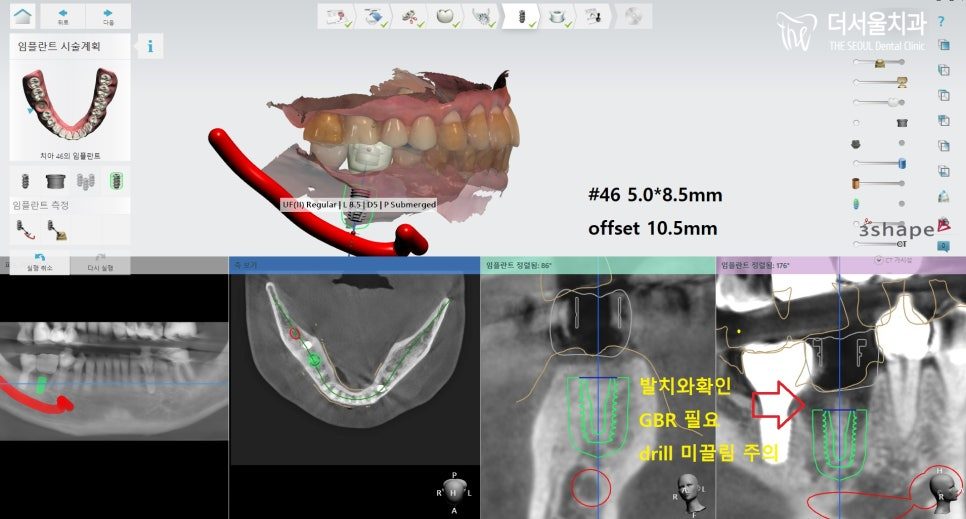
Running the same data through implant planning software gave a different picture. Two things came out of it.
First, the site was not ready. The image had been taken immediately after extraction, and placing a fixture into a fresh socket here would not have produced a good result. Better to allow healing time and to carry out guided bone regeneration (GBR) — a membrane placed over the socket with graft material beneath it, so that bone cells rather than soft tissue fill the space. The membrane is what makes that selective; without it, faster-growing soft tissue occupies the site.
Second, the nerve. The planning display marks the inferior alveolar nerve running through the lower jaw. Injuring it causes altered or lost sensation in the lower lip and chin, and that change can be permanent. It is the reason lower implant placement is planned on CT data rather than judged during surgery.
Why was the older crown remade too?
The obvious plan was to place the new implant and fit it with its own crown.
That is not what was done. The existing crown on the neighbouring implant was five to six years old, and older restorations become more liable to fracture. Rather than replace one and leave the other, both were remade and splinted — joined as a single connected unit rather than two separate crowns.
Why joining them reduces fracture risk
Think of holding back a heavy weight. One person pushing against it is more likely to give way than two people sharing the same load.
Splinted crowns work the same way. Force applied to one is distributed across both, so neither takes the full load alone. Resistance to heavy occlusal force goes up, and the likelihood of a fracture goes down.
It is not the right answer everywhere — separate crowns are easier to clean between, and a problem with one splinted unit affects both. Where it earns its place is on adjacent implants under heavy load, which is what this was.
How long did the treatment take?
The original restoration had been PFM. With the second implant placed, both were remade in zirconia and joined.
Treatment ran from 15 October 2021 to 30 April 2022, most of that being the healing after grafting and the integration period.
What should I avoid after the crowns are fitted?
Splinting improves the odds; it does not make a restoration indestructible. Hard and chewy foods are still worth avoiding, because the damage from them accumulates. A crown that tolerates the load today can fail later from the same forces repeated, and that means a second surgery.
An examination every six to twelve months is what catches problems early. Early-stage problems around an implant are difficult to detect without looking for them, which is precisely why people tend to arrive once they are no longer early-stage.
Frequently asked questions
Why would two implant crowns be joined together?
To share the chewing load. Force applied to one splinted crown is distributed across both, which lowers the risk of either fracturing. It is generally considered where adjacent implants sit under heavy occlusal force.
Is a splinted crown harder to clean?
Yes, that is the trade-off — you cannot floss between joined units in the normal way, so interdental brushes or floss threaders are needed. Whether the fracture-resistance gain is worth that depends on your bite and your cleaning habits, and it should be discussed rather than assumed.
What is guided bone regeneration?
A membrane is placed over a site with graft material underneath, so that bone cells fill the space rather than faster-growing soft tissue. It is used where an extraction socket or a deficient ridge needs to become solid bone before an implant goes in.
Can an implant be placed straight after an extraction?
Sometimes, but not always — and an X-ray taken immediately after extraction can make a site look more ready than it is. Where the socket needs grafting and healing time first, placing early costs more in the long run than waiting.
What happens if the inferior alveolar nerve is damaged?
It causes altered or lost sensation in the lower lip and chin, which can be permanent. It does not cause facial paralysis — that nerve is sensory rather than motor. Avoiding it is why lower implant placement is planned on CT data beforehand.
Read more: digital implants · implant revision · bone grafting