
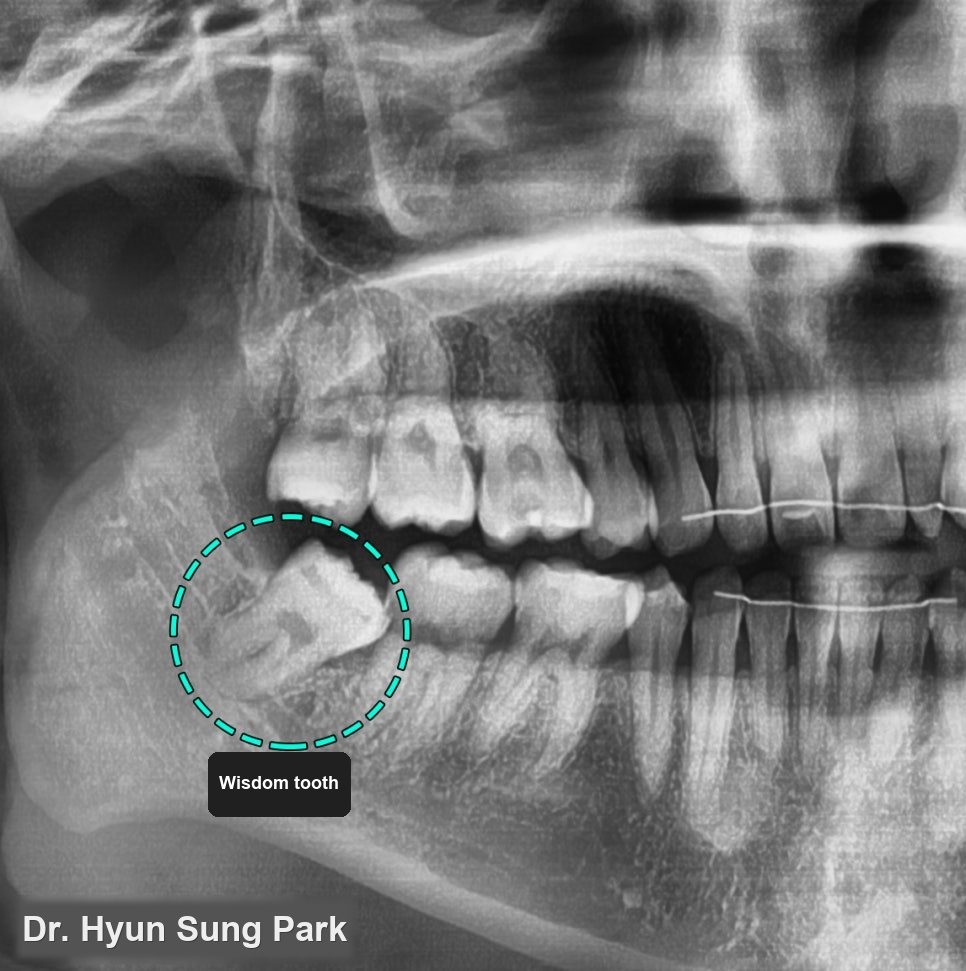
A wisdom tooth that has no room to come through does not simply stay put. This case is a lower wisdom tooth lying sideways against the molar in front of it, and what is involved in removing one safely.
Why does an angled wisdom tooth cause trouble?
The wisdom tooth is the last molar at the back of the arch — the third molar. Where the jaw does not have the space for it, it erupts at an angle or stays partly buried.
On the periapical film here, the wisdom tooth was lying at a slant and pressing against the molar in front of it. That position causes problems in a predictable sequence:
- The angled tooth presses on the root of the neighbouring molar and can damage its enamel.
- A deep pocket forms between the two teeth. Food debris and bacteria collect there, and a toothbrush cannot reach it.
- That leads to decay and gum disease. Where it goes unmanaged for long enough, the molar in front — a tooth worth keeping — can be lost as well.
- A cyst can form around the buried crown, which damages surrounding bone and the adjacent tooth.
The tooth that most often gets ruined by a wisdom tooth is not the wisdom tooth. It is the healthy molar next to it.
Why a CT scan is taken first
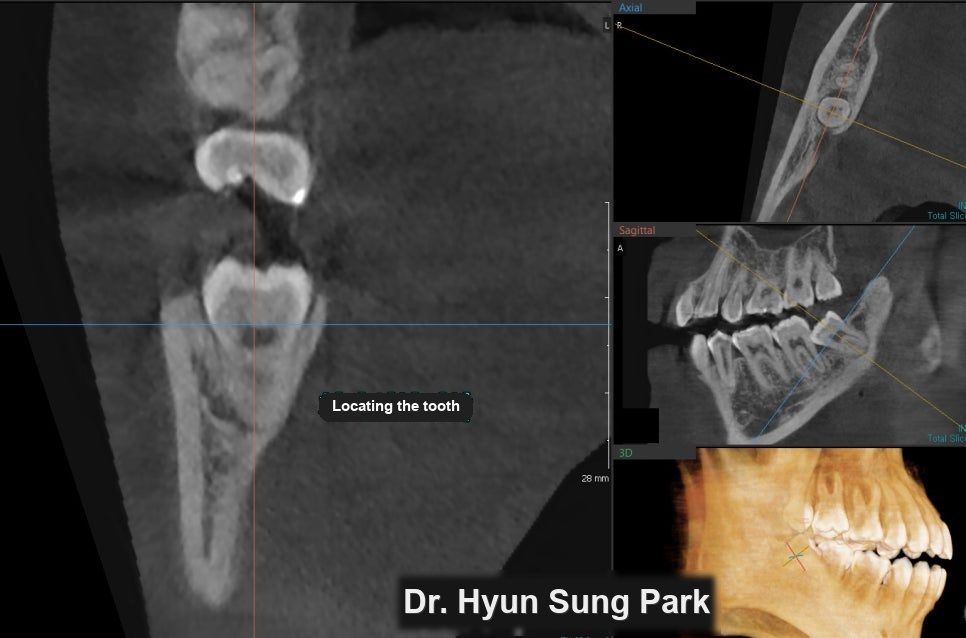
A CT scan was taken before surgery. A standard X-ray is a two-dimensional image; the scan gives the third dimension, and for a lower wisdom tooth that matters more than it sounds.
What it establishes:
- The exact distance between the tooth roots and the inferior alveolar nerve, which runs through the lower jaw.
- The shape and number of the roots — they are frequently not what a flat image suggests.
- The density and condition of the surrounding bone.
- The precise positional relationship with the adjacent tooth.
Lower wisdom teeth sit close to that nerve canal, and nerve injury during removal is the complication that has to be designed out rather than reacted to. The scan is what turns that risk into something that can be planned around.
Anaesthesia
Several small things reduce how uncomfortable the injection itself is.
Cold anaesthetic solution stings more, so it is warmed to close to body temperature before use. Injecting quickly expands the tissue and hurts; it is delivered slowly so the tissue accepts it. And the surgery does not begin until the anaesthetic has had time to take full effect.
None of this makes an extraction a non-event. It does remove a good part of the discomfort that patients most often remember.
What happens during the extraction?
Removing a tooth looks simple and is not. It is minor oral surgery, and it needs precise anatomical knowledge and careful handling, because the inferior alveolar nerve and the lingual nerve are both in the neighbourhood.
The working principle is minimum bone removal. Taking away more bone than necessary slows healing and increases post-operative pain, so the tooth is delivered with as little bone reduction as the position allows.
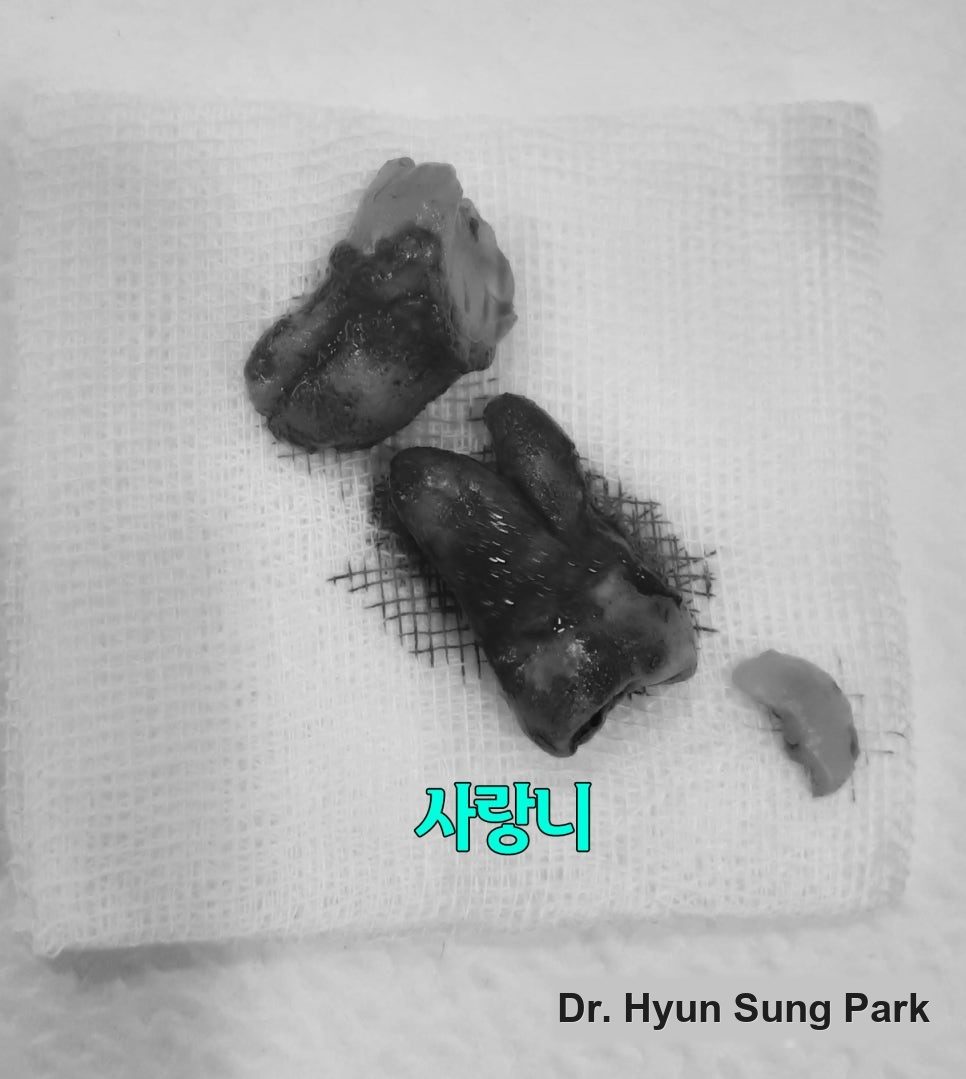
The X-ray taken afterwards confirmed the tooth had been removed cleanly, roots included.
What should I do after the extraction?
Recovery depends substantially on the days after surgery, not only on the surgery.
- Bite firmly on the gauze for 30 minutes to an hour. This is what forms the clot.
- Do not spit saliva or blood — swallow instead. Spitting dislodges the clot.
- No hot food, no alcohol, no smoking. All three interfere with healing of the socket.
- Avoid vigorous exercise and saunas. Raising blood pressure restarts bleeding.
A follow-up examination is worth keeping even when everything feels fine, because early signs of a problem in the socket are easier to see than to feel.
Can this be done on a short trip to Korea?
A single wisdom tooth extraction is usually completed in one appointment, with a short review afterwards. If your trip is a short one, tell us the dates at the consultation so the removal and the review can be scheduled inside it, rather than leaving you to fly with a healing socket.
Frequently asked questions
Does a wisdom tooth have to be removed?
Not always. One that has erupted upright, is cleanable and is not damaging anything can be left and monitored. The case for removal is made by what it is doing to the tooth in front of it, whether it can be kept clean, and what the imaging shows.
Why do I need a CT scan for a wisdom tooth?
For lower wisdom teeth, to establish the distance to the inferior alveolar nerve and the true shape and number of the roots. A two-dimensional X-ray cannot show either reliably, and both determine how the tooth is removed.
How much does it hurt?
The procedure itself is carried out under local anaesthetic. Discomfort afterwards varies with how the tooth was positioned and how much bone had to be removed, and it is managed with prescribed medication. We do not describe extraction as painless — what we can say is which parts of the discomfort are avoidable and how.
How long does recovery take?
Swelling generally peaks in the first two to three days and settles from there, with the socket closing over the following weeks. The aftercare instructions above — particularly not disturbing the clot — make more difference to that timeline than anything else.
Can the tooth in front be saved if it is already damaged?
Often, if it is caught before the decay reaches the nerve. That is the argument for dealing with an angled wisdom tooth earlier rather than waiting for it to hurt, since the damage happens where it cannot be seen.
Read more: emergency dental care · cavities and fillings · root canal treatment