
Patients who need both orthodontic treatment and implants ask the same question, and it has one answer. Orthodontics first. The reason is a property of implants, not a preference about scheduling.
Why must braces come before implants?
Once an implant fixture is placed, it fuses to the jawbone. After that it does not move.
Natural teeth do move — that is the entire basis of orthodontic treatment. So if an implant goes in first and the teeth around it are then repositioned, the implant stays exactly where it was put while everything else shifts past it. The result is an implant sitting in the wrong place in a corrected arch, and the only way to change it is to remove it surgically.
Doing it in the right order avoids all of that. Orthodontic treatment creates the space and settles the tooth positions first; the implant then goes into a site whose position is final.
The last stage overlaps usefully: during the three to four months an implant spends integrating with bone, the remaining fine alignment can be completed.
What this patient presented with
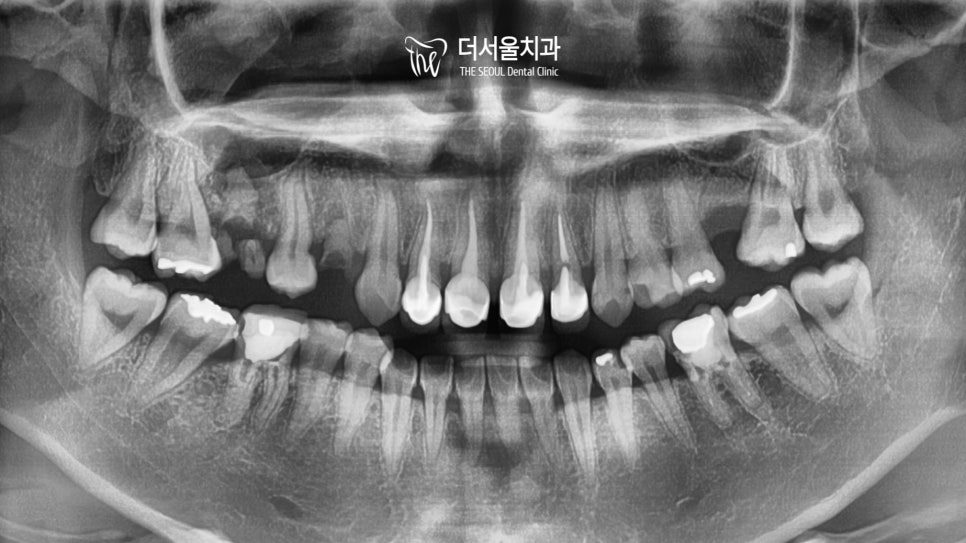
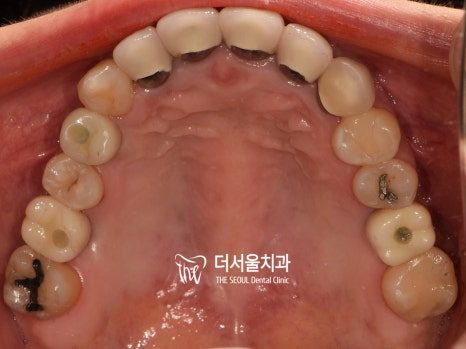
Two problems together. A protrusive profile that made closing the lips difficult, and multiple missing teeth.
Alongside those: spacing between the front teeth, several teeth in poor condition, and a number of earlier restorations that had not held up.
The panoramic X-ray showed retained roots at several sites — fragments of teeth left in the bone after the crown portion had broken away. The lateral cephalometric image confirmed how far forward the upper front teeth sat.
The patient had been aware of the alignment for a long time and had put off treatment over cost and time before deciding not to leave it any longer.
What was the treatment plan?
Orthodontics first, then implants.
Within that: the retained roots would be extracted and the sites cleaned; every missing-tooth site would be restored with digitally guided implant placement; and the front teeth, whose problem was angle and shape rather than position alone, would be re-restored with new prosthetic work after the alignment was settled.
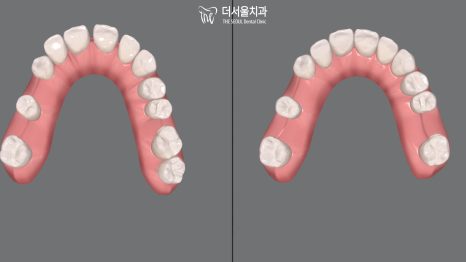
Before starting, an Invisalign ClinCheck simulation was run. This models the tooth movements in sequence and shows the projected end position before any aligner is worn — useful for the clinician to check the plan is achievable, and useful for the patient to see what the treatment is aiming at and roughly how long it will take.
How did the treatment actually run?
The alignment was carried out first, with clear aligners.
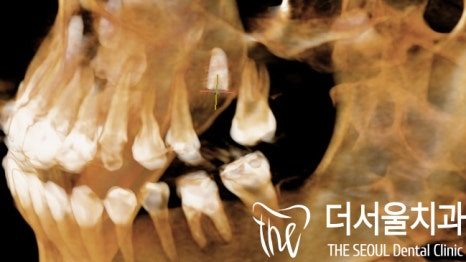
With the teeth in their final positions, implant placement was planned on the CT data: the position of each fixture relative to the surrounding anatomy, the adjacent teeth and the opposing teeth, all worked out before surgery.
That planning stage carries more weight here than in a routine single implant. A fixture in the wrong position cannot be nudged later — correcting it means a second surgery to remove it. The whole point of placing implants after orthodontics is that the target position is known; the planning is what makes sure the fixture actually lands on it.
While the fixtures integrated, the bite and the contacts between teeth were adjusted — the fine work that decides whether the finished arch feels right rather than merely looks right.
The result
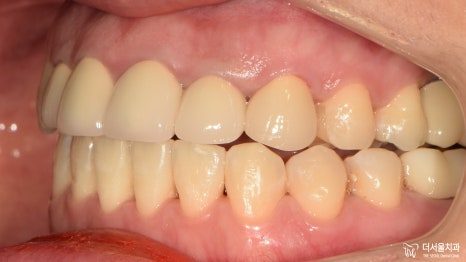
An even arch, with the missing teeth restored to function.
The protrusion that had made lip closure difficult was resolved as part of the alignment, and the front teeth were re-restored to a form that matched the corrected position.
Timeline
From 23 January 2021 to 6 January 2023 — almost exactly two years.
That length is normal for combined treatment and it has a structure to it: the orthodontic phase, then extraction and healing, then placement and integration, then the final restorative work. The individual plan varies from mouth to mouth. The order does not.
Can this treatment be done from abroad?
Combined orthodontic and implant treatment is the hardest kind to compress into visits, because the orthodontic phase needs regular adjustment appointments over a long period. It is worth raising your circumstances at the consultation before committing to anything, so the schedule can be assessed honestly rather than optimistically.
Frequently asked questions
Should I have braces before or after implants?
Before, in almost every case. An implant fuses to bone and cannot be moved afterwards, so it has to be placed into a position that is already final. Orthodontic treatment is what makes the position final.
What happens if an implant is placed first?
The implant stays where it is while the surrounding teeth are moved past it, leaving it out of position in the corrected arch. There is no orthodontic fix for that — the fixture has to be surgically removed and replaced.
Can I wear clear aligners if I already have an implant?
Often yes, if the existing implant is in a position the plan can work around. What it constrains is which movements are possible, so the existing implant has to be assessed before the plan is drawn up, not after.
How long does combined treatment take?
This case ran two years. The orthodontic phase drives most of it, with implant integration and final restorative work adding several months. A shorter figure quoted before imaging is not based on anything.
What is a ClinCheck?
It is the Invisalign planning simulation. It models the sequence of tooth movements and shows the projected result before treatment starts, which lets both the clinician and the patient see what is being aimed at and how long it should take.
Read more: Invisalign and clear aligners · braces · digital implants · dental implants