
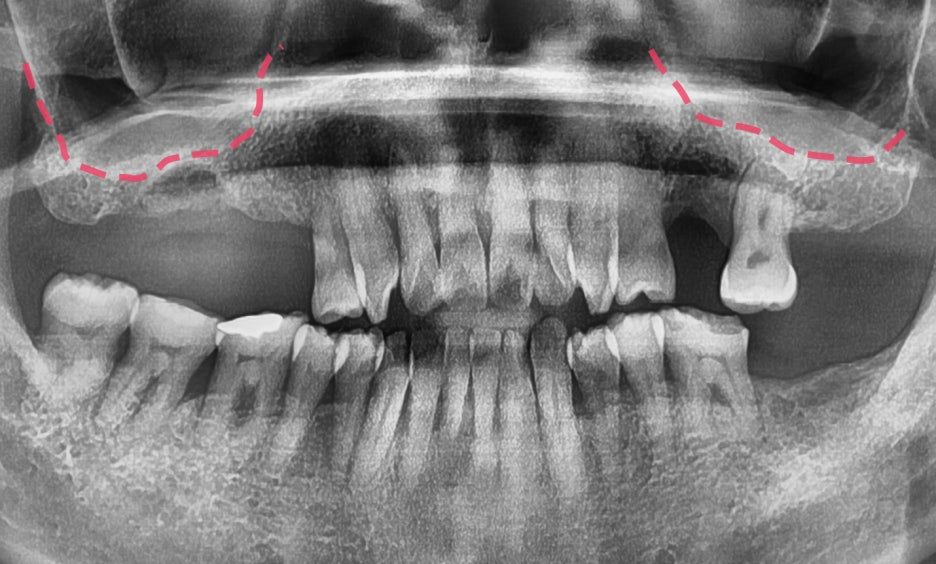
If an upper back tooth is missing and the bone above it is thin, an implant cannot simply be placed there. The floor of the maxillary sinus has to be raised first — and there are two ways of doing it, chosen for different situations.
Why does the upper back jaw run out of bone?
Above the upper molars sits the maxillary sinus, an air space in the bone. When an upper back tooth is lost, the bone beneath the sinus resorbs, and the space expands downwards into the gap left behind.
In most cases where an upper molar has been missing for some time, the remaining height is not enough for a fixture. The floor of the sinus has to be lifted and the space beneath it filled with graft material — a sinus lift, with bone grafting underneath it.
Placing an implant into thin bone without doing this — or without a CT scan to establish how thin it is — risks perforating the sinus membrane, which is the complication this whole procedure exists to avoid.
What are the two sinus lift approaches?
Lateral approach
Access is made through the side wall of the upper jaw. The gum is incised and a window is opened in the lateral surface of the bone, through which the sinus membrane is lifted and graft material placed.
It gives the most direct access and the most control, which is why it is generally preferred for multiple implant sites treated together.
Crestal approach
Access is made from above, through the ridge where the implant itself will go. The sinus floor is lifted vertically through that same channel.
It is less invasive and is the usual choice for a single implant site.
What it actually feels like
This is the question patients ask first, so it is worth answering precisely rather than reassuringly.
The procedure is carried out under anaesthetic. Afterwards, the discomfort most people report is a dull ache rather than sharp pain.
What the lateral approach does more often produce is swelling and bruising, because the gum is opened and bone at the side is reduced to make the window. That is a normal consequence of the technique rather than a sign of a problem, and it typically settles within about a week.
We would not tell you a sinus lift is painless. What can be said is that swelling and bruising, not pain, are the usual complaints, and that the timescale for them is short.
What did this patient present with?
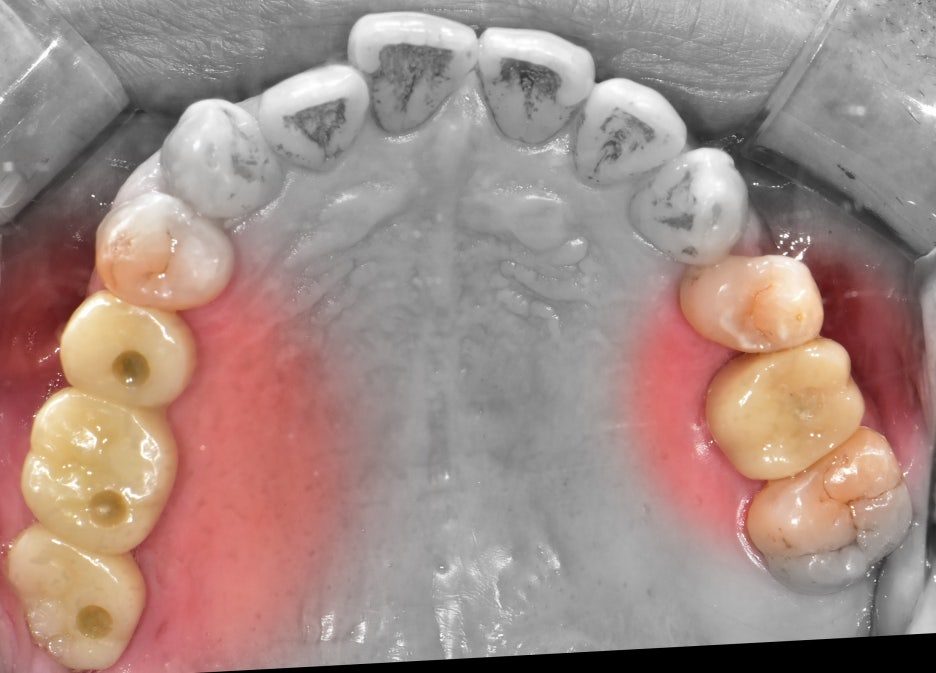
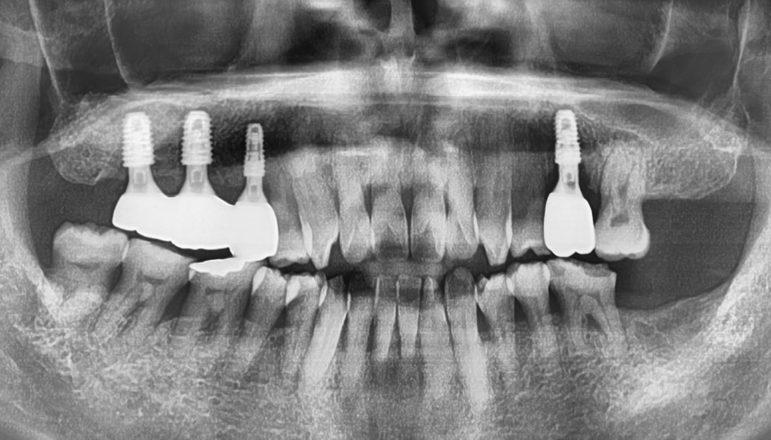
The patient arrived with multiple teeth already lost. On one side, only roots remained; elsewhere the teeth were gone entirely. The only teeth still meeting were the front ones, which cannot manage meat or anything tough — so effective chewing was not possible.
The teeth that were no longer functional and were harbouring infection were extracted first.
That left the underlying problem: how little bone remained. A sinus lift was unavoidable, and this was explained before anything was agreed.
What does the CT scan decide?
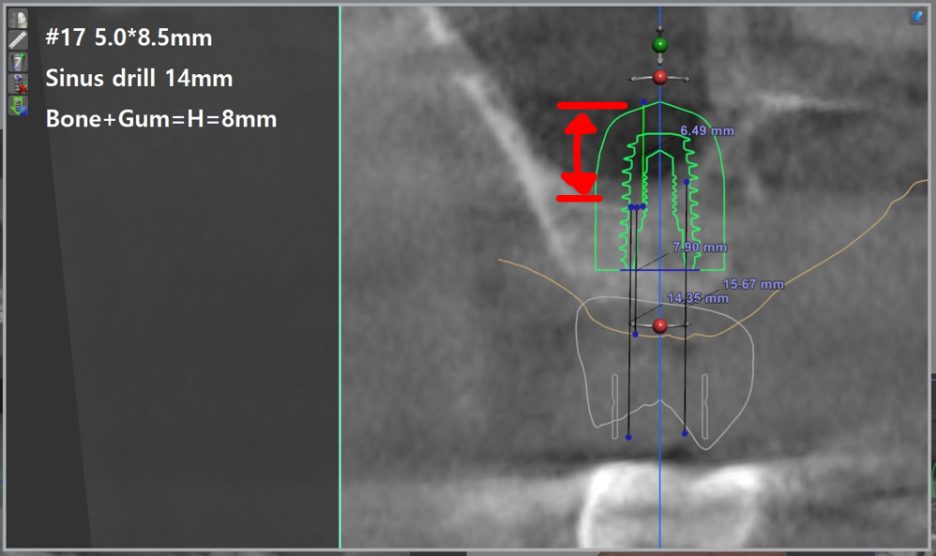
A CT scan was used to measure the distance to the sinus on both the coronal and sagittal views. Both showed the bone to be markedly thin.
Those measurements set two numbers: how much lift is required, and what implant length the site can take. The scan also revealed inflammation that had not been apparent otherwise.
The planning was carried out in the DIOnavi digital implant system, which models the placement in three dimensions and also indicates what form the eventual prosthetic work needs to take — useful, because the restoration is what the implant position ultimately has to serve.
The sequence, and why it takes a year
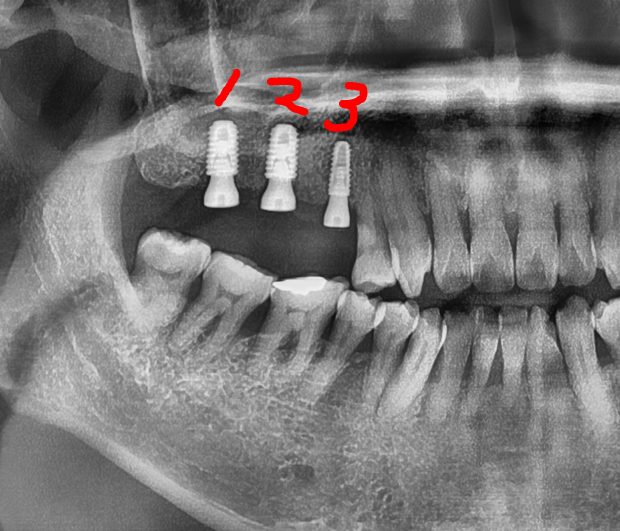
After the sinus lift, roughly three months are allowed to pass. The graft has to consolidate into bone before implants are placed into it; placing them early undermines the reason for grafting at all.
Three fixtures were then placed on the first side, and taken through to zirconia crowns. About two months later, with that side restored, the opposite side was treated — one further fixture, again with a sinus lift.
Four implants in total, both sides, including the grafting and the healing intervals: one year, from January to October 2021.
That is long, and there is no version of this treatment that is short. Each waiting period corresponds to a biological process that has to finish before the next step is safe.
Frequently asked questions
Does a sinus lift hurt?
It is done under anaesthetic, and afterwards most people describe a dull ache rather than sharp pain. Swelling and bruising are more common than pain, particularly with the lateral approach, and generally settle within about a week.
Which sinus lift technique will I need?
Broadly, the lateral approach where several implant sites are being treated together, and the crestal approach for a single site. The CT scan decides it, since how much lift is needed is what makes one approach practical and the other not.
How long after a sinus lift can the implant be placed?
Around three months, to let the graft consolidate into bone. In some cases the lift and the placement can be done together; that depends on how much bone height is already present, which is a CT finding.
What happens if an implant is placed without a sinus lift?
Where the bone is too thin, the fixture can perforate the sinus membrane. That is why a CT scan is taken before placement in the upper back jaw rather than relying on a flat X-ray.
How long does the whole treatment take?
This case ran a year for four implants across both sides, including grafting and healing. A single implant with a crestal lift is considerably shorter. The variable is how much grafting is needed and how your own bone responds.
Read more: bone grafting and sinus lift · digital implants · full-arch restoration