
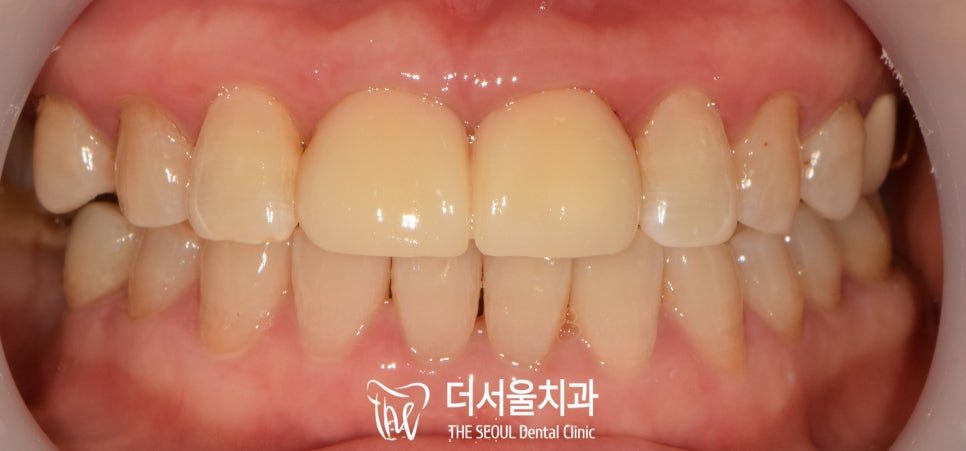
The patient had had the same front-tooth repair done four times. This is what the alternatives to a fifth attempt look like — and why the dentist spent some time arguing against the one that was chosen.
What the patient came in with
Two complaints. A visible gap between the upper front teeth, and an earlier resin repair that had discoloured — the margin between resin and tooth had gone dark.
There were two ways forward: repair it in resin again, or cover the teeth with crowns.
Why did the dentist advise against crowns?
Repeating the resin repair was, clinically, a perfectly reasonable option, and it was put to the patient more than once. Crowning requires reducing roughly a millimetre of healthy tooth structure all round — permanently, on teeth that are otherwise sound.
What settled it was history. This repair had been redone four times, and each cycle of failure and re-treatment had been a source of real frustration. Set against that, and against the fact that crowning would also close the gap between the teeth in the same step, the patient was clear about which they wanted.
We record the reasoning here because it is the honest version: the more conservative option was available, was recommended, and was declined for reasons that were the patient’s to weigh.
How do PFM, zirconia and all-ceramic differ?
PFM — porcelain fused to metal
Porcelain built over a metal framework. The least expensive of the three.
The drawback on front teeth is specific: over time, the metal substructure can begin to show as a dark line at the gum margin.
Zirconia
Strong and aesthetically convincing, and the most commonly chosen for visible teeth.
The drawback is a consequence of the strength: zirconia is hard enough that it can wear the opposing natural teeth it bites against.
All-ceramic (e.max, Empress)
Ceramic throughout, with no metal core. Most often used for veneers.
Its translucency is its strength and its complication — because light passes through it, the colour of the underlying tooth can show through, so a discoloured tooth underneath affects the result. It is also more prone to fracture than zirconia.
Prices differ between these materials and between clinics. Our own published fees for non-covered treatment are on the pricing page; we have deliberately not reproduced figures here that we cannot stand behind.
Why was zirconia chosen for this patient?
Appearance mattered to this patient, but so did closing the space between the teeth naturally and covering discoloured tooth structure where old resin had been removed. Zirconia handles both: it is opaque enough not to be affected by what is underneath, and strong enough to be shaped across a space.
This decision is not made from a materials list. How much tooth has to be reduced differs by material, and the state of the gums and the remaining tooth structure can rule out the material you would otherwise prefer. It is made after examination, with your dentist, for that mouth.
What happens when front teeth are crowned?
Preparation. Local anaesthetic, the old discoloured resin removed, and the teeth reduced by the thickness the chosen crown requires. Front teeth are small and thin, so this stage is done in small increments.
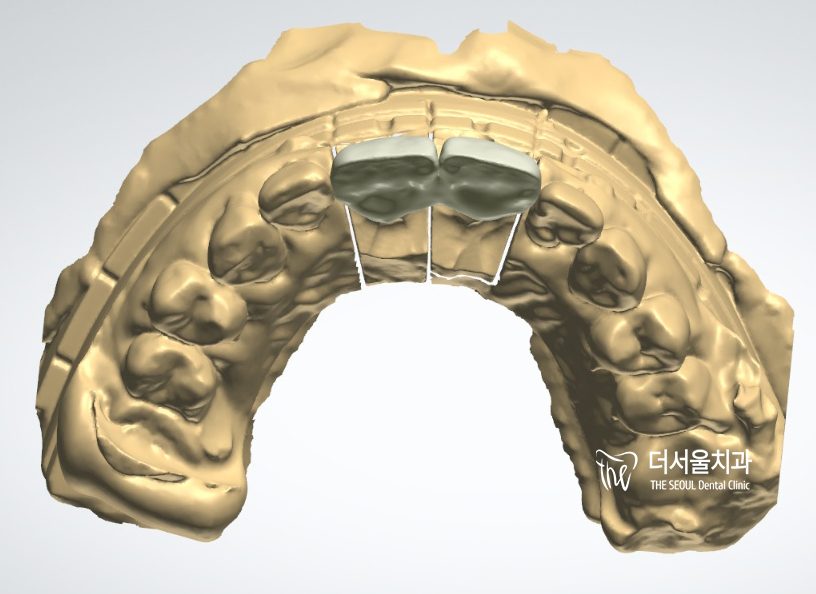
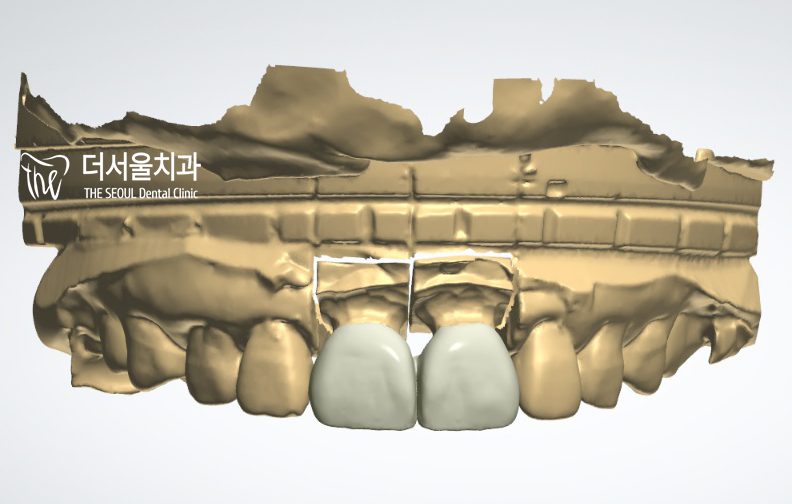
Impression. Taken with an intraoral scanner rather than impression material. The scan captures the gum line to within about a millimetre of detail, and it also records the shade of the adjacent lateral incisors and remaining tooth structure — so the laboratory is designing to the surrounding colour rather than to a note on a form.
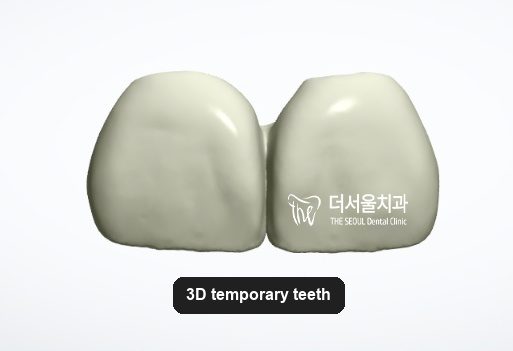
Temporary teeth. Nobody goes home without front teeth. The scan data is used to print temporary crowns on the clinic’s own 3D printer while the patient is still in the chair, so they are fitted as soon as the preparation is finished. A printed temporary has a more accurate margin than a hand-made one, which matters for the fortnight it is in place.
Fitting. The zirconia crowns were made to extend about a millimetre below the gum line, so the transition at the margin is not visible. They were splinted together as a bridge rather than fitted as separate units, which holds the closed space stable over the long term instead of letting the teeth drift back apart.
Treatment ran from 1 April 2022 to 10 April 2022.
Do crowns last forever?
No restoration in the mouth is permanent.
Where a crown fractures or discolours, replacing it is the correct treatment rather than patching it. And when an old crown comes off, what is found underneath — how much decay, what state the core is in — can change what is possible. That is a reason to have restorations checked periodically rather than a reason to avoid them.
Frequently asked questions
Which crown material is best for front teeth?
Zirconia is the usual choice for visible teeth — strong, and not affected by discolouration underneath. All-ceramic is more translucent and looks excellent over a healthy tooth but shows what is beneath it. PFM costs less but can develop a dark line at the gum margin over time.
How much tooth is removed for a crown?
Roughly a millimetre all round, depending on the material. That reduction is permanent, which is why a resin repair is worth considering first where the tooth is otherwise sound.
Can a crown close a gap between front teeth?
Yes — the crowns are shaped to fill the space, and splinting them as a bridge keeps it closed. Whether that is the right approach depends on how wide the gap is and whether the teeth themselves need covering for another reason.
Will I have temporary teeth while the crowns are made?
Yes. Here they were 3D printed from the scan data during the same appointment, so they were fitted immediately after preparation and worn for about ten days.
Does zirconia damage the teeth it bites against?
It can, because it is harder than natural enamel. It is a consideration when planning the bite rather than a reason to avoid the material, and it is one of the things assessed before the material is chosen.
Read more: crowns and veneers · cavities and fillings · pricing