
Patients with diabetes are often told, or assume, that implants are not for them. The honest position is narrower than that: it changes what has to be checked first and how the surgery is done, and it is not automatically a reason not to treat.
Why does diabetes matter for implant surgery?
Diabetes affects clotting. Bleeding during and after oral surgery can be more difficult to control, and healing can be slower.
That is a real consideration, not a formality, and it is why this patient had been hesitating over treatment for some time.
What the examination found
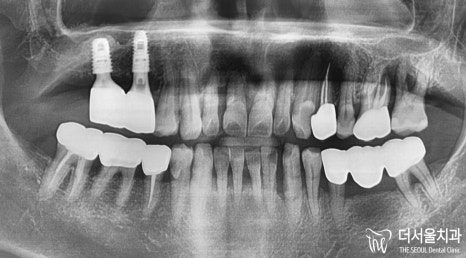
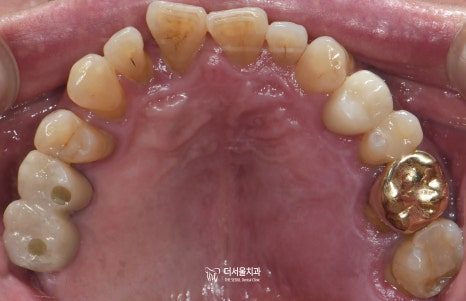
On the upper right, two molars were already missing and a premolar had decayed to the point where it could no longer function — deeply enough that extraction and an implant were the realistic route rather than restoration.
It needed dealing with. The patient was elderly and had both diabetes and high blood pressure, so it could not simply be scheduled.
Do I need clearance from my own doctor?
The patient’s own treating physician was contacted and asked directly whether implant surgery was appropriate. The answer was that it was.
This is the part worth taking from the case. Medical clearance is not paperwork — it is a dentist asking the clinician who actually manages your condition whether the procedure is safe for you now, and adjusting the plan to what they say. If you have a systemic condition and no one has asked you about it in detail, that is worth raising yourself.
How was the surgery adapted for diabetes?
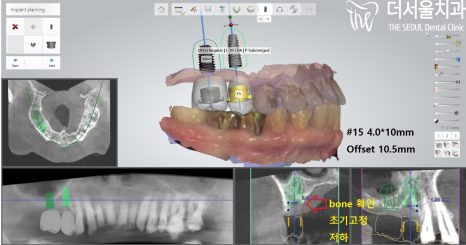
Even with clearance, bleeding still had to be minimised. The approach chosen was minimal-incision placement: the position of each fixture planned digitally beforehand, so that access could be made through a small opening rather than by laying the gum widely open.
Less tissue opened means less bleeding, which is what the caution was about, and generally less swelling and faster healing as well.
What the X-ray showed
The panoramic image was checked for two things before planning: how much alveolar bone remained, and how close the maxillary sinus sat.
The site had been left for a long time and bone loss was extensive, which had brought the sinus down close to where the fixture needed to go. Grafting was therefore unavoidable.
Two sites, two different plans
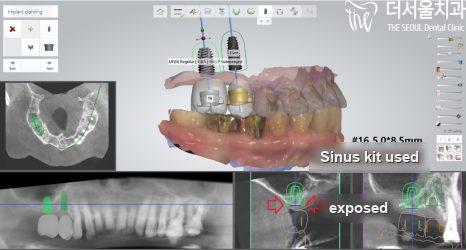
The planning software gave a different answer for each site:
- The premolar site had adequate bone. No graft required — place and finish.
- The molar site required lifting the sinus membrane, so graft material had to be placed beneath it to create a foundation. The planned fixture also projected slightly beyond the available bone at the tip, and covering that meant building the bone up around it.
Two adjacent sites in the same mouth, needing materially different surgery. That is the argument for planning each one on the scan rather than treating “an implant” as a single procedure.
How long did the treatment take?
Post-operative imaging showed the graft material in place and the sinus floor lifted as planned, with the whole thing carried out through minimal incisions.
A temporary restoration was fitted so the patient could eat normally while the zirconia crown was made.
Treatment ran from 8 May 2021 to 21 December 2021.
What care is needed while the implant heals?
The fixture still needed further integration before it could take full load, so the patient was asked to use it carefully in the meantime and to keep to the review schedule.
Follow-up matters more where healing is slower, not less. The reason for the review appointments is to catch a problem while it is still small, and a slower-healing site is exactly where that is worth doing.
Frequently asked questions
Can I have a dental implant if I have diabetes?
Often yes, but it is not decided by the dentist alone. Clearance from the physician managing your diabetes should come first, and the surgery is then adapted — typically minimal-incision placement to limit bleeding. Poorly controlled diabetes is a different situation from well-controlled diabetes, which is why the question goes to your own doctor.
What is minimal-incision implant placement?
The fixture position is planned on CT data beforehand, so access can be made through a small opening rather than opening the gum widely. It reduces bleeding, swelling and healing time, and it is possible because the guide supplies the position that direct vision would otherwise have to find.
I take blood pressure medication. Does that matter?
It is worth telling us, along with everything else you take. Some medications affect bleeding or healing, and the point of asking is to plan around them rather than to rule treatment out.
Why did one site need a bone graft and the other not?
Because bone loss is site-specific. One site had adequate bone; the other had lost enough that the sinus had come down close to the planned fixture position, which required lifting the sinus membrane and grafting beneath it.
Should I tell the clinic about my medical conditions before I travel?
Yes, before you book rather than on arrival. It affects whether clearance is needed, how the surgery is planned and how long healing takes — all of which affect the dates you should be here.
Read more: bone grafting and sinus lift · digital implants · planning treatment in Korea