

Headgear looks like an appliance that pulls the front teeth backwards. It does not. It slows the forward growth of the upper jaw while the lower jaw keeps growing, and the protrusion resolves because the two ends up closer together. Everything else about it follows from that — including why it only works before growth finishes.
What “protruding mouth” means dentally
Where the upper front teeth and the bone supporting them sit forward of where they should, the lips do not close without effort and more gum shows when smiling. Where the upper jaw is forward relative to the lower, this is a Class II malocclusion.
The usual causes are the jaw proportions a child inherits, and in some cases habits sustained over years — thumb sucking, or pushing the lips forward.
How does headgear work?
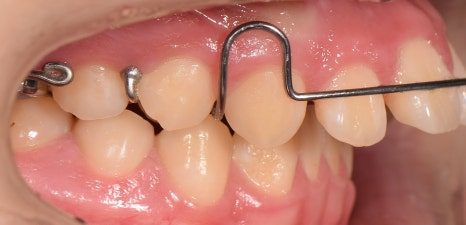
Three parts working together:
- an appliance fitted inside the mouth,
- a band worn around the head,
- elastic modules connecting the two.
The elastics apply a backward force to the upper jaw. That force does not move the jaw backwards — it restrains its forward growth. Meanwhile the lower jaw continues growing normally. Over months, the gap between the two closes and the protrusion reduces.
This is why headgear belongs to the growth years and not to adult treatment. Once growth is complete there is no forward growth left to restrain, and the appliance has nothing to act on.

What decides whether headgear works?
Headgear has to be worn 12 to 14 hours a day. In practice that means putting it on after the evening meal and wearing it through the night.
This is not a detail to be tidied away in the aftercare instructions. It is the mechanism. The appliance restrains growth only while it is being worn, and growth continues during the hours it is off. A child who wears it for six hours a night is not getting a slower version of the result — they may be getting no result.
Treatment also needs to run continuously for around twelve months. Improvement can appear earlier and then relapse if the appliance is stopped, because the growth pattern it was restraining resumes.
When should a child be assessed for a protruding bite?
Where a protruding bite is present, the period between roughly six and twelve years old is when growth pattern and rate can be observed and acted on. Assessment during those years establishes how the jaws are developing, which is what determines whether growth modification is an option at all.
Ongoing review matters as much as the starting decision, because what is being managed is a moving process rather than a fixed deformity.
The case: a protruding upper jaw with a missing lateral incisor
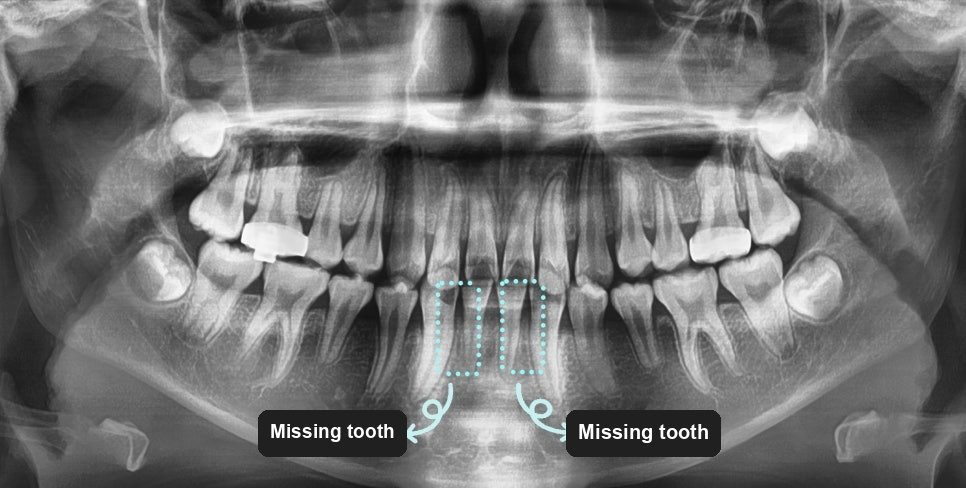
The child presented with the upper jaw notably forward. Contributing to the imbalance was a missing lateral incisor — one of the teeth beside the upper front teeth had not developed.
A missing tooth changes the arithmetic of an arch. There is less tooth material in the upper arch than the lower to work with, which alters how the two arches can be made to meet.
The plan was to bring the upper jaw back relative to the lower, so headgear was used, together with a removable appliance.
What twelve months of headgear achieved
After approximately twelve months of wear, the forward growth of the upper jaw had been restrained and the malocclusion had improved. At the start the protrusion was pronounced enough that the upper teeth were barely visible in profile; by the end the jaw relationship had moved towards a normal one.

Why was a second phase of treatment needed?
Growth modification fixed the jaw relationship. It did not resolve the tooth arithmetic.
Because of the missing lower tooth material, the upper teeth needed to move further back than the correction had achieved. An upper premolar was extracted to create that space, and treatment continued with clear aligners to move the teeth into their final positions.
That phase was still under way when this case was written up. The teeth were progressively reaching their planned positions.
Two phases is a common shape for treatment started during growth, and it is worth expecting rather than being surprised by. The first phase addresses what only growth allows; the second addresses the teeth once the jaws are in a workable relationship.

One thing parents can check without a dentist
When the baby teeth start being replaced, it is worth having the number of teeth checked. A tooth that never develops — as in this case — is not visible as an absence early on, but it changes what treatment will be needed later.
Children are also less thorough at brushing than they report being, and an appliance in the mouth gives plaque more places to sit. Supervision through that period is part of the treatment, not separate from it.
Frequently asked questions
Does headgear pull the teeth backwards?
No. It restrains the upper jaw’s forward growth while the lower jaw continues to grow, which reduces the discrepancy between them. The effect is on growth, not on tooth position directly.
How many hours a day does it have to be worn?
12 to 14 hours, usually from after dinner through the night. The appliance only acts while it is being worn, so the hours are the treatment rather than a recommendation attached to it.
Can an adult have headgear for a protruding bite?
No. It works by modifying growth, and in an adult growth has finished. Adult treatment addresses tooth position, and where the skeletal discrepancy is large, surgery.
What happens if we stop partway?
The growth pattern being restrained resumes, and improvement already gained can relapse. This is why treatment is planned to run continuously for around a year rather than in stages.
Will braces still be needed afterwards?
Often yes. Growth modification and tooth alignment are different jobs. In this case a second phase with aligners followed, after a premolar was extracted to create the space the arch needed.