
Implants are reliable, but they are not maintenance-free. When the bone around one is lost, the fixture stops being anchored — and getting it back is a longer job than placing it was in the first place.
What goes wrong
Implant treatment has become a dependable way to replace a missing tooth. What it is not is permanent regardless of what happens afterwards.
Without consistent maintenance, peri-implantitis — inflammation of the tissue around the implant — and the bone loss that follows can develop. Left far enough, that is what causes an implant to fail.
What are the signs of a failing implant?
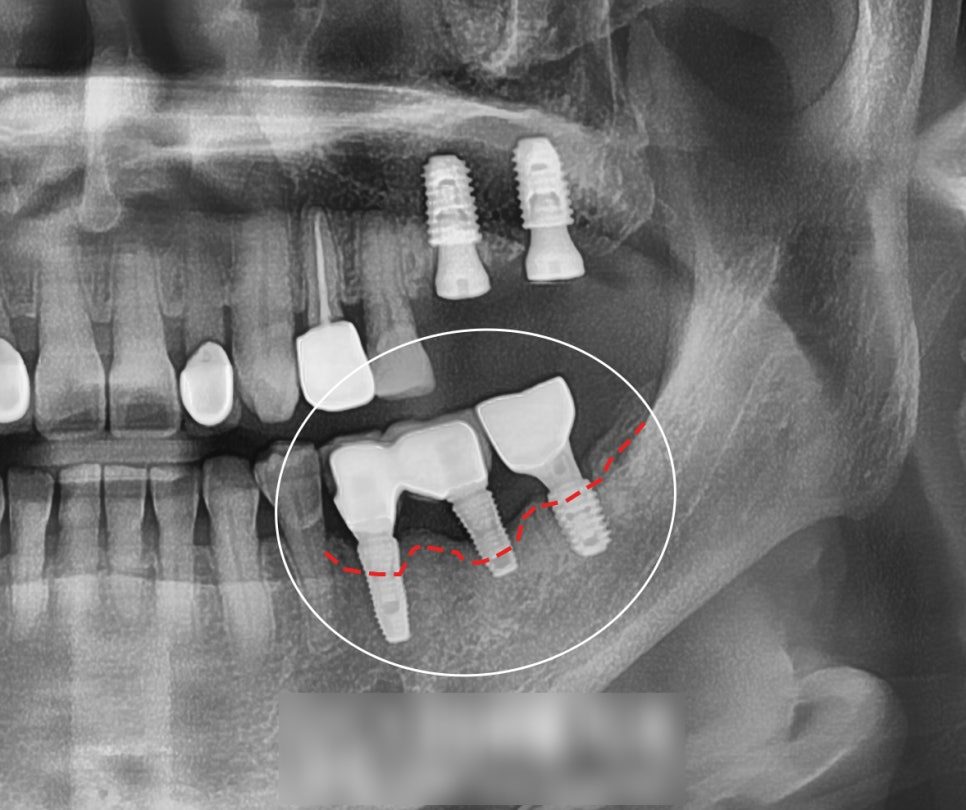
Imaging showed substantial bone loss around the implant, with severe inflammation of the surrounding tissue.
At that stage the typical symptoms are pain around the implant and mobility. Both were present here.
When does an implant have to come out?
A useful clinical threshold: when roughly a third of the fixture’s threads have lost their bone support, removal may be necessary.
This case was past that. Alveolar bone loss was extensive enough that the fixture was no longer properly retained. With mobility that pronounced, eating on that side would have been difficult, and the surrounding inflammation meant ongoing pain. A crown placed at another clinic had already come away as the implant loosened.
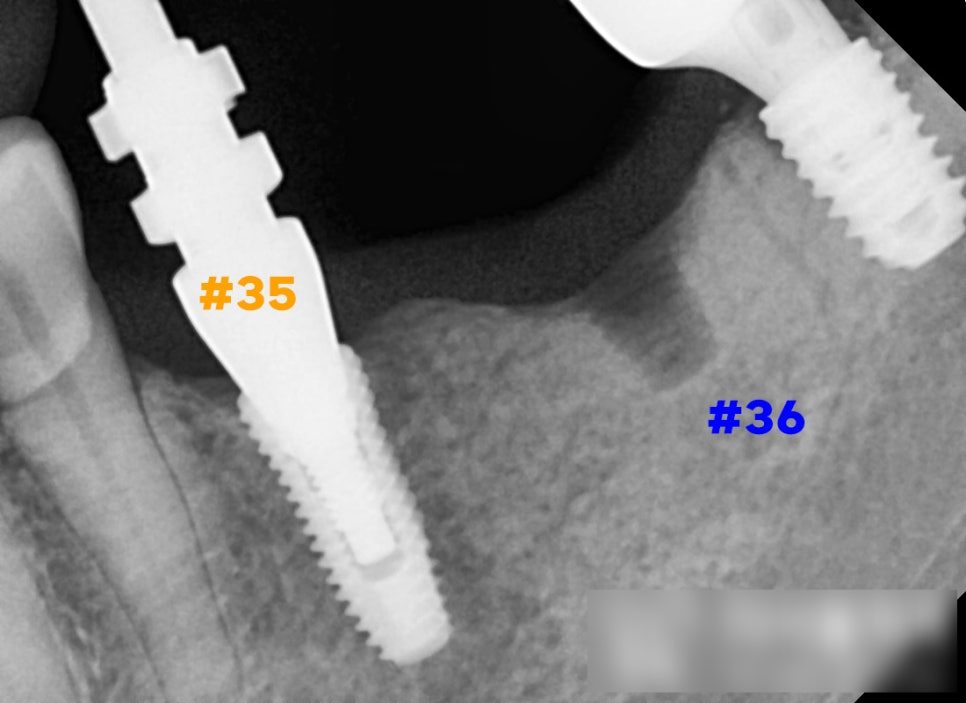
The plan was therefore: remove the existing fixture, allow the site to heal, bone graft, and re-place.
It is worth being clear that this is a bigger undertaking than the original placement. A natural tooth is connected to bone by the periodontal ligament, with a degree of give. An implant is fused directly to bone, so removing one and rebuilding the site is a demanding procedure.
Why not place a new implant straight away?
Direct examination confirmed the imaging — enough bone had been lost that the fixture was clearly exposed.
The surrounding tissue was cleaned thoroughly first. The existing fixture, by then poorly retained and involved in the inflammation, was removed, and the site was left to heal rather than being re-implanted immediately. Bone graft material was placed to rebuild the deficient area.
Waiting is the part patients find hardest, and it is not optional. New bone has to form before a fixture has anything to hold onto.
Re-placement
Over the following months the bone filled in. Follow-up imaging showed new bone formation and the grafted material well incorporated.
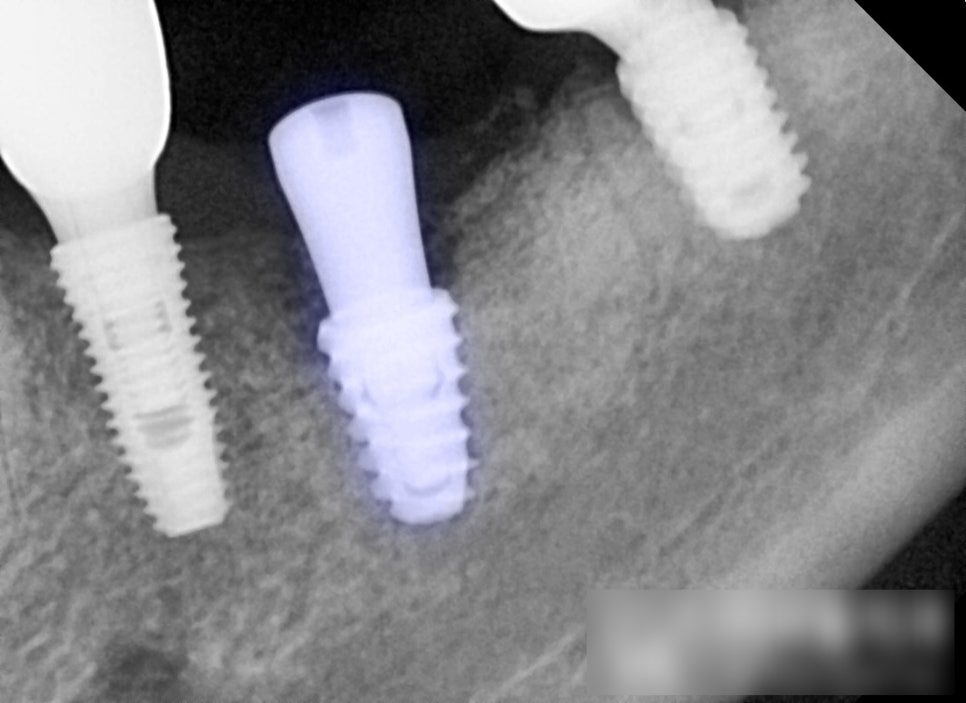
The re-placement was planned digitally, with two constraints driving the position:
- A position offering good primary stability — the initial mechanical grip that holds the fixture while bone integrates around it
- A safe distance from the inferior alveolar nerve, which runs through the lower jaw
A new fixture of different diameter and length was selected to suit the rebuilt site, and further bone reinforcement was placed at the same time as re-placement.
The restoration: why two implants were joined
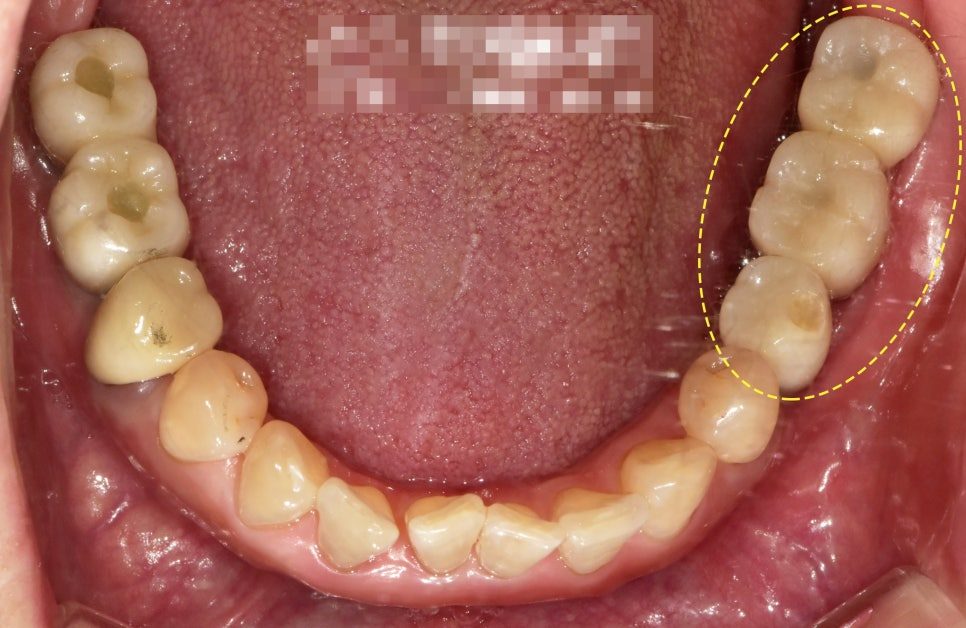
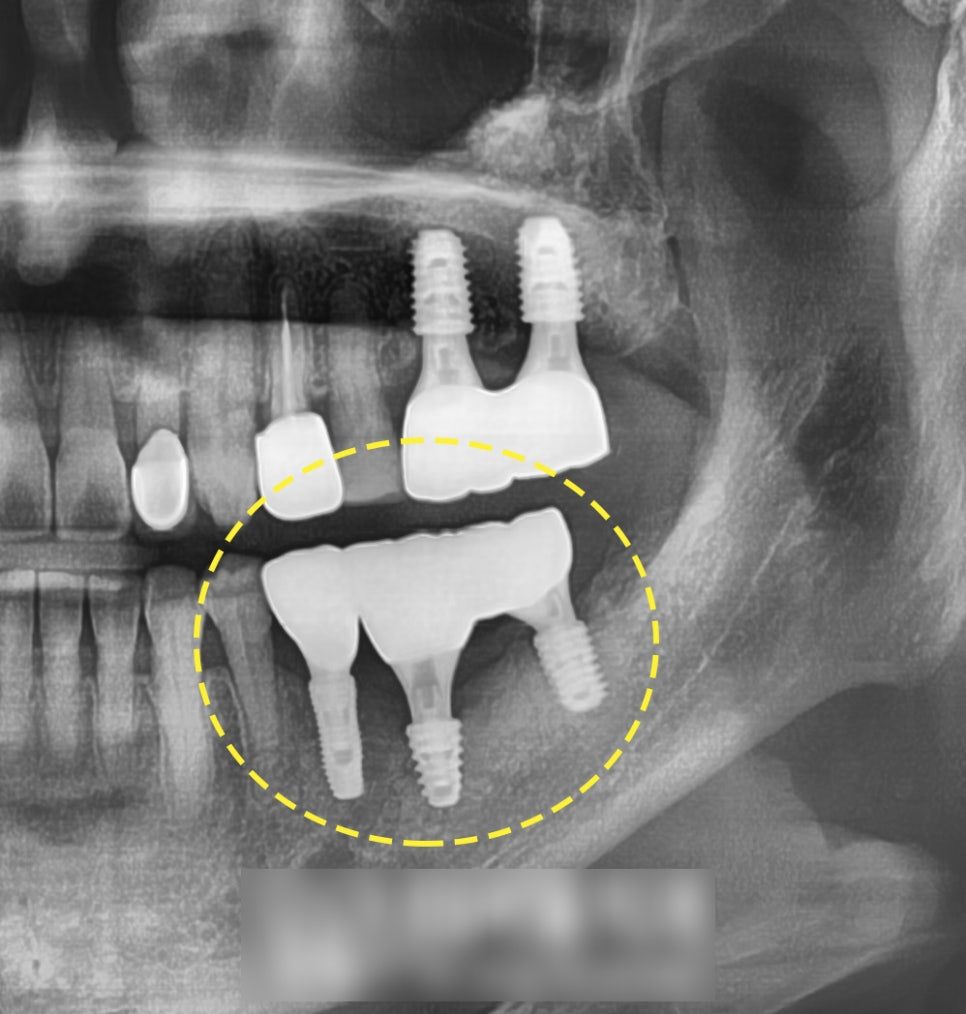
Once stability was adequate, the restoration was fitted — a bridge splinting the two lower left molars (#36 and #37) together rather than two separate crowns.
The reason is mechanical. Where bone quality is not ideal, implants are relatively vulnerable to lateral force — sideways loading during chewing. Joining them distributes that load across both fixtures instead of concentrating it on either one, which is what gives the result a better chance of lasting in a compromised site.
How long does implant revision take?
Treatment ran from mid-February to late August 2023 — about six months from the first examination to the final restoration, including removal, a healing period, grafting, re-placement and a second integration period.
If you are travelling for revision treatment, plan for at least two trips. The healing intervals are not compressible, and revision needs more of them than a straightforward placement.
How do I stop this happening again?
Peri-implantitis develops the same way gum disease does, and it responds to the same things:
- Daily cleaning around the implant, including the surfaces a brush does not reach
- Check-ups every three to six months, where the tissue around the implant is examined specifically
- Getting pain or any sense of movement looked at promptly — bone loss found early is a much smaller problem than bone loss found late
Frequently asked questions
Can a failed implant be replaced?
Usually yes, but not in one appointment. The existing fixture is removed, the site is allowed to heal, bone graft material rebuilds the deficient area, and a new fixture is placed once there is enough bone to hold it. Expect around six months.
Why is my implant loose?
Most often because bone around it has been lost to inflammation. It can also be a loose abutment screw, which is a much simpler fix. An X-ray distinguishes the two, and the difference matters — do not assume it is the serious one, or the trivial one.
Is removing an implant difficult?
More so than removing a natural tooth. A tooth sits in bone with a ligament between; an implant is fused directly to the bone. That is why revision is considered a demanding procedure and why the site needs rebuilding afterwards.
What is peri-implantitis?
Inflammation of the gum and bone around an implant, driven by plaque much as gum disease is. The implant itself cannot decay, but the bone holding it can be lost — and that is what loses the implant.
Why join two implant crowns together?
To share sideways chewing forces across both fixtures. Where bone quality is compromised, implants are relatively vulnerable to lateral loading, and splinting spreads it rather than concentrating it on one.
Read more: failed implant revision · bone grafting and sinus lift · dental implants overview