
Small problems in the mouth do not stay small. This case shows what several years of them look like together — and why the order in which they are treated matters as much as the treatment itself.
What do I lose by putting treatment off?
A small problem left alone grows, and treatment later is more expensive and more uncomfortable than it would have been.
But the cost that matters most is different: teeth and the bone around them do not regenerate. Money can be recovered. A tooth cannot, and neither can the bone that held it.
What did the examination find?
In the upper arch:
- #14 and #15 — upper right premolars, both missing
- #24 — deeply hollowed out by decay
In the lower arch:
- #36 and #46 — both first molars missing, with only a retained root remaining at #36
Across both arches there were numerous fractured and worn teeth. Without prompt treatment, more would have been lost.
What did the X-ray show?
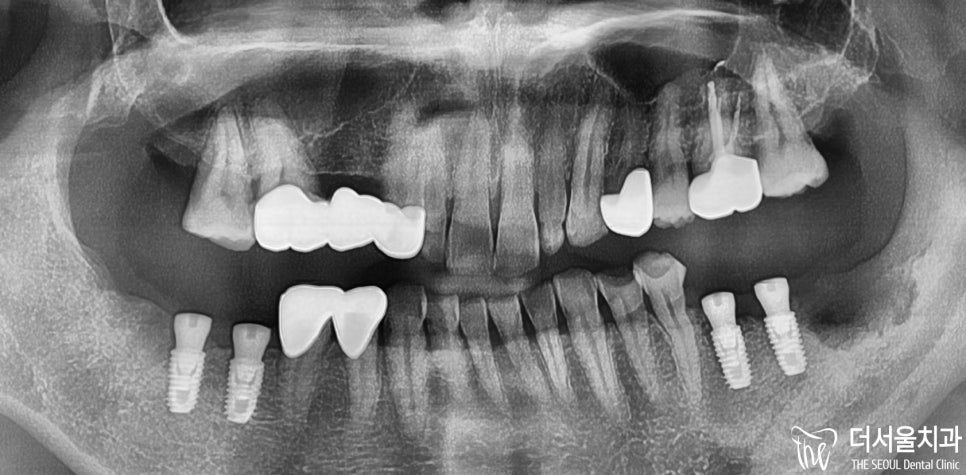
The panoramic view was worse than the visual examination.
The root regions of #37 and #38 showed marked darkening — clear evidence of established infection. Those teeth had lost their anchorage and were markedly mobile.
The imaging also showed a consequence of the long delay: teeth had tilted sideways into the empty spaces, reducing the room available for restorations. A tooth left unopposed or unsupported drifts, and once it does, the space needed to replace its neighbour is no longer there.
That is why treatment sequence matters in a case like this. Restoring space and restoring teeth are not the same task.
The plan
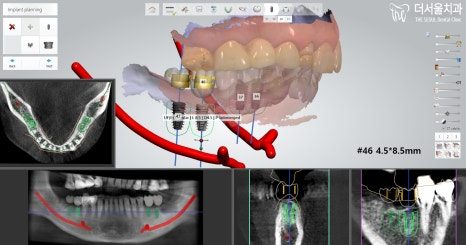
Extractions of the affected molars and wisdom teeth came first, followed by planning on a computer analysis program.
The planning distinguished the two sides:
- The 40s region presented no particular difficulty
- The 30s region had bone loss from infection, so placement there needed more care — though not, in the end, a bone graft
Establishing that grafting was not required is as much a result of planning as establishing that it is. It is measured, not assumed in either direction.
Treatment
Fixtures were placed in the lower molar regions on both sides. Crown work in the upper arch was carried out in parallel rather than afterwards, using the implant healing period:
- 10s region — a bridge
- #24, the fractured tooth — a crown
- #26 — restored to establish proper occlusion
Once the fixtures had integrated with the bone, the implant restorations were fitted.
Did the bite work properly again?
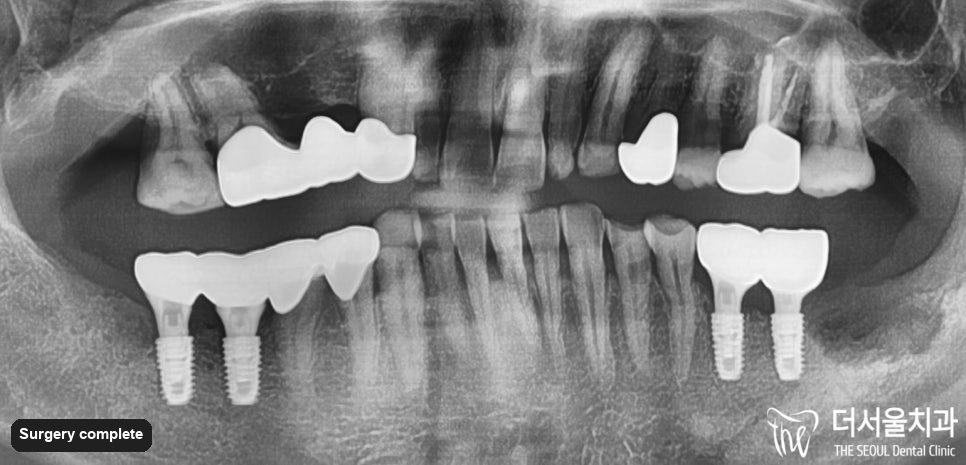
Post-treatment imaging confirmed the fixtures were stably anchored in bone.
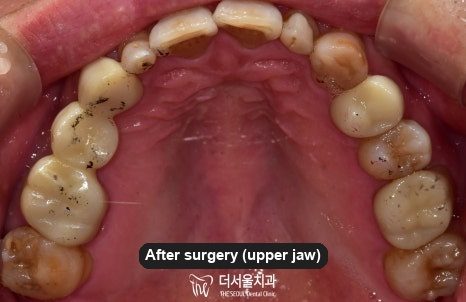
The more consequential change was to the bite. The occlusion had been substantially distorted by the missing teeth and the drifting that followed, and it now meets correctly — upper and lower teeth contacting as they should across the arch.
That is what full-mouth treatment is actually for. Individual restorations are the means; a working bite is the objective.

How long does a full-mouth rebuild take?
Treatment ran from early July to late December 2022 — under six months for a plan combining extractions, implants at multiple sites, a bridge and several crowns. Running the upper crown work during the implant healing period is what kept it there.
The warning signs worth acting on
Where infection is present, the signals are usually these:
- Swollen gums
- Pus discharge
- Persistent bad breath
None of them require pain to be present, and all of them mean treatment should not wait. The later the intervention, the more likely it is that bone grafting joins the plan alongside the implants.
Frequently asked questions
What happens if I leave a gap where a tooth is missing?
Neighbouring teeth tilt into the space and the opposing tooth drifts down into it. That reduces the room available to place a restoration later, so the delay changes what treatment is possible, not just when it happens.
What is a retained root?
What is left when the crown of a tooth breaks away and the root stays in the bone. It cannot function, and it is a site where infection develops, so it generally needs removing rather than leaving.
Do I always need a bone graft where there is infection?
No. This case had bone loss from infection on one side and still did not require grafting. Imaging measures how much bone remains at each site, and the answer differs between sites in the same mouth.
Can several treatments be done at the same time?
Often yes, and it usually shortens the overall plan. Here the upper crown work was carried out during the implant healing period rather than after it, which kept a large case inside six months.
How do I know if I have an infected tooth root?
Swollen gums, pus discharge and persistent bad breath are the common signs, and pain is not always among them. Infection at the root is diagnosed on an X-ray, which is why these symptoms warrant an examination rather than watchful waiting.
Read more: digital guided implants · dental implants overview · crowns and veneers