
The question almost every adult with an underbite asks is whether jaw surgery is unavoidable. It is not always — but what decides it is specific, and it is worth understanding before you assume either answer.
What is an underbite?
A Class III malocclusion is a bite in which the lower jaw is developed further forward relative to the upper. The lower front teeth sit in front of the upper ones instead of behind them.
The consequences are both appearance and function. The teeth do not meet evenly, which makes chewing less efficient and can be uncomfortable over time.
What decides whether surgery is needed
The determining factor is growth.
A Class III bite typically arises from a combination of the lower jaw over-developing and the upper jaw under-developing. Where the upper jaw is too narrow, the teeth meet in reverse from childhood — a crossbite.
That timing is what changes the options:
- In children, the jaws are still growing, so appliances can influence that growth. Treatment is comparatively straightforward and most cases finish within about a year.
- In adults, growth has finished. Treatment works by moving teeth rather than influencing jaw development, and takes roughly two to three years.
Whether an adult case can be managed without orthognathic surgery depends on how much of the discrepancy is skeletal and how much can be resolved by moving teeth. It is assessed individually — it is not something to conclude from photographs or from someone else’s outcome.
What did the examination find?
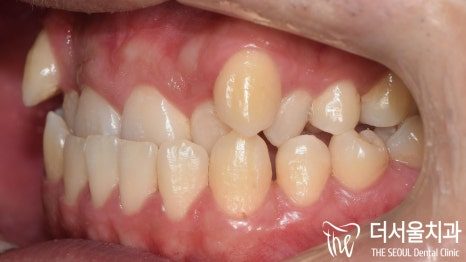
The reverse bite was pronounced. Where the upper teeth should overlap the lower ones, the upper teeth sat tucked behind them.
Alongside that: crowding, an out-of-position canine, and irregular alignment. Viewed from the biting surface, multiple cavities were found on the tongue-side surfaces — unsurprising, since crowded and reverse-biting teeth are difficult to clean properly.
So the plan had to address the Class III relationship, the crowding and the displaced canine, and the decay, rather than the bite alone.
The patient had been aware of the problem since childhood but had not been able to have it treated, and had come now wanting to know whether it could be corrected without surgery.
How was jaw surgery avoided here?
It could, and the reason was a feature of this particular mouth.
A lower molar had been lost to severe decay. That empty space could be used: the lower teeth could be moved backwards into it, retracting the lower arch and resolving the reverse bite without operating on the jaw. An implant would then be placed once the movement was complete.
This is worth being clear about — the space is what made the non-surgical approach viable here. Another patient without that space might not have the same option.
How did the bite change month by month?
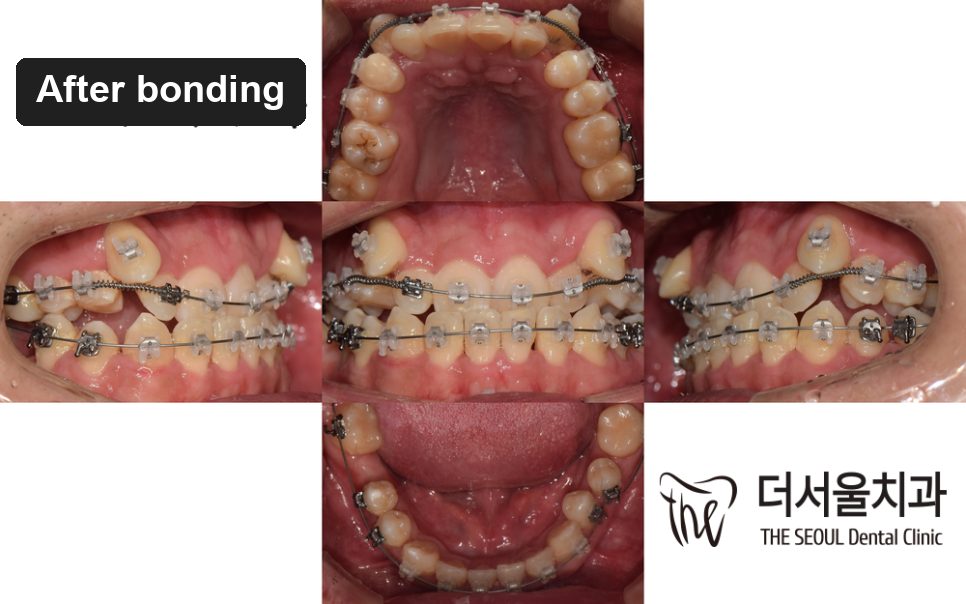
Brackets were bonded to the tooth surfaces and connected with a wire.
Where each bracket is placed determines the direction that tooth will move, so bracket position was set individually against each tooth’s size, shape and characteristics. This stage looks routine and is not.
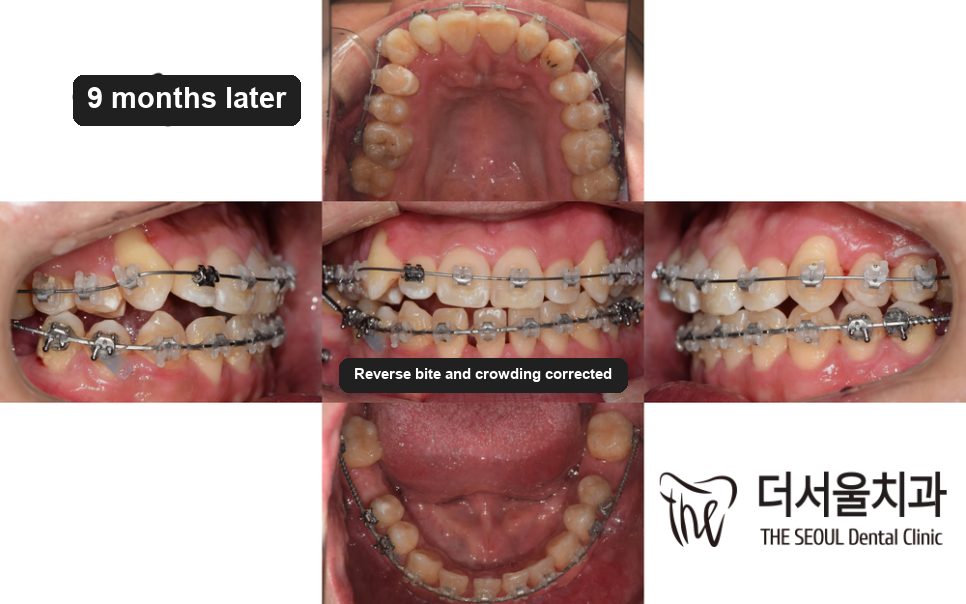
Nine months in
The out-of-position canine had moved into its correct place. More importantly, the reverse bite had begun to correct. The alignment was not yet tidy, but the teeth that most needed to move had moved.
Eighteen months in
The bite was meeting normally and the alignment was in order.
The implant was placed at this point — deliberately, not incidentally. Placing an implant while substantial tooth movement remains produces a serious problem: an implant does not move. Once integrated, it is fixed, and the teeth around it continue to be repositioned past it. Getting this sequence wrong produces an alignment that cannot be corrected afterwards.
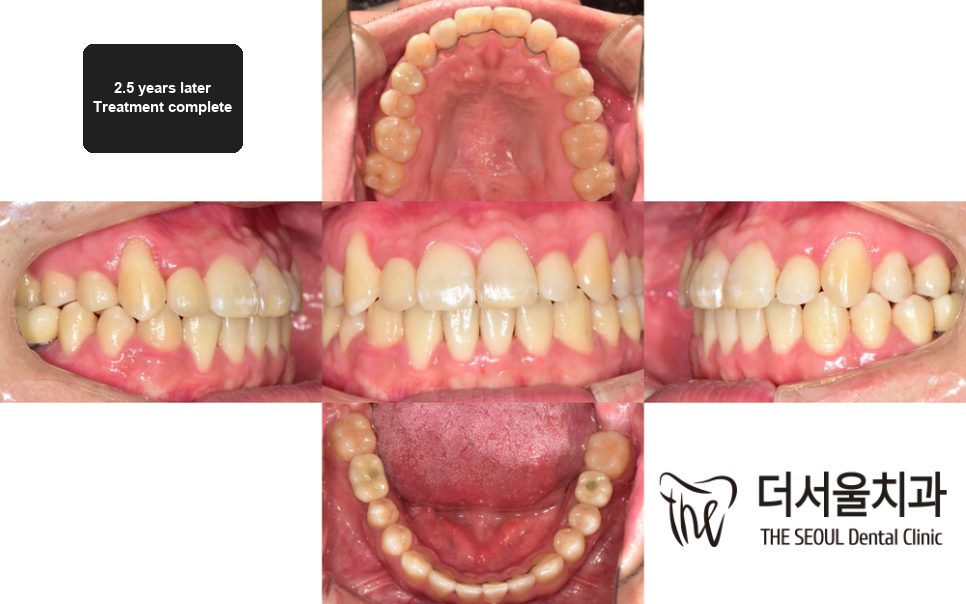
Thirty months: completion
Two and a half years may sound long. Part of it was deliberate.
Class III cases are particularly prone to relapse — returning towards the original position after treatment. Finishing quickly makes relapse more likely, so the final movements were carried out slowly on purpose.
The underbite, the crowding, the displaced canine and the decay were all addressed, and the implant restored the missing molar.
Can I have this treatment from abroad?
Treatment ran from January 2021 to the end of June 2023 — 30 months. Orthodontic treatment of this kind cannot be carried out from abroad on short visits; it needs regular adjustment appointments over years. If you are considering it, raise your circumstances at the consultation so the schedule can be assessed honestly.
Frequently asked questions
Do I need jaw surgery for an underbite?
Not always. It depends on how much of the discrepancy is skeletal versus how much can be resolved by moving teeth, and that is assessed individually. This case was managed without surgery partly because a missing lower molar provided space to work with.
Is an underbite easier to treat in childhood?
Generally yes. While the jaws are still growing, appliances can influence that growth, and most cases finish within about a year. In adults, growth has finished, so treatment moves teeth instead and takes roughly two to three years.
Why did treatment take two and a half years?
Partly the case complexity and partly by design. Class III bites relapse readily, and finishing quickly increases that risk, so the final movements were made slowly.
Can I have an implant during orthodontic treatment?
Yes, but timing is critical. An implant does not move once integrated, so it must be placed after the surrounding teeth have reached their final positions. Placing one too early leaves an alignment that cannot be corrected.
Will my underbite come back after treatment?
Class III bites are more prone to relapse than most, which is why retainers matter and why finishing slowly helps. Wearing your retainer as instructed is the single thing most within your control.
Read more: braces · Invisalign and clear aligners · children’s orthodontics