
When bone loss is advanced across most of a mouth, the treatment is not one procedure but a sequence, and the order it runs in is most of the plan. This case took ten months from first examination to final crowns.
What the first examination found
The picture was consistent throughout the mouth rather than confined to one area.
Several teeth were markedly mobile. Others had drifted and tipped out of position. Most of the lower teeth were already missing. Where teeth remained, the gum had receded to the point where the roots were largely exposed — the visible consequence of alveolar bone loss, the bone that holds teeth in place dissolving away.
What the X-ray added
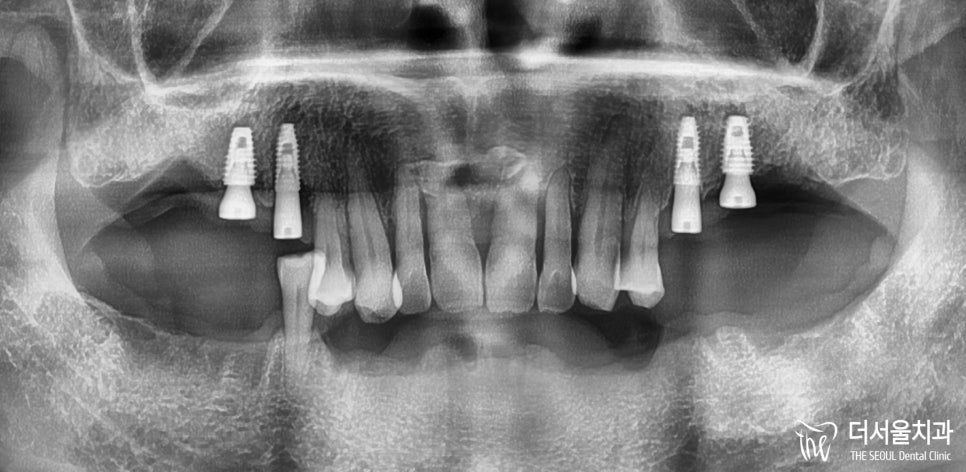
A panoramic X-ray was taken, and the situation was more advanced than the clinical view suggested.
Bone had been lost extensively across both arches. Teeth were tipped sideways. Several sites showed active infection.
The plan that followed from it: in the lower jaw, one tooth could be retained and the remainder had to be extracted. In the upper jaw the remaining teeth were also mobile, so they too required removal, followed by bone grafting and then implants.
Why must bone grafting come before implants?
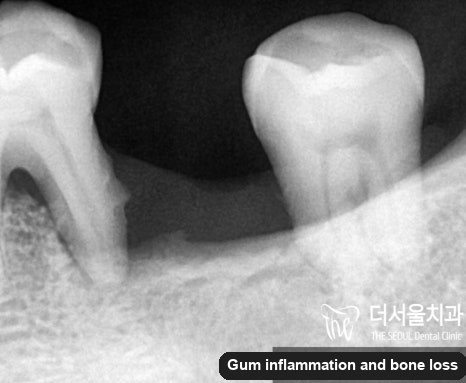
An implant is anchored in bone. Where the bone has thinned or receded, there is not enough of it to hold a fixture securely, and placing one anyway produces a restoration that fails.
Bone grafting rebuilds that foundation before anything is placed into it. In this mouth the thickness and depth were insufficient in multiple places, so grafting was not optional.
There was a second finding that changed how the surgery was carried out. The cortical bone — the dense outer layer — was compromised at some sites. A drill can skid on a compromised cortical surface instead of engaging it, so those sites needed a slower, more controlled approach.
Why is the surgery planned on a computer first?
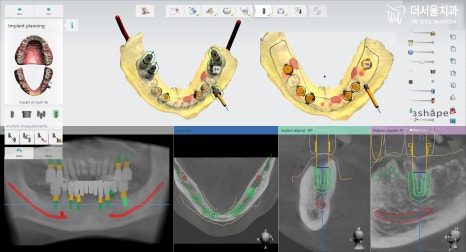
Before surgery the case was planned in simulation software, using the scan data.
What is settled at that stage: which additional procedures each site needs, the length and diameter of each fixture, and exactly where each one is placed. Working it out on screen is considerably cheaper than working it out in the mouth, and it is the step that makes a case of this size predictable rather than exploratory.
What order does the treatment run in?
The teeth marked for removal were extracted first, with the infected sites cleaned and dressed. Then a pause, deliberately — the tissue needs to settle before grafting into it.
Once healing had progressed, bone grafting was carried out where the bone was deficient.
Implants were then placed in the upper jaw first. The lower jaw followed once it in turn had recovered sufficiently, and the fixtures were left to integrate.
That waiting period is not padding in the schedule. Osseointegration — bone fusing to the surface of the fixture — is what allows an implant to take chewing loads. Loading a fixture before it has integrated is how implants are lost.
Finishing
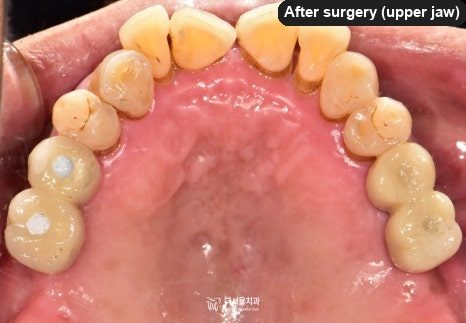
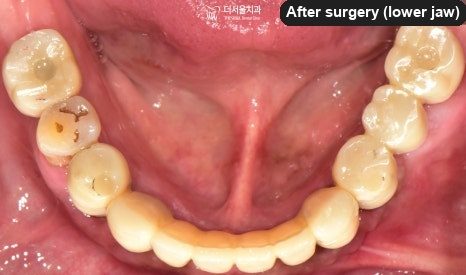
Once integration was confirmed, the abutments were connected and the crowns fitted and adjusted.
The lower arch, which had been the most depleted at the start, was restored to an even, aligned set of teeth.
Timeline
From 22 January 2021 to 27 November 2021 — a little over ten months.
Most of that is healing time rather than chair time: after extractions, after grafting, and after fixture placement. It is why full-mouth rehabilitation cannot be compressed into a single trip, and why an honest schedule is worth more at the planning stage than an optimistic one.
How many trips does this take from abroad?
A case of this size means several visits spread across months. The realistic pattern is a first trip for examination, extractions and grafting, then a return for placement, and a further return for the final crowns — with the exact intervals depending on how your own healing goes.
Send a recent panoramic X-ray if you have one and we will tell you what the sequence would look like in your case, including where the waiting periods fall. Our published fees for non-covered treatment are on the pricing page.
Frequently asked questions
Can I have implants if I have lost a lot of bone?
Frequently yes, but not immediately. The bone has to be rebuilt by grafting first and allowed to heal before fixtures can be placed. How much grafting is needed is determined by CT rather than by examination alone.
How long does full-mouth treatment take?
This case ran a little over ten months. The variables are how many extractions are needed, how much grafting, and how your own bone heals — which is why a timeline given before the imaging is not worth much.
Why is there so much waiting between stages?
Because three separate healing processes have to complete: soft tissue after extraction, the graft consolidating into bone, and the implant integrating with that bone. Each has its own timeframe and none of them can be hurried without raising the risk of failure.
Are the upper and lower jaws treated at the same time?
Not necessarily. Here the upper jaw was implanted first and the lower followed once it had healed sufficiently. Staging like this keeps a functional side available and keeps each surgical site manageable.
What does osseointegration mean?
It is bone fusing directly to the surface of the implant fixture. Until that has happened the fixture cannot carry chewing forces, which is why crowns are not fitted at placement.
Read more: bone grafting and sinus lift · full-arch restoration · dental implants · pricing