
If you need orthodontic treatment and an implant, the two cannot simply be booked one after the other in any order. Orthodontics works by moving teeth through bone. An implant works by not moving at all. That single opposition is what decides the sequence.
Why does the order matter at all?
Orthodontic treatment moves teeth gradually through the jawbone, and the bone and surrounding tissue remodel around them as they go. The whole arrangement is in motion for the duration of treatment.
A dental implant is the opposite. The fixture is placed in the jawbone and then fuses to it — osseointegration — and that rigid union is the point of the thing. It does not migrate, and it cannot be moved by an orthodontic appliance.
Place a fixture first and then start moving the teeth around it, and the implant becomes a fixed obstacle in an arch that is trying to reorganise. For that reason the default sequence is: align the teeth first, then place the implant into the finished arrangement.
When is the default sequence wrong?
The default is not a rule. It applies when the planned tooth movement involves the space where the implant is going, or would be obstructed by a fixture sitting in it.
Where the planned movement is elsewhere in the mouth, and the implant site is not needed as space to move teeth into, the fixture can be placed first. That is what happened here, and it saved the patient several months — the implant was fusing to the bone during the same period the aligners were being planned and worn.
Deciding this requires knowing in advance where every tooth is going to end up. That is what the digital treatment plan is for.
The case: crowding, a crossbite, and a missing upper molar
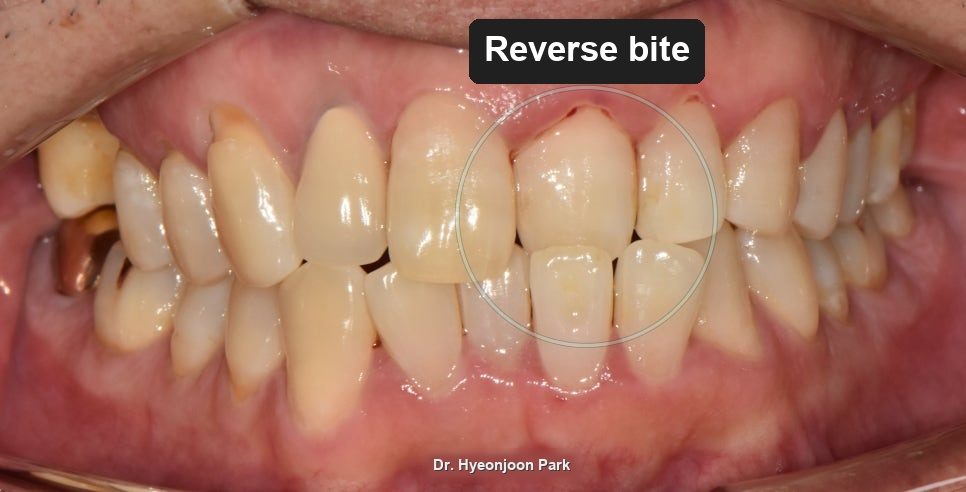
The patient attended in May 2024. Examination found teeth overlapping each other — crowding — along with a section at the front where the teeth met in reverse, and an uneven gum line following the irregular tooth positions.
The back teeth, by contrast, met correctly. This is a Class I malocclusion: the jaw relationship is normal and the problem is in how the teeth are arranged within it.
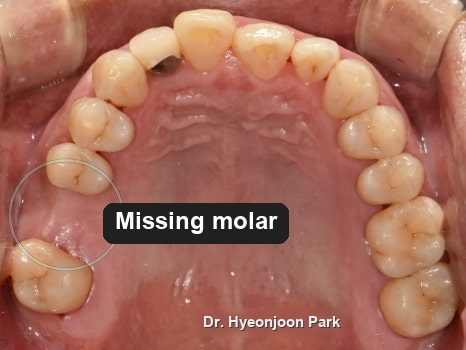
Separately, an upper molar was missing.
What happens to the teeth around a gap?
A missing back tooth is easy to dismiss because chewing continues on the other side. The teeth themselves do not agree.
Teeth are not fixed in place permanently; they shift in response to the forces on them. Where a tooth is missing, the neighbouring teeth tend to tip into the space, and the opposing tooth in the other jaw tends to drift down into it — over-eruption. Over time the bite that was working starts to come apart, and the arch loses its balance.
That is why the gap was treated as part of the orthodontic problem rather than as a separate item to deal with later.
Why do front teeth that meet too early wear down?
Where the front teeth are arranged so that some contact before the others, those teeth take a disproportionate share of the load. Teeth make contact hundreds of times a day, and the ones meeting early absorb more of it than they were shaped to.
The visible result is accelerated wear at those points. Where the loading continues, the same teeth are the ones that go on to crack or fracture. In this patient the upper front teeth already showed wear before treatment began.
How the implant was planned
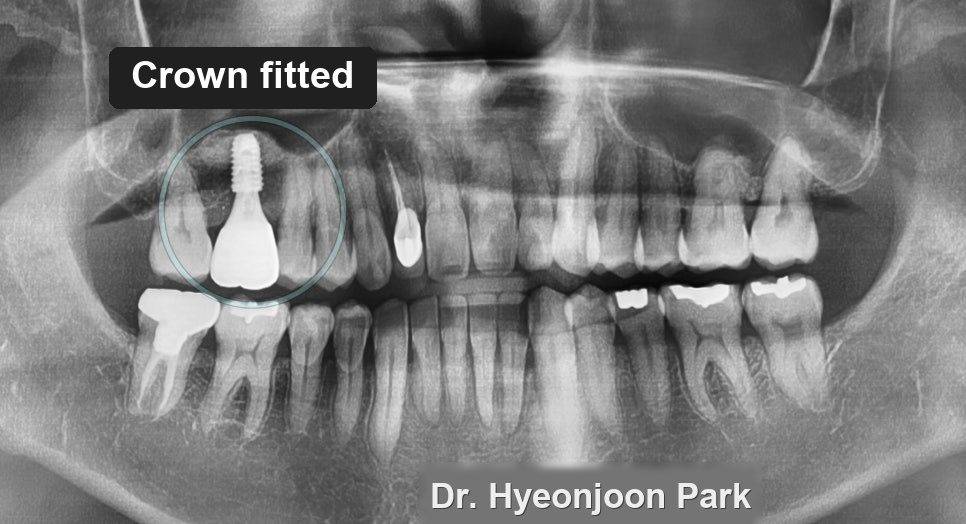
A CT scan was taken before placement, because the upper back region sits close to the maxillary sinus — an air-filled space above the upper molars, separated from the jaw by a thin membrane.
Where the bone height below the sinus is insufficient, drilling into it risks tearing that membrane. The scan established the available height and the position of the sinus relative to the planned site.
Here the height was insufficient, so a sinus lift with bone graft was carried out: the membrane was raised and graft material placed beneath it to create enough bone for the fixture. The fixture was then placed in May 2024 and left to fuse.
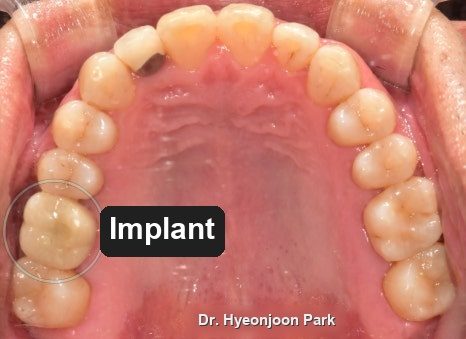
The crown was fitted in November 2024, after fusion was confirmed.

Why clear aligners were used
The orthodontic phase used clear aligners rather than fixed brackets and wires. They are removable and less visible, which was the patient’s preference.
The more relevant advantage in a case like this is planning. The aligner system produces a three-dimensional plan showing where each tooth starts, where it finishes, and the path between — which is exactly the information needed to answer the sequencing question before any surgery is done.
What changed, and what was left over
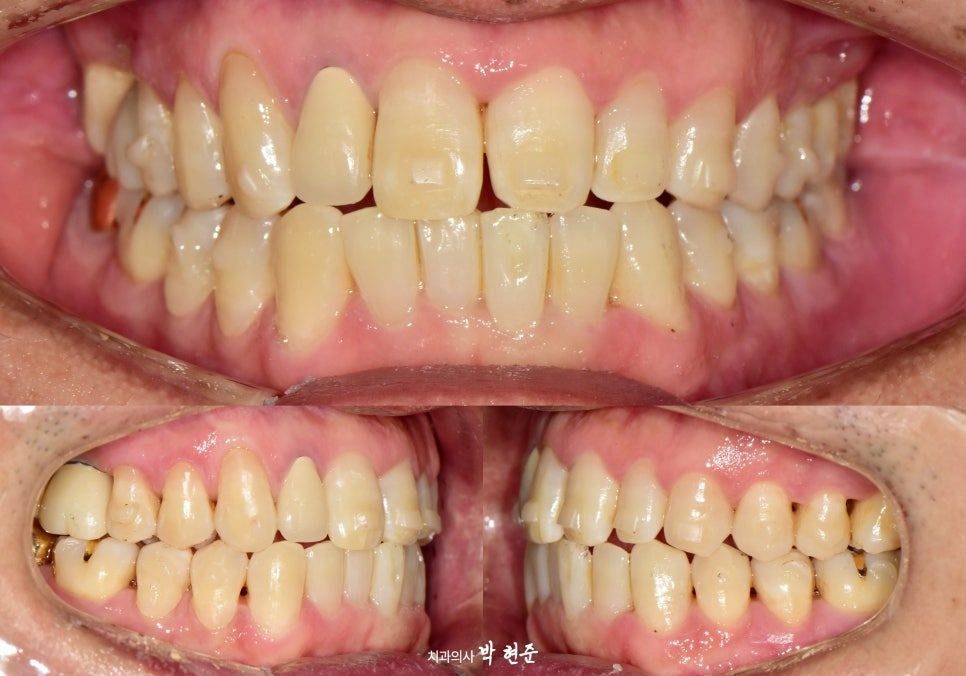
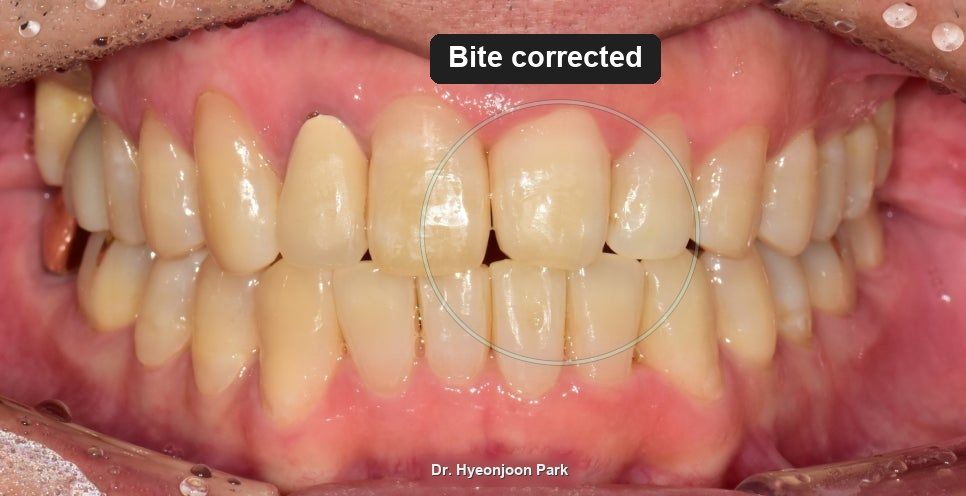
By April 2025 the front teeth that had been meeting in reverse were closing correctly, the crowding had resolved, and the arch formed an even curve. The implant sat in its planned position within the finished arch.
The wear on the upper front teeth from before treatment remained. Orthodontics repositions teeth; it does not restore tooth structure that has already been lost. Restoring the shape of those teeth is a separate decision, discussed with the patient rather than assumed.
Treatment ran from May 2024 to April 2025, with the orthodontic phase taking approximately six months of that.
Frequently asked questions
Should braces or an implant come first?
Usually orthodontics first, because an implant cannot be moved once it has fused to the bone. The exception is when the planned tooth movement does not involve the implant site, in which case placing the implant first can run the two phases in parallel.
Can an implant be moved with braces if it is in the wrong place?
No. A fused implant does not respond to orthodontic force. This is precisely why the sequence has to be decided before the fixture is placed rather than after.
Does a missing back tooth really need treating if I can still chew?
The concern is not the chewing you can do now. It is that the neighbouring and opposing teeth move into the gap over time, which changes the bite and makes later treatment more involved.
What is a sinus lift and why was it needed?
The upper back jaw often has limited bone height because the maxillary sinus sits above it. A sinus lift raises the sinus membrane and places graft material beneath it, creating the bone height an implant needs.
How long does treating both together take?
This case ran about eleven months in total. The length depends on how far the teeth have to move and whether the implant needed grafting before placement, both of which vary considerably between patients.