
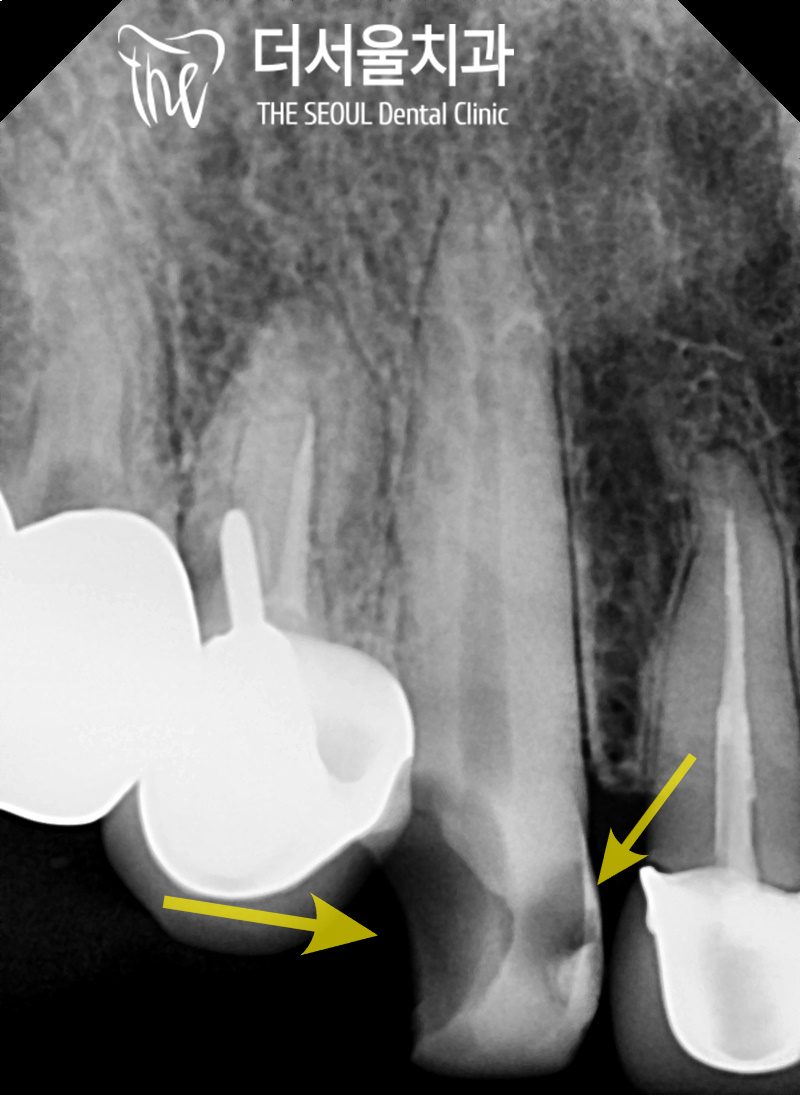
Root canal treatment is what stands between a badly damaged tooth and extraction. This case is a canine that had lost close to half its crown — close enough to the line that saving it was a genuine decision rather than an obvious one.
When is root canal treatment needed?
Root canal treatment is carried out when the pulp inside a tooth is damaged or infected. It exists to keep a natural tooth in place rather than extract it, and it comes up in four situations:
- Decay severe enough that inflammation has spread into the canal
- A tooth cracked or broken by impact or accident
- Severe wear or a deep notch at the gum line
- A previously treated tooth where the problem has recurred
Why did the tooth break?
The patient came in urgently with damage to the upper right canine.
Teeth break for two broad reasons: external impact, or decay that has eaten away enough structure that the remaining surface gives way. This was the second. Severe decay had eroded the tooth surface, it had been left untreated, and the weakened structure eventually broke.
The X-ray confirmed decay across most of the crown. Nearly half the tooth had fractured away.
The decision: save it or replace it
With damage this extensive, the realistic options were root canal treatment and a crown, or extraction and an implant.
What made the decision difficult was uncertainty rather than the visible damage: with decay that widespread, it was hard to establish in advance how far the internal infection had progressed. That is a genuine limitation, not a formality — some of what determines whether a tooth is savable is only visible once treatment has begun.
The decision was to attempt to save the natural tooth. Cases at this margin are discussed between the dentists here, including colleagues certified in conservative dentistry — the Korean specialty covering root canal treatment and restoring damaged teeth.
The diagnosis and plan were explained to the patient and treatment proceeded with their agreement.
Managing comfort
The patient was anxious about discomfort before starting, which is common for this treatment.
Several things reduce discomfort during and after root canal treatment: local anaesthetic technique, working under rubber dam isolation so the field is stable, and conscious sedation where a patient wants it. How much discomfort any individual experiences still varies with the tooth, the state of the infection and their own sensitivity, so none of this is a promise — but there is more available than most people expect, and it is worth asking about rather than enduring.
How is a canine root canal different from a molar?
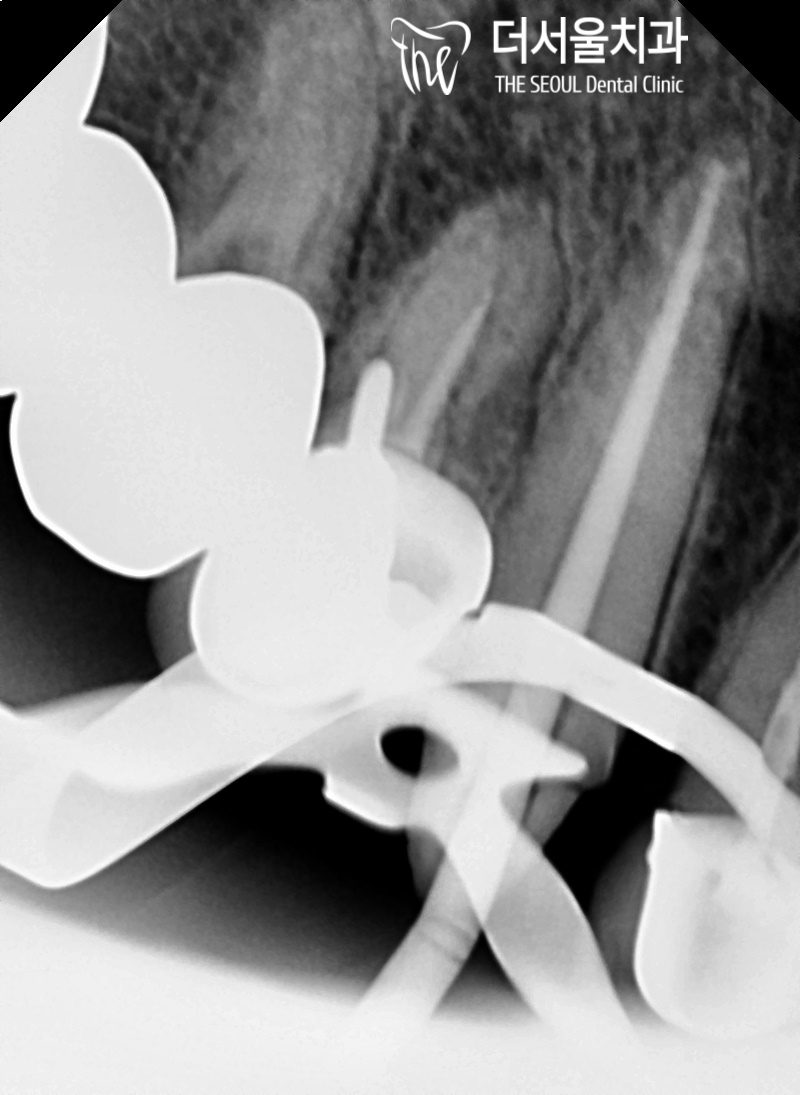
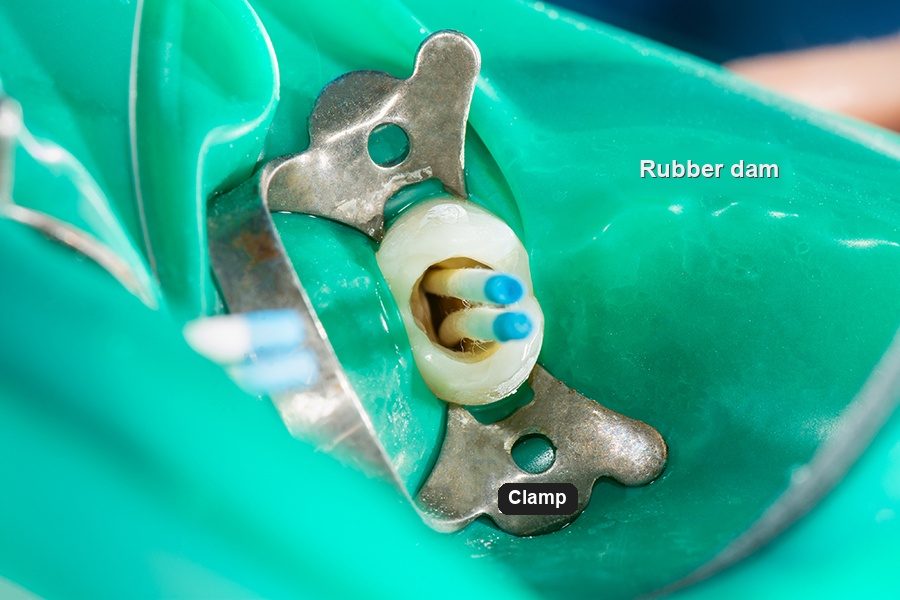
Before starting, a clamp and rubber dam were placed to create a dry, isolated field. This keeps saliva — and the bacteria in it — out of the tooth being treated. Contamination during treatment is a leading cause of failure afterwards.
A canine has fewer roots than a molar and a less complex internal shape, which makes the mechanics simpler. But it has the longest root of any tooth in the mouth, so cleaning it to full length takes as much care as a molar does.
It is also highly visible, which puts real weight on getting the restoration’s shape and shade right. Different teeth need different things, and the approach follows the tooth.
Why is the cleaning stage repeated?
Spiral-shaped files were used to remove the infected tissue and clean the interior. The clean-and-disinfect cycle was repeated several times, so that no infected or damaged tissue remained.
This stage is repetitive and it is where the outcome is largely decided. Shortening it is the most common reason root canal treatment fails later.
The restoration
Once treatment was complete, a crown was made to resemble the natural tooth and fitted. On the completed result the restored canine is difficult to pick out from the teeth around it, which for a front tooth is the standard to aim at.
How long did the treatment take?
Treatment ran from mid-March to the start of May 2022 — about six weeks across several appointments, most of them for the cleaning and disinfection stage.
The point worth taking away
This tooth did not break because of an accident. It broke because decay was left long enough to hollow out the structure holding it together. At an earlier stage it would have been a filling; by the time it presented it was a marginal decision between saving and replacing.
Prevention here is not complicated: cleaning, regular check-ups, and scaling. It is just easy to postpone until something breaks.
Frequently asked questions
Can a tooth that has broken in half be saved?
Sometimes. What matters is how much sound structure remains below the break, whether the fracture extends into the root, and how far infection has spread. An X-ray narrows it down, but some of it is only established once treatment starts.
Is root canal treatment painful?
Local anaesthetic is used throughout, and rubber dam isolation and conscious sedation are available. How much discomfort you feel depends on the tooth, the infection and your own sensitivity, so we will not promise you a particular experience — but tell us you are anxious and there is more we can do than you might expect.
What is a rubber dam and why is it used?
A thin sheet that isolates the tooth being treated from the rest of the mouth. It keeps saliva and its bacteria out of the opened tooth. Contamination during treatment is a common reason root canal work fails afterwards, so the isolation is doing real work.
Is it better to save a tooth or replace it with an implant?
Where a natural tooth can be saved with a reasonable outlook, that is generally preferred — it keeps the root and the bone around it. Where too little sound structure remains, an implant is the more durable answer. The honest position is that some cases sit close to the line, and this was one of them.
How many visits does root canal treatment take?
Usually three to four, plus further appointments for the crown. The variation is in how many canals the tooth has and how the infection responds to cleaning.
Read more: root canal treatment · cavities and fillings · crowns and veneers