
An underbite in a seven-year-old and an underbite in a thirty-year-old are the same bite and a different problem. In the child the jaws are still growing, and growth can be influenced. In the adult it has finished, and it cannot. Nearly everything about the treatment options follows from that one difference.
What happens between ages six and twelve?
Between roughly six and twelve, baby teeth are being replaced by permanent ones. During this mixed dentition stage both are present at once and the arrangement is unstable by nature.
Teeth can end up out of position for several reasons: inherited jaw proportions, oral habits, or baby teeth being lost earlier or later than they should be. Some of this settles by itself. Some of it does not.
What makes this period worth watching is not the crooked teeth. It is that the jaws are growing at the same time, and the way they grow is not fixed.
The case: a reverse bite found at examination
A child attended in October 2023. Looking at the teeth alone, little seemed wrong beyond some minor irregularity.
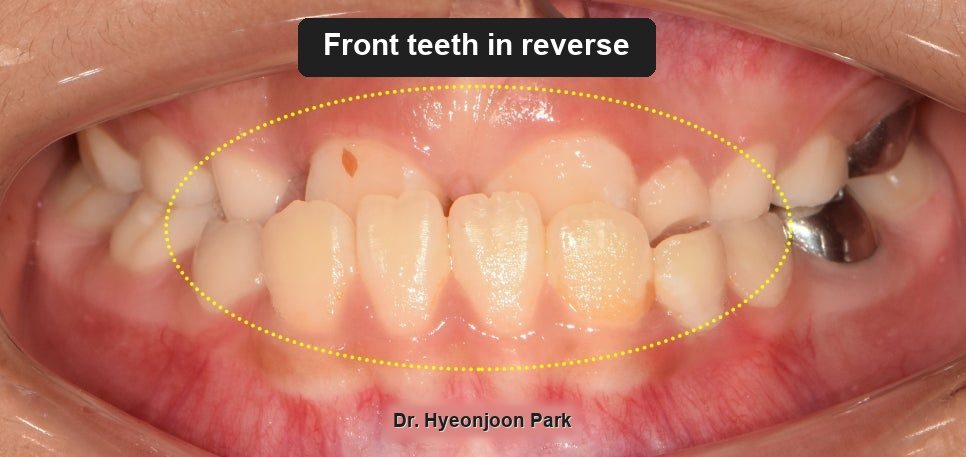
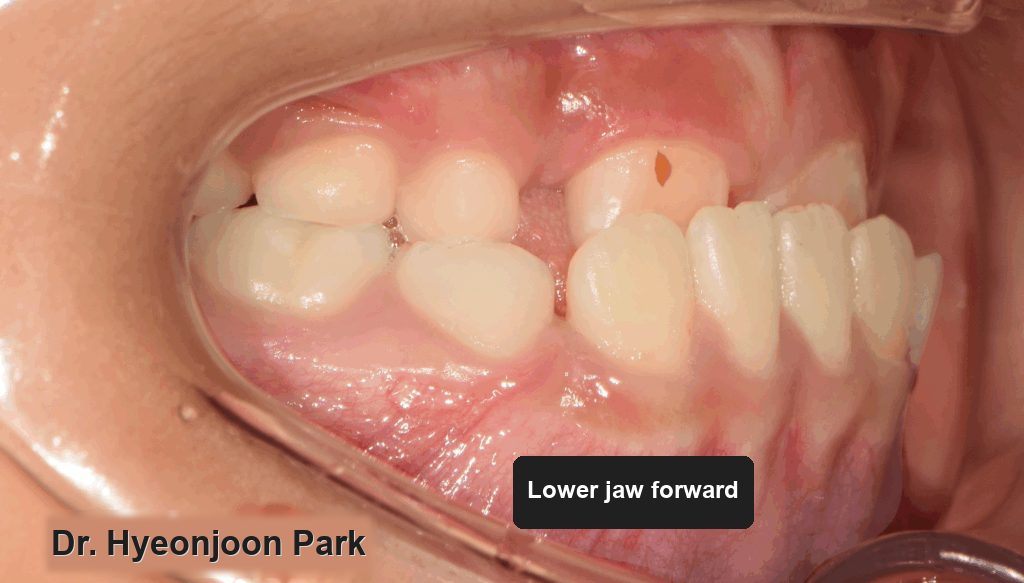
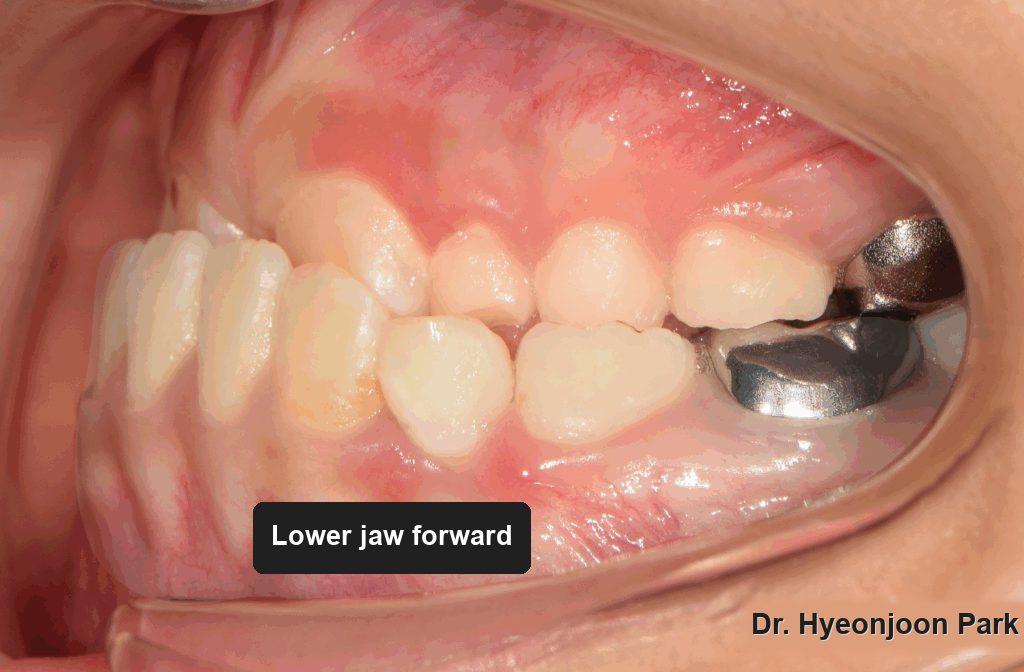
The problem appeared when the teeth were brought together. The lower jaw sat forward of the upper, and the front teeth met in reverse — the lower ones closing in front of the uppers instead of behind them.
This is a Class III malocclusion. Class III describes the relationship between the jaws, not the alignment of the teeth, which is why an examination that only looks at how straight the teeth are can miss it entirely.
Can a reverse bite cause jaw pain?
Where the upper and lower jaws grow at different rates, the mismatch does not stay still. The lower jaw continues to be positioned forward, and the joint and the teeth both take the consequences.
At the temporomandibular joint the early signs are stiffness and clicking. Where it progresses, pain and headaches follow, and in severe cases opening the mouth becomes difficult.
At the teeth, the effect is uneven loading. Specific teeth take more force than they are shaped for, which accelerates wear at those points and, where it continues, leads to fracture.
What can be done while the jaw is still growing?
This is the part that makes timing decisive.
While the jaws are still developing, orthodontic treatment can influence the direction of that growth as well as the positions of the teeth. Once growth is complete, that option closes: treatment can then rearrange teeth within the jaws, but it cannot alter where the jaws sit relative to each other. Correcting a skeletal discrepancy in a finished adult requires jaw surgery.
So early treatment for a Class III bite is not the same procedure done sooner. It is a different intervention, available only for as long as the jaw is still growing.
What it aims at is straightforward to state and worth stating precisely: to guide growth so that the discrepancy does not widen, and to reduce the likelihood that surgery is the only remaining option later. It cannot guarantee that outcome. Growth continues after treatment ends and is not fully predictable, which is why children treated in this window stay under review rather than being discharged.
How the treatment was planned
Clear aligners designed for children in the mixed dentition — Invisalign First — were used here.
Planning began with a three-dimensional simulation of the whole sequence: where each tooth sat at the start, where it was intended to finish, and the stages in between. For a child’s case this doubles as the explanation given to the parent, because it shows what is being attempted rather than describing it.
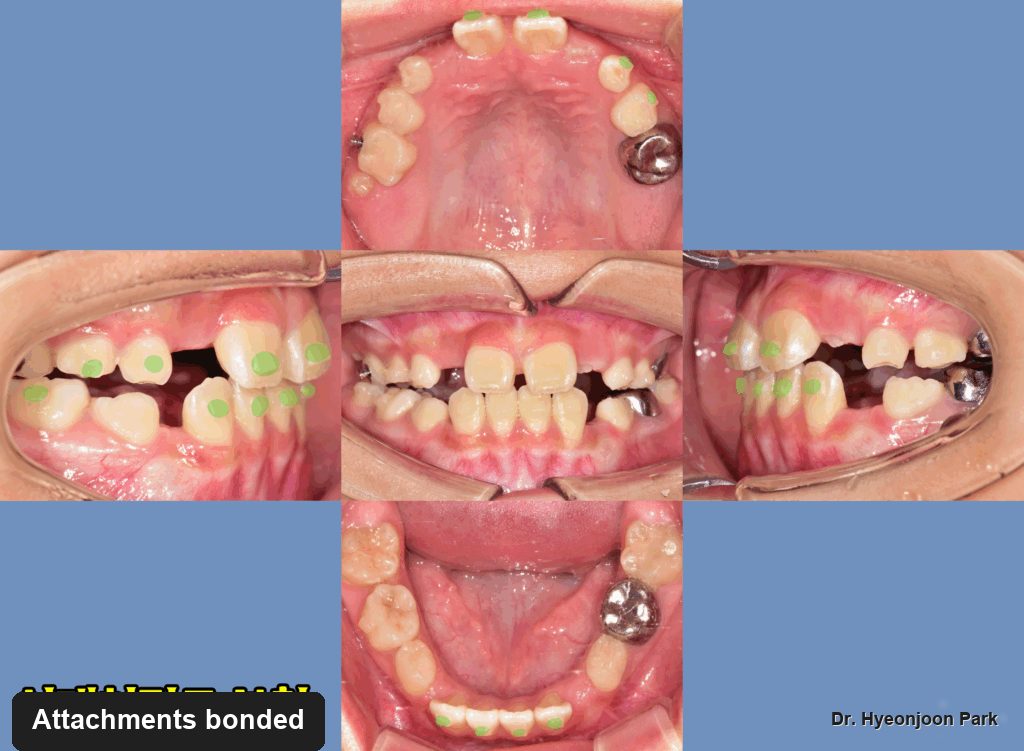
Small tooth-coloured attachments were bonded to specific teeth. Without them an aligner tends to slide over a tooth; with them it has something to push against, so the intended movement actually happens.
The plan had two components running together: moving the lower teeth back so the front teeth could meet in the correct relationship, and holding enough space in the arch for the permanent teeth still to come through.
How long did the treatment take?
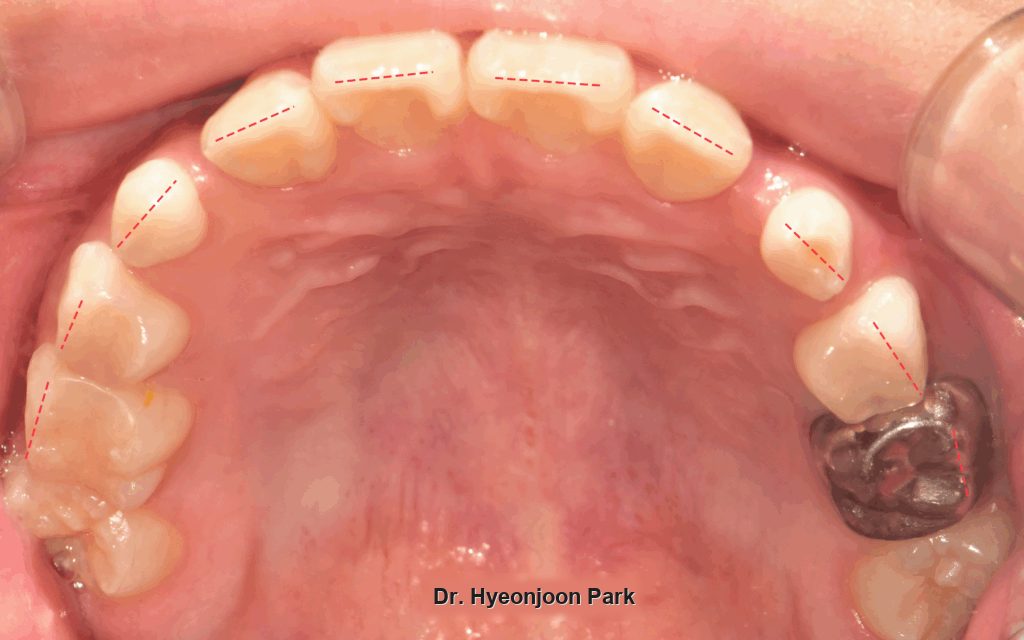
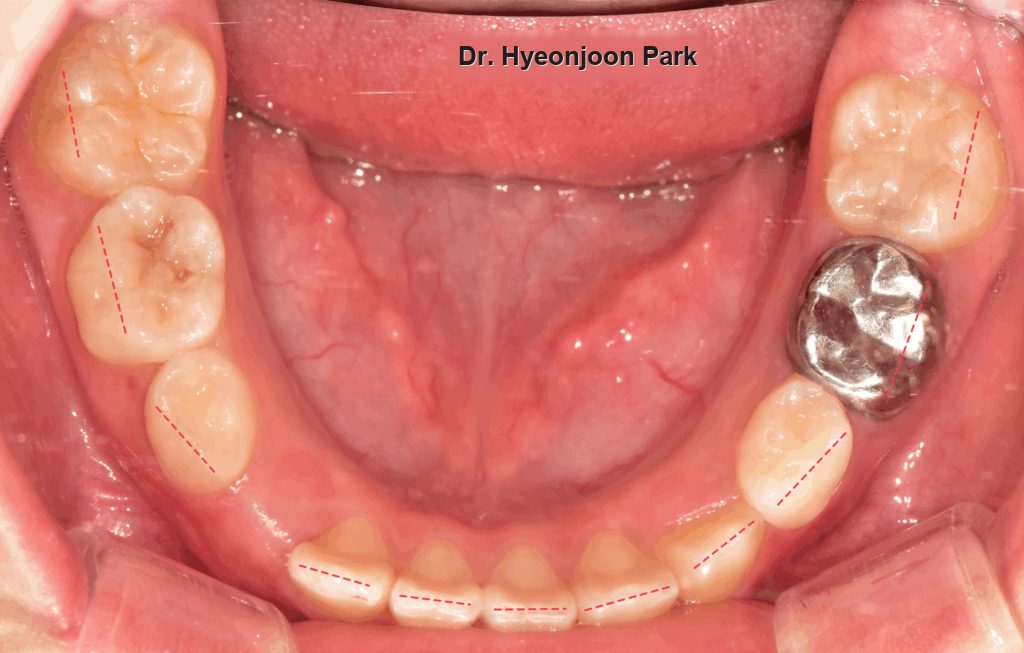
By February 2025 the front teeth that had been closing in reverse were closing correctly, with the upper teeth in front. The arch had taken an even U-shaped curve, and space had been maintained for the remaining permanent teeth.
Treatment ran from October 2023 to February 2025 — about sixteen months.
The child remains under periodic review. That is not a formality: the jaws continue to grow after treatment finishes, and the point of treating during the growth window is to keep influencing that growth in the right direction, which requires knowing what it is doing.
When should a child’s bite be checked?
The useful answer is: before you can see a problem. A reverse bite was almost invisible in this case until the teeth were brought together, and the arrangement that matters — how the jaws relate to each other — is not something a parent can assess by looking at the front teeth.
An examination during the mixed dentition years establishes whether the jaws are developing proportionately. Where they are, nothing needs doing. Where they are not, the option that exists during growth is not going to exist indefinitely.
Frequently asked questions
Can a child’s underbite be corrected without surgery?
While the jaws are still growing, treatment can guide their development and correct the bite, as in this case. That option is not available once growth is complete, which is when surgery enters the discussion.
Does early treatment mean my child will not need braces later?
Not necessarily. Early treatment addresses the jaw relationship and holds space for the permanent teeth. A second phase to align the permanent dentition is common and is planned on its own merits when the time comes.
Is my child too young for orthodontic treatment?
For a skeletal problem such as a Class III bite, the growth years are the window rather than an obstacle. For purely cosmetic crowding, waiting is often reasonable. Which of the two applies is what the examination establishes.
Are clear aligners suitable for children?
Systems designed for the mixed dentition account for teeth still erupting and for space needing to be maintained. Suitability depends on the case and on whether the child will wear them for the required hours each day.
What happens if a reverse bite is left untreated?
The jaw discrepancy tends to become more pronounced with continued growth, and the uneven loading wears specific teeth. Treating it later is still possible, but with a narrower set of options.