
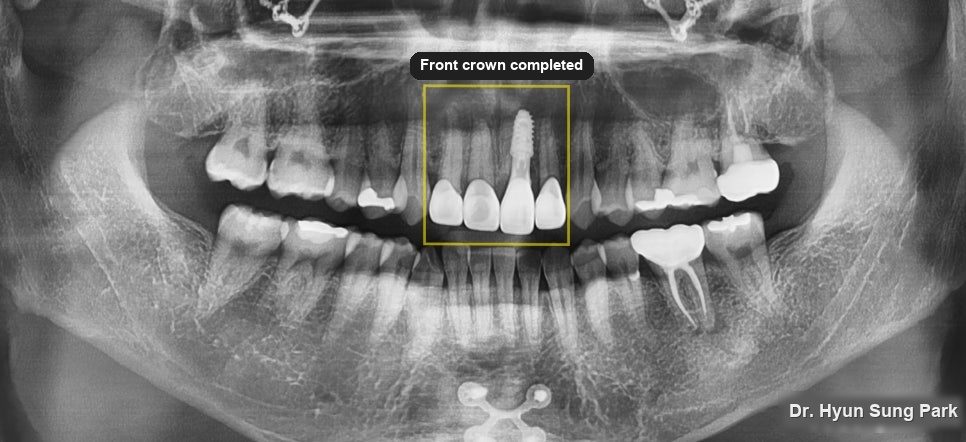
When a front tooth breaks badly, a crown is not always enough to put it back. What decides between saving and replacing is what is left below the gum — and after that, the thing that determines how long the replacement lasts is the bite.
When a front tooth fracture goes past saving
Front teeth fracture from trauma or impact, and also when a tooth weakened by earlier root canal treatment finally gives way.
Where the fracture takes the whole crown of the tooth, ordinary restorative treatment often cannot recover it. There is not enough structure left above the gum to hold anything.
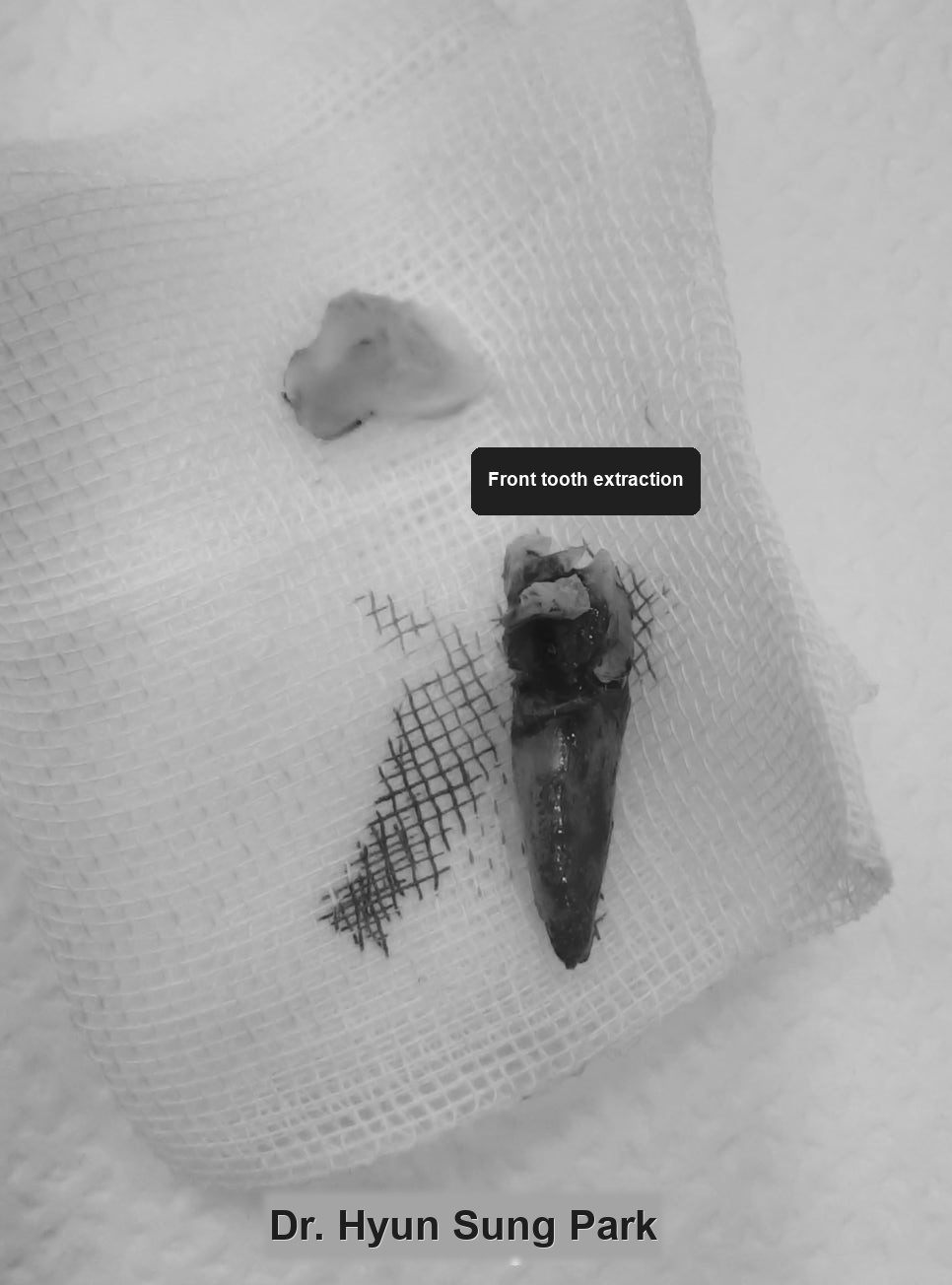
This patient had fallen heavily, and the fracture of the upper front tooth was severe. It was past the point of being preserved, and it was painful.
Why does the extraction technique matter?
An X-ray was taken to check the state of the root and the health of the surrounding bone. Those two things — not the visible damage — are what decide whether a tooth can be kept.
The finding was that tooth #21, the upper left central incisor, needed extraction.
The extraction was carried out cleanly, removing the root completely without damaging the surrounding tissue. That matters more than it sounds: a clean extraction site with intact surrounding bone gives the implant a much better foundation than one where tissue has been torn.
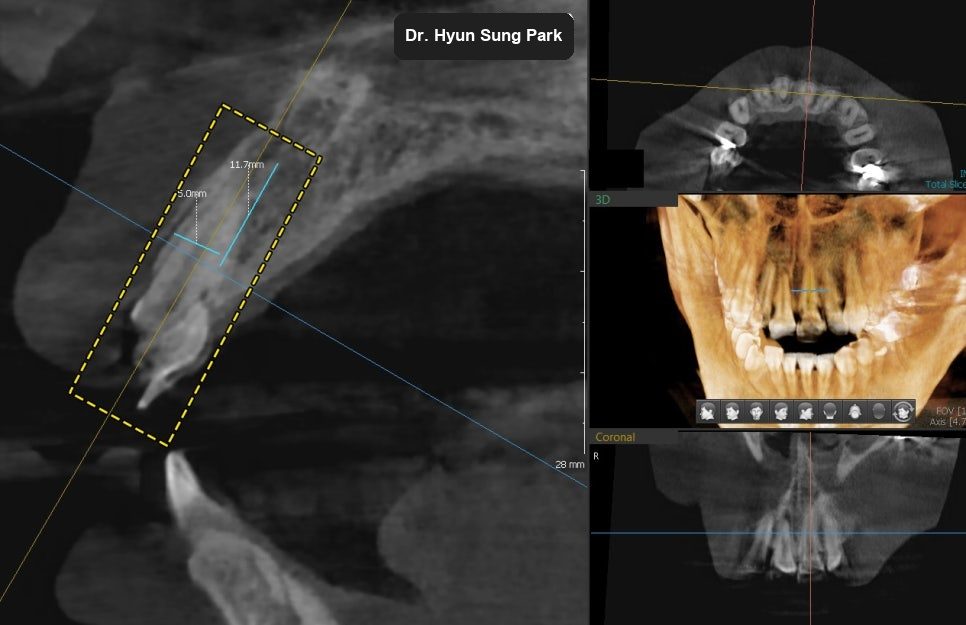
Why are front implants harder to place?
Front teeth have to satisfy both appearance and function, which makes them the most difficult place in the mouth to place an implant.
- The alveolar bone is thinner and narrower at the front than elsewhere. Place a fixture without accounting for that and it can show through the gum, or fail later.
- This area shows when you smile, so the junction between gum and artificial tooth has to look natural. There is nowhere to hide a discrepancy.
Both of those have to be settled in planning, before any surgery.
Immediate placement or waiting?
Whether an implant goes in immediately after extraction, or after a healing period, depends on two things: the condition of the bone, and whether infection is present.
Here there was no inflammatory reaction at the site, so implant surgery proceeded at that appointment.
Placement was planned digitally, and the position confirmed afterwards. A fixture positioned properly in the centre of the alveolar bone does not move and holds its stability over the long term.
Correct fixture placement is one of the main factors in how long the restoration lasts. An implant placed slightly off-axis puts the crown under loads it was not designed for, and those loads have to go somewhere.
Can the healing period be shortened?
Three to four months are allowed for osseointegration — the fixture bonding into the bone. This waiting is what the stability of the finished restoration is built on, and it cannot be shortened by booking appointments closer together.
Once integration is confirmed, the abutment is connected and the final crown made.
The crown
A front tooth crown is not made to shape alone. It has to sit in harmony with the teeth beside it so it reads as a natural tooth rather than as a replacement.
The finished crown was matched in shade to the surrounding teeth. The margin against the gum was smooth, and the crown sat in proportion with its neighbours. Function was unaffected — speech and chewing were normal.
What actually decides how long the crown lasts
The answer is bite balance.
If chewing force concentrates on one side, or on one tooth, the crown is loaded beyond what it was made for and can fracture.
So the bite was adjusted precisely, accounting for the patient’s chewing habits, the height of the restoration and the points where it contacts the opposing teeth — so that force is distributed evenly across the arch rather than concentrated.
This is the least visible part of implant treatment and one of the most consequential. A crown that looks perfect and sits 0.1 mm high is a crown under constant excess load.
Timeline
Treatment ran from mid-January to early April 2025 — about two and a half months from extraction and placement to the final crown.
Should I wait to see if the pain settles?
If a tooth has been broken or fractured by trauma, get it assessed promptly rather than waiting to see whether the pain settles. What can be done depends heavily on the state of the root and the surrounding bone, and both can deteriorate while you wait.
Frequently asked questions
Can a broken front tooth be saved with a crown?
Sometimes, if enough sound structure remains above and below the gum. Where the whole crown of the tooth has fractured away, there is usually too little left to hold a restoration, and replacement is the realistic option. An X-ray of the root and surrounding bone is what settles it.
Can an implant be placed the same day the tooth is removed?
It depends on the bone condition and on whether infection is present. Where there is no inflammation and the bone is adequate, immediate placement is often possible — as here. Where infection is present, the site is cleaned and allowed to heal first.
Will a front tooth implant be noticeable?
It should not be. The shade is matched to the neighbouring teeth and the gum margin is shaped to sit naturally. The front of the mouth is the least forgiving site, which is exactly why the fixture position is planned digitally rather than judged during surgery.
Why does an implant crown fracture?
Usually because of bite imbalance — force concentrating on that crown rather than spread across the arch. It is why the bite adjustment at the end of treatment matters as much as the surgery, and why grinding habits are worth mentioning.
How long does a front tooth implant take?
Around two to three months in a straightforward case like this one, most of it waiting for the fixture to bond into bone. If bone grafting is needed first, expect longer.
Read more: digital guided implants · emergency dental care · crowns and veneers