
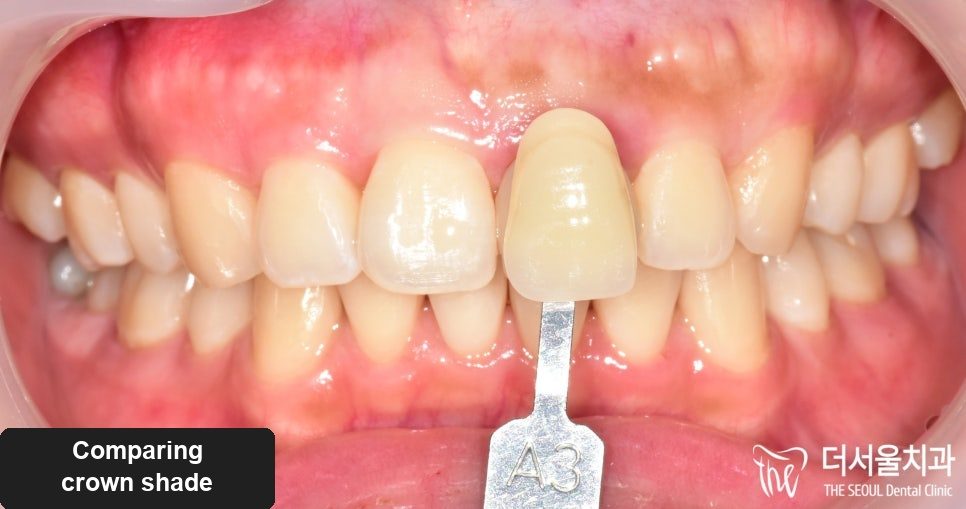
A tooth that is getting darker on its own is not stained. Staining comes from outside and affects the teeth that meet the coffee or the wine. A single tooth changing colour while its neighbours stay the same is reporting something happening inside it.
What does the colour actually indicate?
Inside every tooth is the pulp — the nerve and blood supply. When that tissue dies, the tooth loses its blood supply and the colour changes from the inside out. This is why the change is gradual and why it affects one tooth rather than several.
Two patterns are worth distinguishing:
- Progressively darker, greyish or brownish — usually a dead or dying pulp.
- Black — usually decay, which is a different problem with a different treatment.
Neither is a cosmetic issue that can be polished away, and neither reverses on its own.
What causes a pulp to die in a tooth that was treated years ago?
Three situations account for most of it: a crack in the tooth, a fracture, or a filling placed a long time ago with slow changes underneath it since.
What these have in common is that the pulp has been under low-grade insult for a long period rather than injured suddenly. That is also why there is often no pain worth reporting. The tooth is changing colour precisely because the nerve inside it is no longer in a condition to complain.
Can an X-ray show whether the nerve is dead?
The patient attended after noticing two things about an upper front tooth: it had chipped, and it was steadily becoming darker. The tooth had been filled for decay some years earlier.
The colour was dark but not black, which pointed to a dying pulp rather than active decay as the cause.
A panoramic radiograph showed the damaged area. What it did not show was the state of the pulp — a radiograph images hard tissue, and the condition of the nerve is inferred from the tooth’s appearance, its history and its response to testing, not read off the film. This is worth knowing if you have been told your X-ray “looked fine”.
What happens if a darkening tooth is left?
The tooth was treated before necrosis progressed further. That distinction is the practical reason not to wait and see with a darkening tooth.
Once the pulp dies, the process does not stop at the tooth. Bacteria occupy the empty canal space and the infection extends through the root tip into the surrounding bone. At that stage the treatment is longer, and the odds of keeping the tooth are lower.
There is a replacement for a front tooth that cannot be kept — an implant works well in this position. The reason to prefer saving the natural tooth is not sentiment. A natural root sits in bone that is maintained by the root being there, and no restoration reproduces that relationship. Where the tooth is still restorable, restoring it is the option that keeps more of your own structure.
What does treating a dark front tooth involve?
1. Root canal treatment
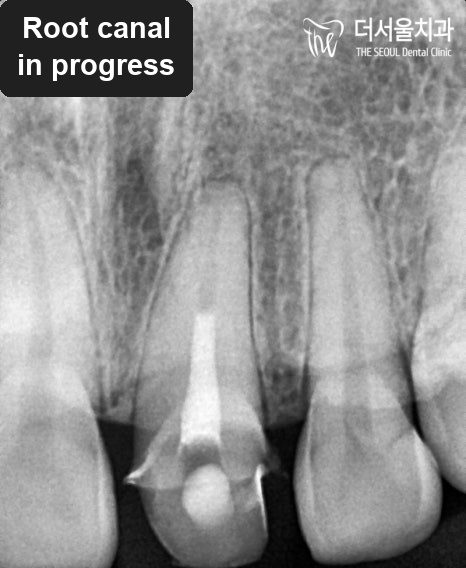
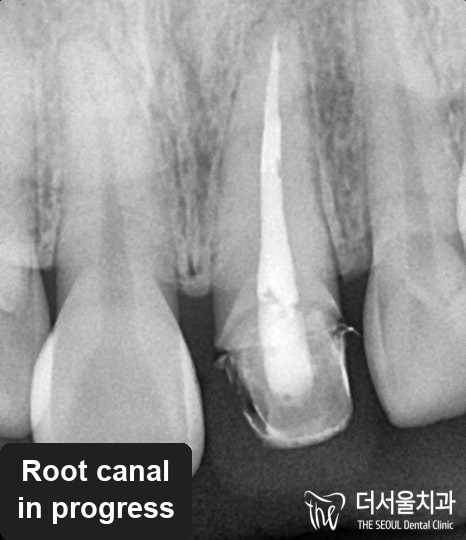
The dead pulp tissue was removed from inside the tooth and the emptied canal was cleaned and sealed with a filling material. This addresses the source: with the necrotic tissue gone and the space filled, there is nothing left inside for bacteria to occupy.
2. A post
A post was placed inside the treated root before the crown was made.
The reason is structural. A tooth that has had a root canal has lost internal tissue, and a front tooth that has also chipped has lost material from the outside. A post is anchored in the root canal and gives the crown a solid foundation to be built on, rather than the crown relying on what remains of a weakened tooth.
3. Preparation and the crown
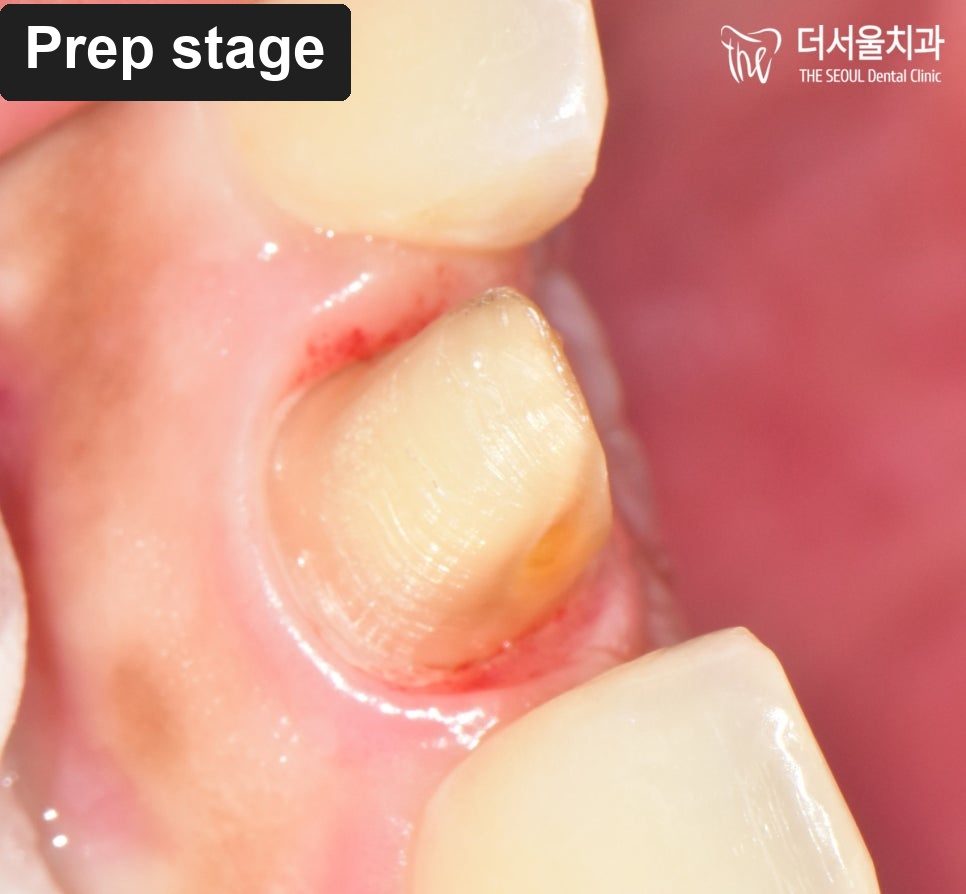
The tooth was shaped — preparation — so the crown would seat correctly, an impression was taken, and the crown was made to fit.
4. Matching the shade
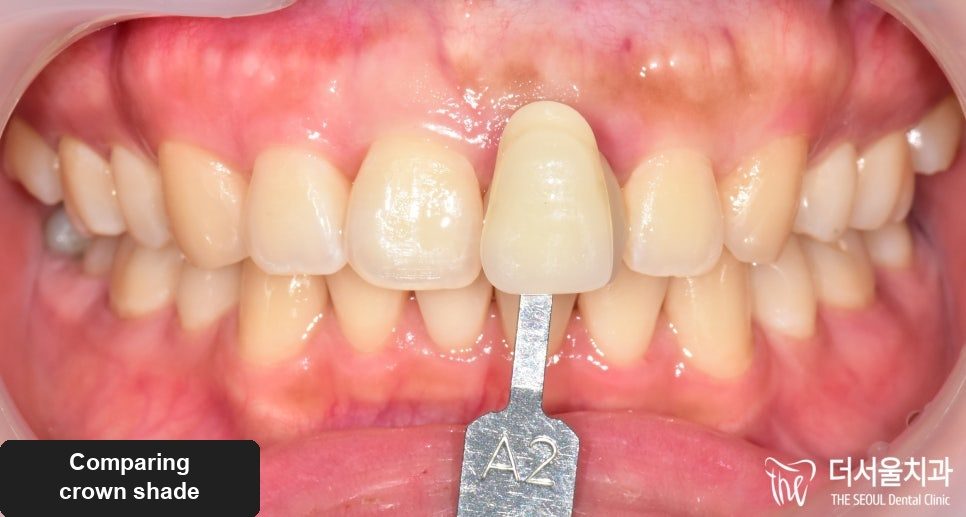
For a front tooth the shade is part of the treatment, not an afterthought. Shade tabs were held against the neighbouring teeth to compare: A2 and A3 were the candidates, and A2 matched the adjacent teeth more closely. The crown was made in A2.
How long did the treatment take?
The discolouration and the chipped edge were both resolved by the crown, and the shade matched the teeth on either side.
Treatment ran from January to February 2022 — about five weeks, over several visits.
What to do if a tooth of yours is darkening
Note whether it is one tooth or several, and whether the shade is grey-brown or black. Then have it examined rather than watched. The tooth is not going to lighten by itself, and the interval in which it can be treated straightforwardly is the interval before the infection reaches the bone.
Frequently asked questions
Why is only one of my teeth changing colour?
Because the cause is inside that tooth. External staining from food and drink affects the teeth exposed to it, not a single one. A lone tooth darkening usually means its pulp has died.
Will whitening fix a dark tooth?
No. Whitening acts on the outer tooth surface. Where the discolouration comes from a dead pulp inside, the cause is internal and the treatment addresses the pulp, not the surface.
It does not hurt, so is it urgent?
Absence of pain is not reassurance here — the nerve that would produce the pain is the tissue that has died. What is time-sensitive is treating it before infection extends into the surrounding bone.
Do I always need a crown after a root canal on a front tooth?
Not always. It depends on how much tooth structure is left. Where the tooth has also chipped or was previously filled, as here, a crown protects what remains. A tooth with most of its structure intact may not need one.
Will the crown match my other teeth?
Shade is selected by comparison against your adjacent teeth before the crown is made. In this case A2 was chosen over A3 for that reason.