
Between a conventional denture that moves and a full arch of implants that costs a great deal, there is a third option that most people have never had explained to them.
What do dentures do to the jaw over time?
Dentures come in two forms: partial, where some natural teeth remain, and full, for a jaw with none.
Both have the same long-term consequence. When teeth are lost, the gum and the alveolar bone beneath resorb, and wearing a denture does not stop that. Over years the ridge flattens.
That matters beyond comfort. It affects the remaining natural teeth, and it can reach the point where implants later become difficult — needing substantial grafting, or in some cases no longer being viable at all.
Why a denture gets looser the longer you wear it
A full denture holds in place by suction: maximum contact with the gum creates negative pressure.
As the ridge resorbs, the fit degrades and the suction weakens. The standard response is relining — adding material to restore the fit. That works, and it adds weight. On an upper denture, added weight works with gravity, so it drops more readily, which prompts another reline. The cycle repeats and each turn of it makes the next one more likely.
Patients often end up unable to manage foods as unchallenging as bread.
The mouth in this case
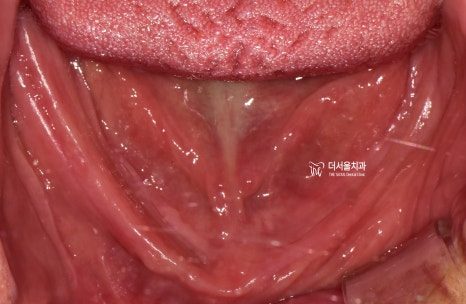
The photographs showed a fully edentulous jaw where the ridge was not the rounded shape it should be but a series of sharp peaks — the bone reduced in both width and height.
This patient had begun losing teeth in their thirties and had worn dentures for roughly forty years. They knew the drawbacks of dentures in detail, having lived through the whole cycle described above.
What are the options for a jaw with no teeth?
For a fully edentulous jaw the choice is a full arch of implants, or an implant overdenture.
Full-arch implants perform best. Because each fixture integrates with bone, chewing force reaches roughly 70–80% of natural teeth. The obstacle is cost, and for most people it is a real one.
An overdenture uses a small number of implants — typically two to four per arch, and for patients aged 65 and over, two of those may fall under national insurance cover — and clips a removable denture onto them.
The cost difference between the two is substantial: an overdenture is a fraction of a full arch, not a marginal saving. We are not quoting figures here, because they depend on how many fixtures are needed and what additional procedures the site requires; our published fees are on the pricing page.
There is no universally correct answer. The point worth taking is that “full-arch implants are unaffordable” does not mean the only remaining option is a conventional denture.
Why is a toothless jaw harder to treat?
With no teeth left, two references that are normally simply present have to be reconstructed.
The midline
You cannot just take the centre of the panoramic image. That may look symmetrical and still leave the mouth functioning poorly. The midline is established instead from anatomical landmarks — the incisive papilla and the lingual frenum among them.
Vertical dimension
Vertical dimension is the distance between nose and chin when the back teeth are in contact — in effect, the position at which the jaw joint sits comfortably.
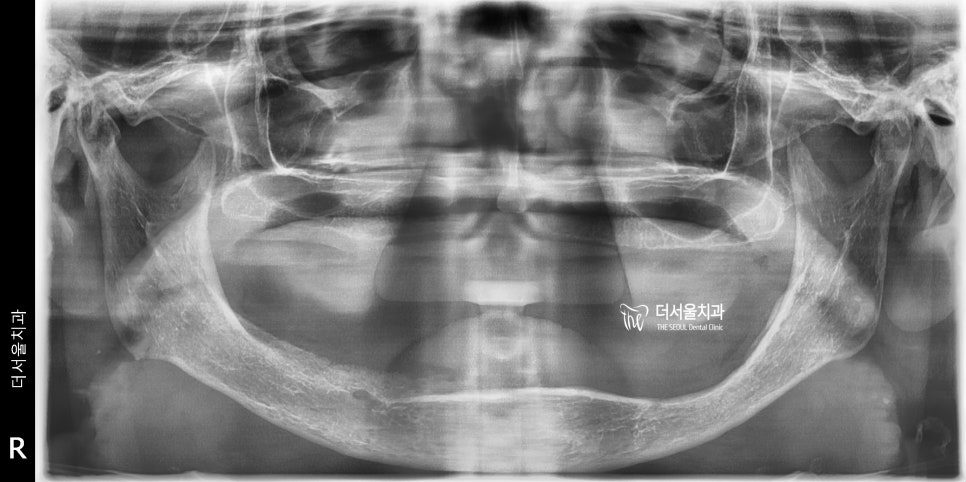
Without back teeth, that distance collapses. On this patient’s imaging the lower jaw had moved forward as a result, changing the facial profile.
Getting it wrong in either direction causes problems. Too high, and the jaw aches and the lips do not close. Too low, and chewing is inefficient and the face looks collapsed.
Recording the bite
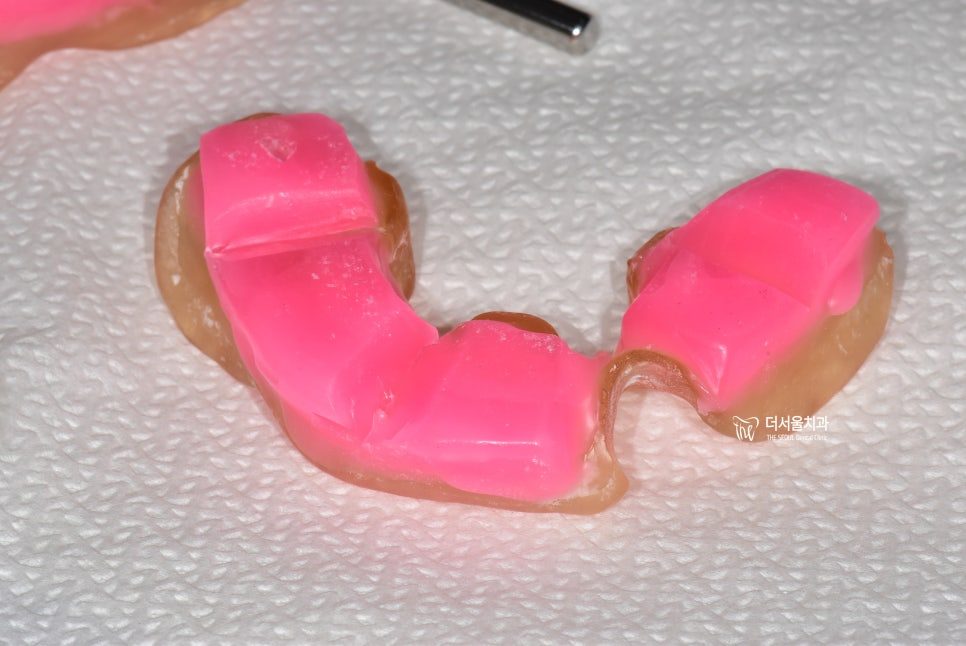
An individual tray is made and a wax rim built on it, and the bite relationship is recorded against that. It is not a single-appointment procedure — the reference points and the jaw joint position are established over several visits.
The final result was set with both centric occlusion (where the teeth meet comfortably) and centric relation (where the jaw condyle is stable) taken into account, balanced against the facial profile.
Grafting
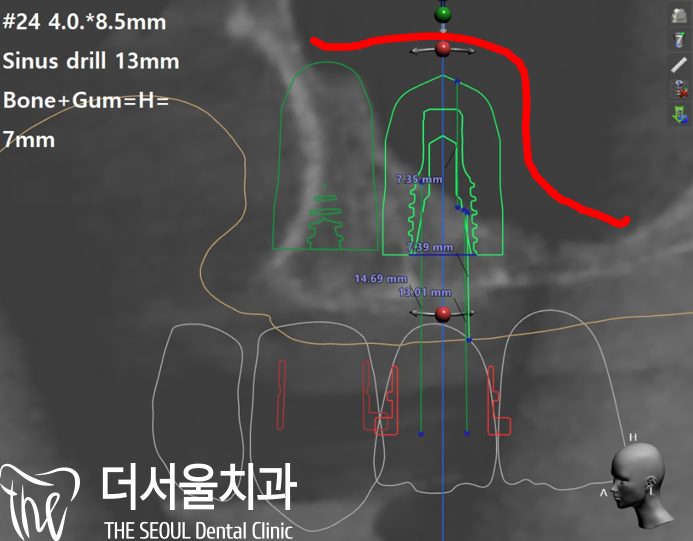
Because the ridge had resorbed so far, a sinus lift with grafting beneath it was needed in the upper jaw, and grafting in the lower where the ridge had become sharp.
How does the denture attach to the implants?
Attachments are fitted to the implants, and matching housings sit inside the denture — a male and female part that clip together.
The forms in common use are ball, magnet and locator (the “press-stud” type). Each has different retention characteristics and different maintenance, and which suits you is a conversation with the dentist treating you rather than a matter of general preference.
Treatment ran from 5 July 2020 to 2 March 2021.
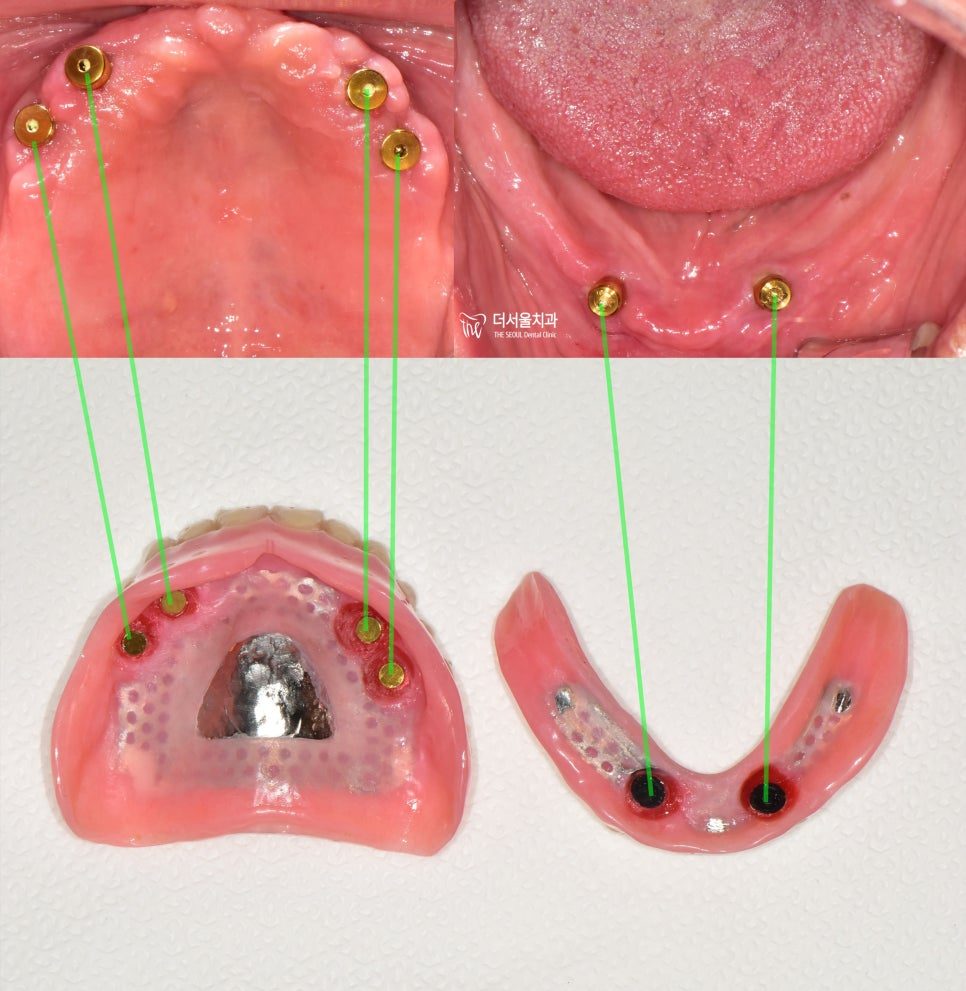
Is an overdenture easier to keep clean?
The denture still comes out with a firm pull, so the fitting surface can be cleaned properly — easier maintenance than fixed work.
And because it is anchored to implants rather than held by suction, it stays put under chewing forces that would displace a conventional denture.
Frequently asked questions
What is an implant overdenture?
A removable denture that clips onto a small number of implants — usually two to four per arch — instead of relying on suction against the gum. It is removable for cleaning but held firmly while worn.
How does it compare with a full arch of implants?
Full-arch implants restore more chewing force and are fixed in place. An overdenture costs substantially less, needs fewer fixtures and therefore less surgery, and is removable. Which is right depends on your jaw, your priorities and your budget.
How many implants does an overdenture need?
Typically two to four per arch, depending on the jaw and the attachment type. That is the reason for most of the cost difference against a full arch.
Why does my denture keep getting looser?
Because the bone underneath continues to resorb, so the fit that generates the suction degrades. Relining restores it temporarily but adds weight, which on an upper denture makes it drop more easily — a cycle that repeats.
Which attachment type is best?
Ball, magnet and locator attachments all work, with different retention strength and different maintenance. There is no single best one; it is chosen for your jaw and how much retention you need.
Read more: full-arch restoration · bone grafting and sinus lift · dental implants · pricing