
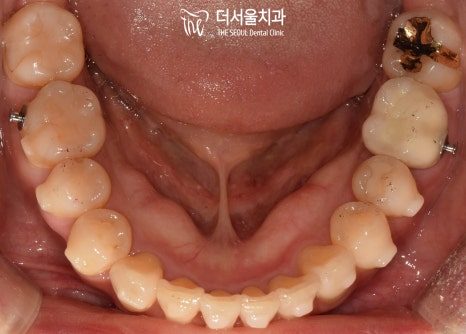
Two questions decided this case, and neither had an off-the-shelf answer: whether teeth had to come out, and how fast it should be finished. The second one is the more interesting.
What did the crowding look like at the start?
The alignment was substantially out. On the upper right, the second tooth from the centre sat well back out of the arch; the same was true of its lower counterpart. Beyond those two, the arch was generally irregular.
The patient’s occupation involves speaking for much of the day, which is why treatment had been put off for years — visible fixed appliances were not workable.
Why were no teeth taken out in this case?
Extraction would have created space easily. It would also have retracted the mouth further than this face could afford: too much retraction here would have left the lower face looking sunken and, in effect, older.
So the plan was built around not extracting, and around resolving the crowding by expanding and aligning within the arch instead.
This is the same judgement as in any crowding case, made in the opposite direction from the usual assumption. Extraction is not the default and neither is avoiding it — what settles it is the space available and the predicted effect on the face.
What does the aligner simulation show?
Because the appliance needed to be inconspicuous, treatment was planned with Invisalign.
A simulation was run before anything was made, modelling the sequence of movements and the projected end position. Two useful things come from that: the clinician can confirm the plan is achievable without extractions, and the patient can see what they are committing two years to.
The projection showed the irregular arch resolving, and the lower teeth — largely hidden behind the uppers at the start — becoming properly visible as the overlap reduced.
How it ran
Aligners were fitted and progress checked against the simulation at each review appointment. The teeth were tracking as planned.
By a little past the first year the alignment had improved markedly. It was also not finished, and this is where the second decision came in.
What happens if teeth are moved too fast?
The remaining movements were carried out slowly and deliberately over the following months rather than compressed.
The reason is not caution for its own sake. Moving teeth faster than the surrounding bone can remodel produces two specific problems:
- An untidy result — the final positioning is where the detail is, and detail does not respond to being rushed.
- Root resorption — the roots themselves can shorten under excessive force. That is not reversible, and it affects the tooth for the rest of its life.
A patient who wants to be finished sooner is asking for something reasonable. It is still the wrong thing to give them, and the reason is worth explaining rather than deflecting.
What changed by the end of treatment?
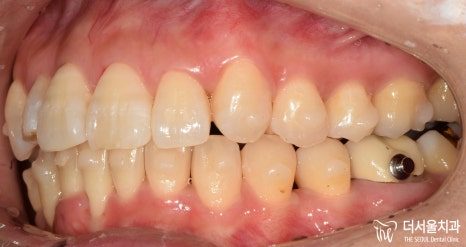
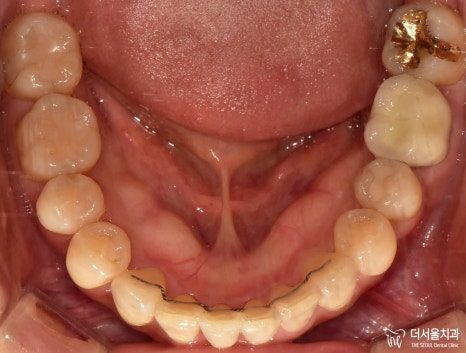
The front teeth had come into line and the molars that had been tipped inward had uprighted into position. The upper and lower arches met properly, which restored normal chewing.
On the radiographs, the teeth that had been bunched together showed even spacing along the arch. On the lateral cephalometric view, the forward-inclined upper front teeth had uprighted, and the lower teeth that had sat too far back had come forward into position.
Treatment ran from 12 October 2022 to 6 July 2024.

The honest summary
There is no rule that orthodontic treatment requires extractions, and no rule that it does not.
It depends on how much space there is, what the face is predicted to do afterwards, and what the patient’s priorities are. For one person extraction is clearly right; for another, clearly wrong. Which is why the answer comes after the assessment, and why a clinic that tells you before examining you is guessing.
Frequently asked questions
Can clear aligners treat severe crowding?
They can in many cases, including this one, where the crowding was substantial and no teeth were extracted. What determines it is the space available and the movements required, which is what the planning simulation is for.
Will I need teeth extracted for orthodontic treatment?
Not necessarily. It depends on the space in the arch and on the predicted effect on your face. Extraction is neither the default nor something to avoid on principle, and the answer comes from the assessment rather than ahead of it.
Can orthodontic treatment be sped up?
Only within limits. Moving teeth faster than the bone can remodel risks an imprecise result and, more seriously, root resorption — the roots shortening permanently. Where we decline to accelerate, that is the reason.
Are clear aligners suitable if I speak for a living?
That is one of the situations they suit best, since they are far less visible than fixed appliances and are removed for eating. They do have to be worn for the great majority of each day to work, which is the trade-off.
How long does aligner treatment take?
This case took just under two years, including a deliberately slow finishing phase. Simpler cases are shorter. Any figure quoted before a simulation has been run is an estimate rather than a plan.
Read more: Invisalign and clear aligners · braces · children’s orthodontics