
If you live in Korea and are enrolled in the National Health Insurance, dental implants are partly covered — but only under conditions that rule out a lot of cases. Worth knowing before you assume either way.
What does Korean insurance cover in dentistry?
More than most people expect. Examinations, scaling, X-rays, glass-ionomer fillings and dentures all attract partial cover, with the patient paying a share.
Implants are included in that list. The eligibility rules are narrow, which is where the confusion usually starts.
Who qualifies for a covered implant?
The scheme reached its present shape in stages: cover began in July 2014 for people aged 75 and over, extended to 70 and over in July 2015 and to 65 and over in July 2016, and the patient’s share was cut from 50% to 30% in July 2018. That sequence is documented in a study of the policy published in the International Journal of Environmental Research and Public Health (Choi and Jung, 2020).
As they stand:
- Age 65 and over.
- Two implants per lifetime — not two per year, and not two per jaw.
- 30% patient co-payment of the covered amount.
- PFM crowns only — porcelain fused to metal.
What does the cover leave out?
A completely edentulous jaw. Cover applies to partial edentulism — the jaw being treated has to have at least one remaining tooth. If the upper jaw has one tooth and the lower has none, only the upper qualifies. A single failing tooth still counts as a tooth for this purpose.
Zirconia crowns. The covered restoration is PFM. Choosing zirconia instead moves the crown outside the scheme.
Additions to the surgery — bone grafting, custom abutments, and locator attachments that connect an implant to a denture are all outside the cover.
That last group matters more than it first appears, because bone grafting is needed in a large share of implant cases. Cover on the fixture does not mean cover on everything the site turns out to need.
Whether you qualify is determined by the National Health Insurance Service on the basis of your examination, not by the clinic. What we can do is check your situation against the criteria at the consultation and handle the application if you are eligible. If you are reading this from outside Korea, note that this scheme applies to people enrolled in Korean national insurance; visitors are not covered.
The case
A patient who had had one implant placed under the scheme a year earlier returned to have the opposite side done. With two covered in a lifetime, the second one was applied for and carried out under the same arrangement.
How is the nerve avoided during surgery?
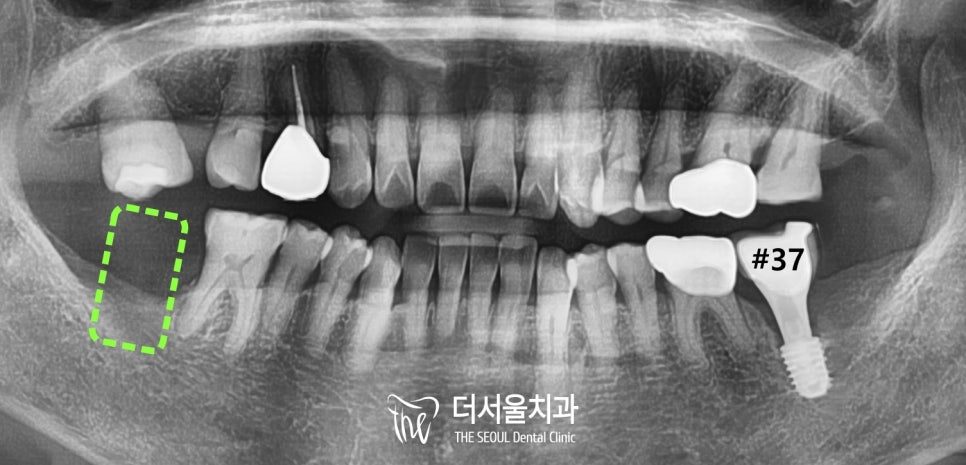
The panoramic X-ray showed the same picture on the lower right as the previously treated left side: considerable bone loss around the site.
That made this a case requiring deep placement, which brings the inferior alveolar nerve canal into play. The nerve running through that canal supplies sensation to the lower lip and chin, and disturbing it during surgery can leave altered sensation.
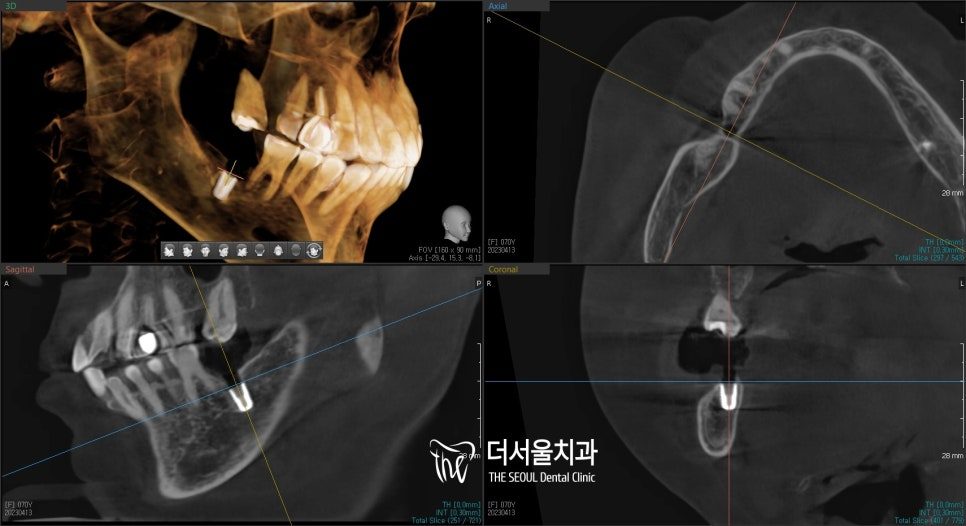
So the placement was planned in simulation first: the patient’s anatomy reconstructed from the scan data, the position of the nerve canal and the safe clearance from it established, and the bone thickness and depth measured, before deciding the fixture position and the path to it.
Minimal-incision placement
Because the position had already been determined digitally, the fixture could be placed through a small opening at that site rather than by laying the gum open more widely.
Less soft tissue disturbed generally means less swelling and faster healing. It is possible here because the planning removed the need to see a wide field during surgery — the guide supplies the position that direct vision would otherwise have to find.
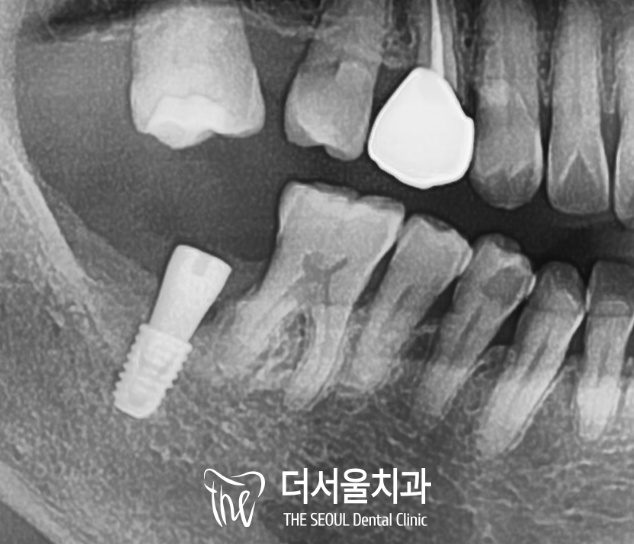
Panoramic and CT images taken afterwards confirmed the fixture had gone in along the planned path and to the planned position.
Finishing
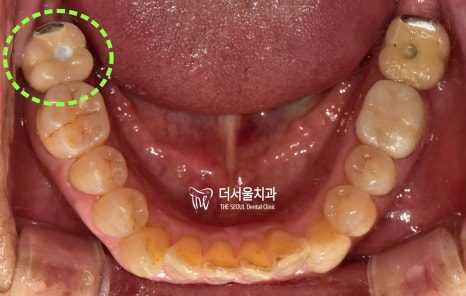
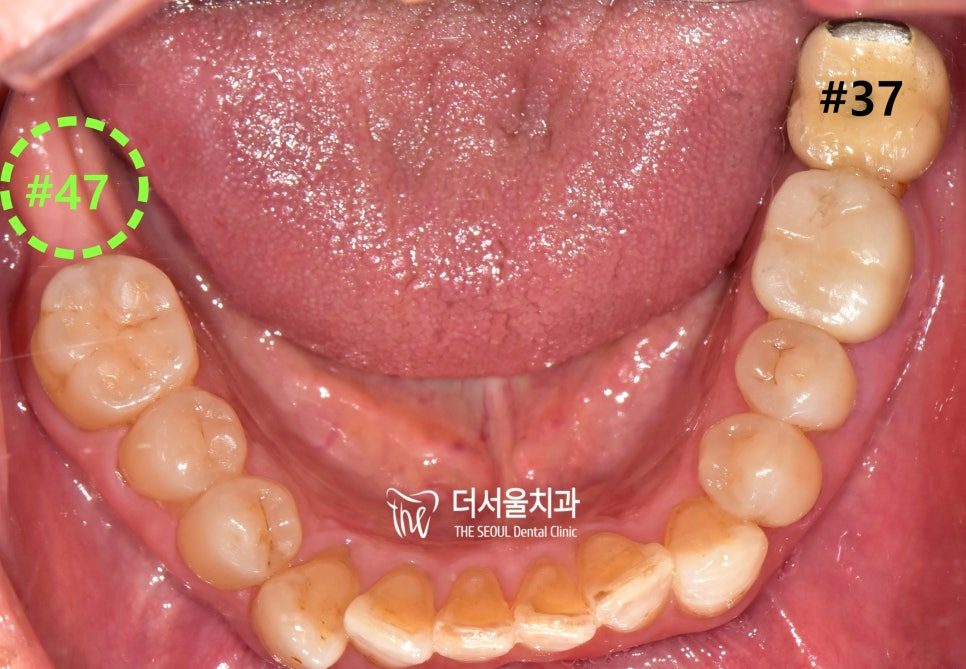
After integration with the bone, the PFM crown was fitted — the restoration the scheme covers.
Treatment ran from 16 March 2022 to 11 August 2022, the interval being largely the integration period.
How do I look after an implant afterwards?
An implant needs the same cleaning as a natural tooth, and arguably more attention. Where oral hygiene slips, inflammation develops around the fixture, and an inflamed site can loosen or fail, which means replacing it.
Brushing properly, using floss or interdental brushes, and keeping regular check-ups is what makes the difference between an implant that lasts and one that has to be redone — and a redone implant is not covered twice.
Frequently asked questions
Does Korean national health insurance cover dental implants?
Partly, for enrolled patients aged 65 and over: two implants in a lifetime, with a 30% patient co-payment, restored with a PFM crown. Eligibility is determined by the National Health Insurance Service on the basis of your examination.
I am a foreign resident in Korea. Does this apply to me?
The scheme applies to people enrolled in Korea’s National Health Insurance, and enrolment rather than nationality is what matters. If you are enrolled and meet the age and clinical criteria, bring it up at the consultation and we will check it. Visitors not enrolled in Korean national insurance are not covered.
Can I choose a zirconia crown under the scheme?
No. The covered restoration is PFM. You can have zirconia, but that part falls outside the cover.
Is bone grafting covered?
No, and neither are custom abutments or locator attachments. Since grafting is needed in a substantial share of implant cases, it is worth establishing at the examination whether your site will require it.
What if I have no teeth left in that jaw?
Cover applies to partial edentulism, so the jaw being treated must have at least one remaining tooth — even a failing one. A completely edentulous jaw falls outside the scheme.
Read more: digital implants · dental implants · pricing