
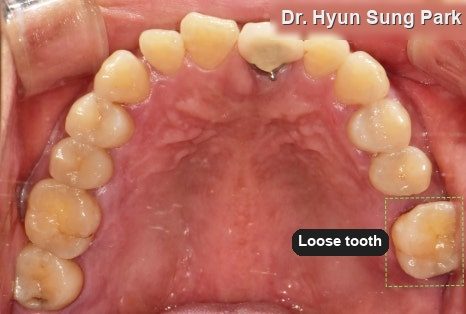
A missing molar is easy to live with for a while, which is exactly why it gets left. Understanding what the treatment actually involves — and what goes wrong while you wait — makes the appointment itself far easier to follow.
What happens if a missing molar is left alone?
Tooth loss is not a rare end state. The World Health Organization puts complete tooth loss at almost 7% of people aged 20 or over, rising to 23% among people aged 60 or over, and describes it as the end point of a long history of decay and gum disease rather than a sudden event — which is why the tooth next to a gap is worth protecting now. Source: WHO, Oral health fact sheet.
You avoid chewing on the empty side without deciding to. That one-sided habit has consequences:
- Strain on the temporomandibular joint, and over time facial asymmetry
- Food that is not broken down properly, which places a load on digestion
- Debris collecting around the gap, making oral hygiene harder
One lost molar is rarely the end of it. The problems compound.
How is the placement planned digitally?
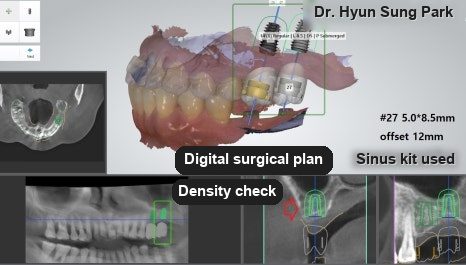
In the case described here, examination showed that both the upper and lower jaw needed treatment. The central question in this kind of work is simple to state and hard to execute: how precisely, and how safely, can the fixture be placed? That is what the digital plan is for.
- CT imaging establishes the position of the maxillary sinus and the course of the inferior alveolar nerve canal — the two structures that must not be encroached on.
- Virtual placement sets the fixture position in the guide system before surgery rather than during it.
- Prosthetic position is planned at the same time, so the finished crown meets the opposing tooth correctly instead of being corrected afterwards.
Planning this way reduces the scope for error during surgery and shortens the time the patient spends in the chair.
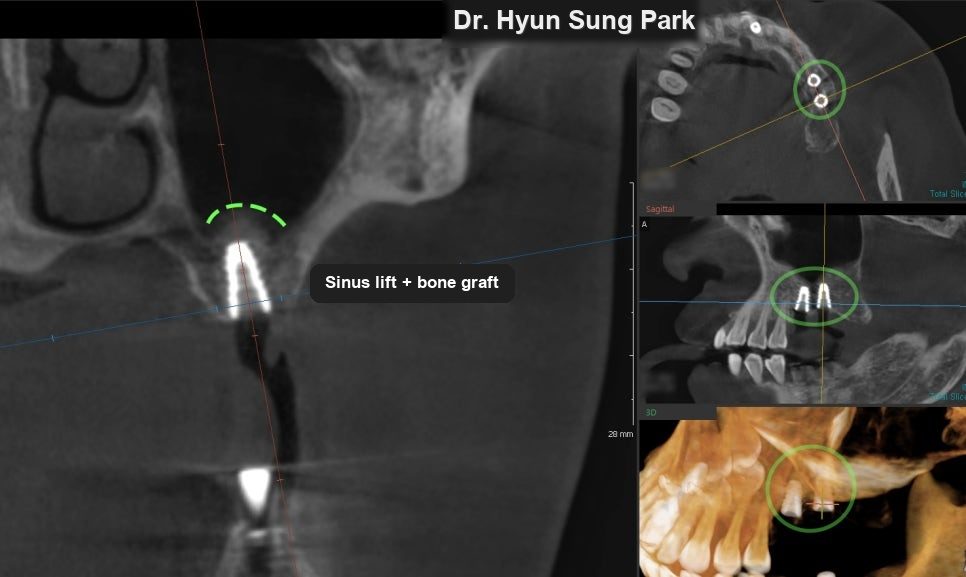
The upper jaw: sinus lift with bone graft
Treating upper molars means working close to the maxillary sinus, an air cavity sitting directly above them. Where bone height is insufficient, a sinus lift creates the space the bone needs to occupy.
Creating the space is only half of it. Bone grafting has to accompany it, because the graft is what gives the fixture a foundation to stay fixed in over the long term. A sinus lift performed without grafting achieves nothing on its own.
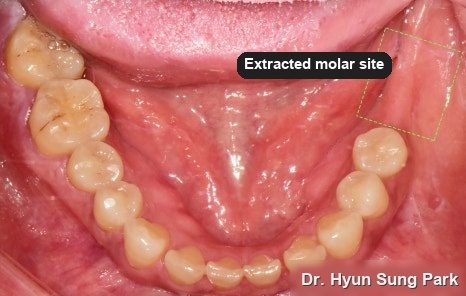
The lower jaw: working around the nerve
Once the upper fixtures were confirmed stable, the lower jaw was treated, with the placement position set precisely to avoid the inferior alveolar nerve. This is the reason lower molar implants are planned from CT data rather than from a standard X-ray.
The prosthetic and the bite
The crowns were made to the occlusal relationship planned at the outset. Once fitted, they took the form of natural teeth and met the opposing teeth comfortably. The bite was even, chewing caused no discomfort, and the one-sided chewing pattern that had developed was corrected.
Timeline
Treatment ran from late February to mid-June 2025 — roughly three and a half months across both jaws, including healing time between surgery and the final prosthetic. Overseas patients should plan this as more than one visit; the healing interval is biological and cannot be compressed.
How do you make the prosthetic last?
Surgery is not the end of the work. Six things matter afterwards:
- Hard foods — return to them gradually. Dried squid and cartilage are worth being careful with rather than forcing.
- Cleaning around the site — bacteria spread easily there, so it needs attention every day.
- Regular scaling and check-ups — the single most effective thing you can do to prevent inflammation.
- The first week — avoid hot food, strongly seasoned food and alcohol.
- Smoking is a leading cause of failed osseointegration.
- Floss, interdental brushes and an oral irrigator — use them properly rather than occasionally.
Patients who build preventive habits before a problem appears notice the difference in how long the prosthetic lasts.
Frequently asked questions
How long can I leave a missing molar before treating it?
There is no safe interval to aim for. The longer the gap stays, the more the neighbouring and opposing teeth shift, and the more likely you are to develop a one-sided chewing habit that affects the jaw joint. Bone in the empty site also reduces over time, which can turn a straightforward implant into one that needs grafting first.
Why does a molar implant need a CT scan?
Because of two structures a standard X-ray cannot show in three dimensions: the maxillary sinus above the upper molars, and the inferior alveolar nerve canal below the lower ones. Placement position, angle and depth are all set relative to those, which is why they are planned from CT data before surgery rather than judged during it.
Is a sinus lift always needed for an upper molar implant?
No — only where the bone height below the sinus is insufficient for the fixture. Whether you need one is determined from your CT scan. When it is needed, bone grafting is done at the same time.
How long until I can eat normally?
Ordinary eating resumes well before treatment finishes, but hard foods should be reintroduced gradually rather than immediately. For the first week, avoid hot food, strong seasoning and alcohol. Your own schedule depends on how the site heals and will be set at your check-ups.
Read more: digital guided implants · bone grafting and sinus lift · dental implants overview