
Dental restorations have a service life. A bridge that has been in place for years can look perfectly serviceable while decay develops underneath it, where neither you nor a visual examination can see it.
When should an old restoration be replaced?
Around ten years is a common working figure, after which a restoration is assessed and replaced if its condition warrants it. Good home care can extend that considerably. It can also go the other way — some restorations need attention before five years are out.
What decides which of those you get is largely maintenance: careful cleaning around the restoration, and check-ups that look at it rather than only at your natural teeth.
What the examination found
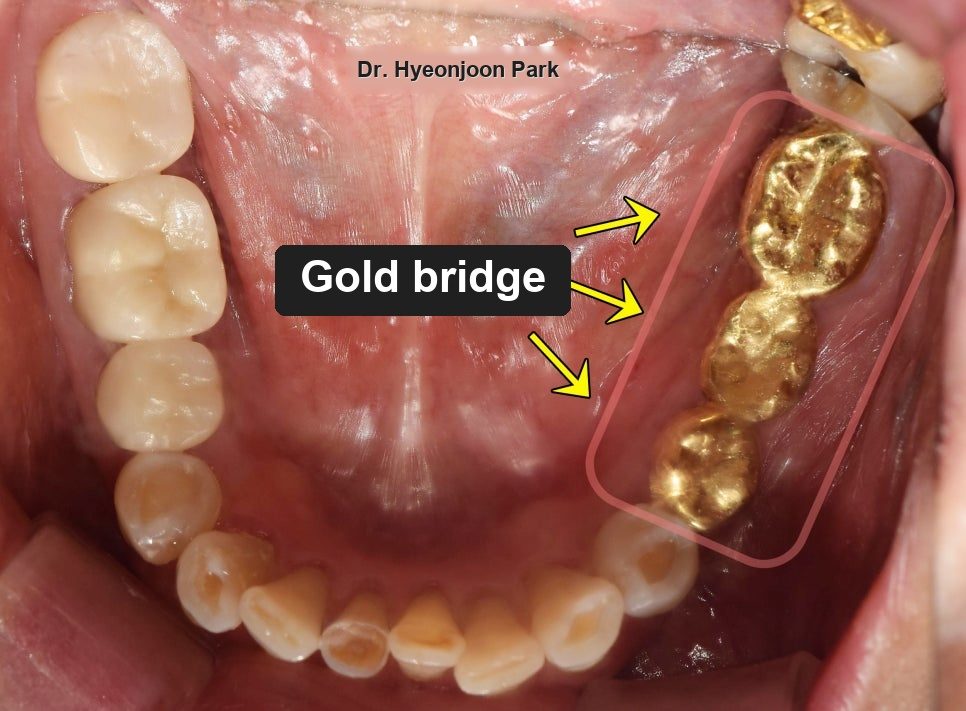
The lower right molar area carried a gold bridge. Gold is a durable material, and this one showed enough wear to indicate it had been in service for a long time.
The mechanism of failure here is worth understanding, because it is silent.
A restoration is made to fit tightly against the gum. Over years, if cleaning around it is not thorough, the gum recedes. That recession opens a fine gap between restoration and tooth, bacteria get in, and decay develops underneath — out of sight, and often without pain until it is extensive.
Why bridges need more attention than single crowns
A bridge uses the teeth on either side as abutments, and a false tooth — the pontic — spans the gap between them. The pontic does not have a root; it sits over the gum.
That area traps food readily and accumulates plaque, which is why periodontal problems are common around bridges. Cleaning under a pontic requires a floss threader or an interdental brush; a normal brushing action does not reach it.
What was hiding under the bridge?
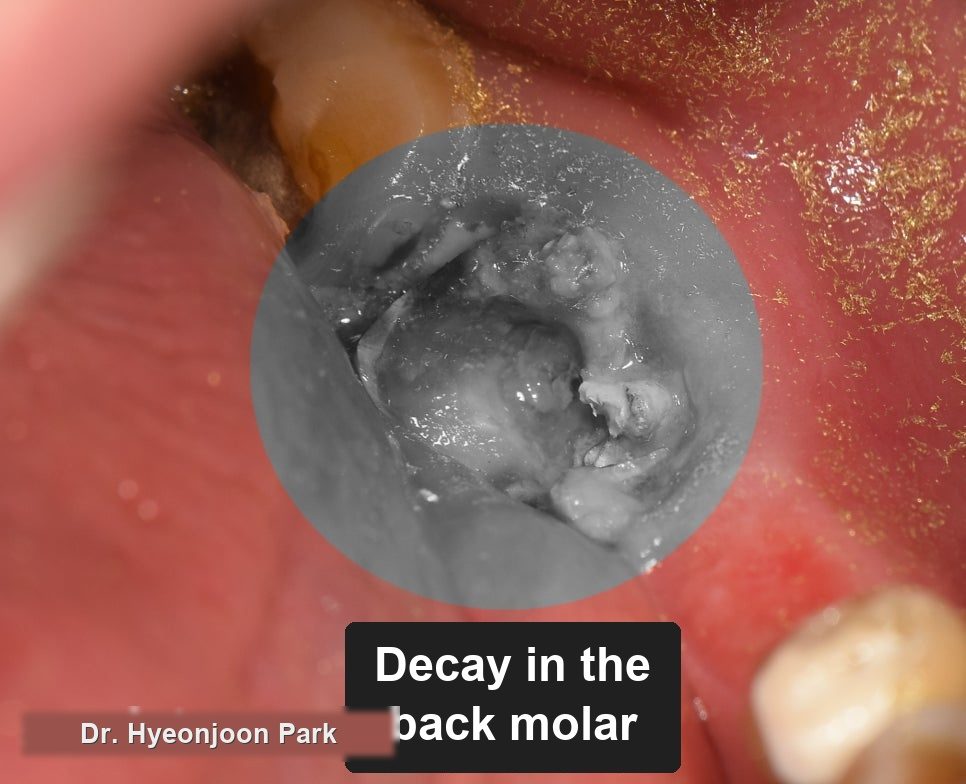
With the restoration removed, the rear abutment tooth showed extensive decay. Only a small amount of sound tooth structure remained, and old filling material was visible inside.
The decision was extraction and an implant rather than an attempt to save the tooth. The reasoning was structural: root canal treatment could have preserved it in the short term, but molars carry high chewing loads, and the remaining tooth structure was unlikely to withstand them. The probable sequence was a crack or fracture, then inflammation, then a more complicated treatment than if the tooth had been replaced in the first place.
Saving a tooth is generally preferable. It stops being preferable when the outlook is poor enough that you are buying a year or two at the cost of a harder problem later.
Is sedation the same as being put to sleep?
For patients who find dental treatment difficult, even routine appointments can be hard, and implant placement more so.
Conscious sedation is an option in that situation. Unlike general anaesthesia it induces a drowsy, relaxed state in which you remain able to respond to simple instructions. Local anaesthetic is still used at the surgical site. Most patients remember the appointment only vaguely afterwards, which is what makes a long procedure manageable for someone who has been avoiding treatment.
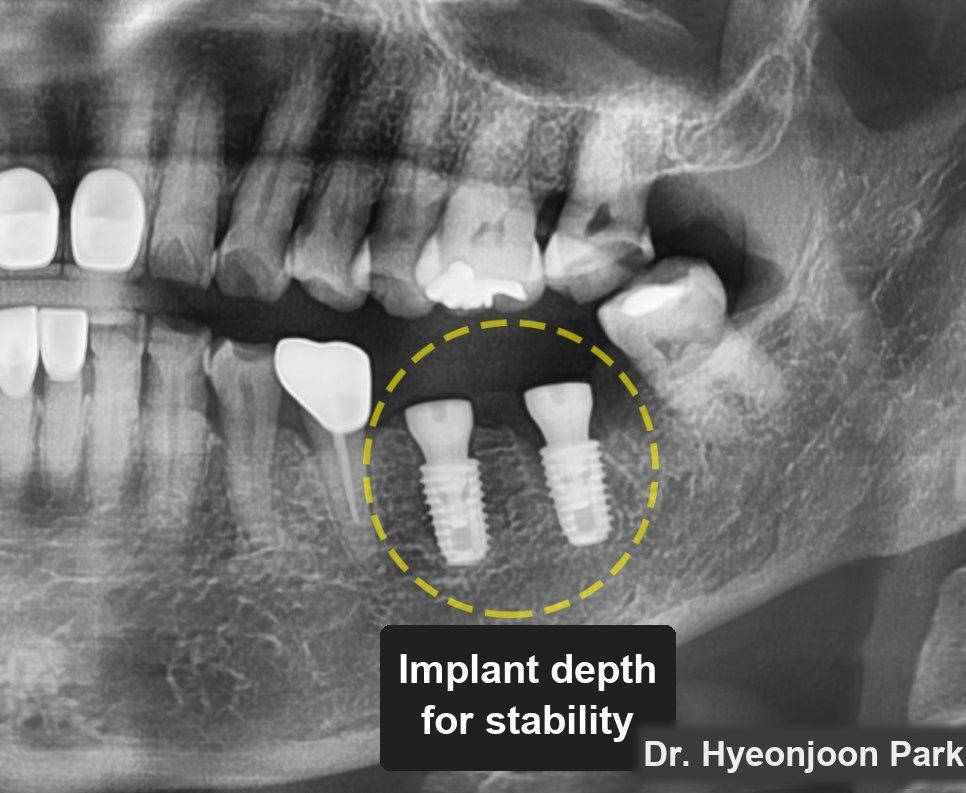
An optimal path for the fixture was selected before placement, and the fixture was placed accordingly. Post-operative panoramic imaging confirmed appropriate position and depth. After a healing period, the restoration was fitted.
The result
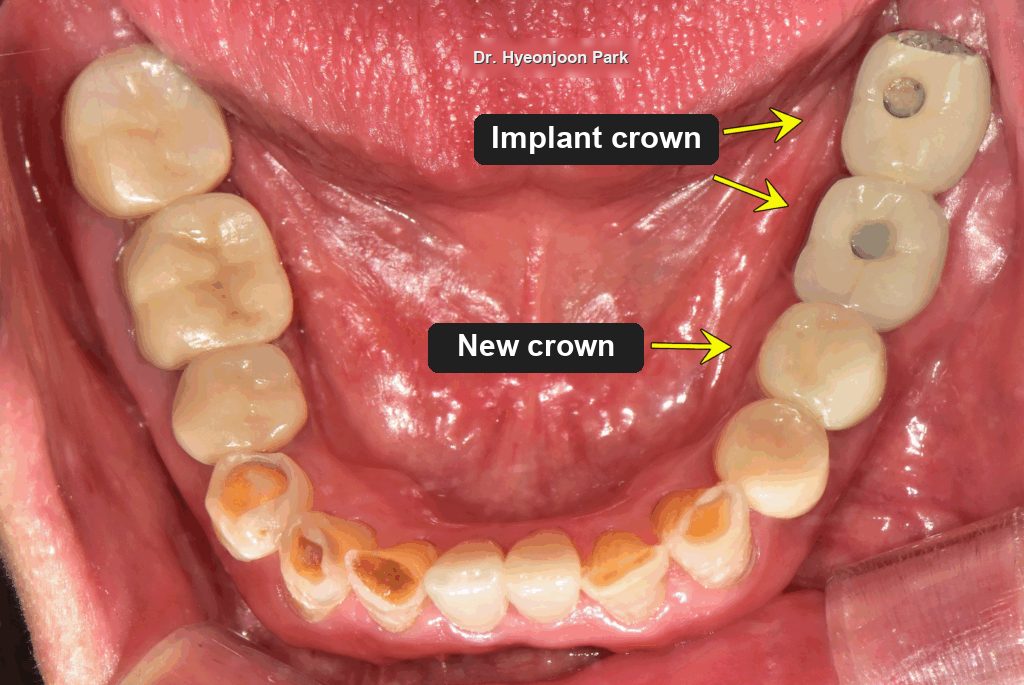
The new restoration is considerably less conspicuous than the gold it replaced, and the material is durable enough for long-term use in a molar position.
Spacing between the implant restoration and the adjacent teeth was set appropriately, and at follow-up the site was stable with no signs of inflammation.
Can the gum around an implant still get infected?
An implant cannot decay. The gum and bone around it can still become inflamed, and peri-implant inflammation left to progress is a real cause of implants needing revision surgery.
So the outcome from this point is a maintenance question rather than a surgical one:
- Clean around the restoration daily, including the surfaces a toothbrush does not reach
- Attend check-ups every three to six months so inflammation is found early
- Have existing older restorations assessed rather than assuming that no pain means no problem
How long did the treatment take?
Treatment ran from mid-November 2023 to late March 2024 — about four and a half months from the initial examination to the final restoration, most of it the wait for the fixture to bond into bone.
Frequently asked questions
How long does a dental bridge last?
Around ten years is a reasonable expectation, though the range is wide in both directions. What most affects it is how well the area under the pontic and around the abutment teeth is cleaned.
Can decay develop under a crown or bridge?
Yes, and it is one of the more common reasons an old restoration has to be replaced. Gum recession over time opens a fine gap, bacteria enter, and decay progresses out of sight. It frequently causes no pain until it is extensive.
How do I clean under a bridge?
A floss threader or an interdental brush, used under the pontic — the false tooth spanning the gap. Ordinary brushing does not reach that surface, and it is where the problems start.
Should a badly decayed molar be saved or extracted?
It depends on how much sound structure is left. Molars take heavy chewing loads, and a tooth rebuilt from very little tends to crack. Where the outlook is poor, replacing it is often better than a repair that fails in a year or two.
Can I have implant surgery if I am afraid of dental treatment?
Yes. Conscious sedation leaves you relaxed and drowsy but still responsive, and most people remember little of the appointment. Say so at the consultation so it can be planned for.
Read more: dental implants overview · crowns and veneers · cavities and fillings