
Anyone considering treatment for a protruding mouth asks the same first question: will teeth have to come out? It is the right question, because the answer is not a preference — and getting it wrong shows on the face.
What does a protruding mouth look like?
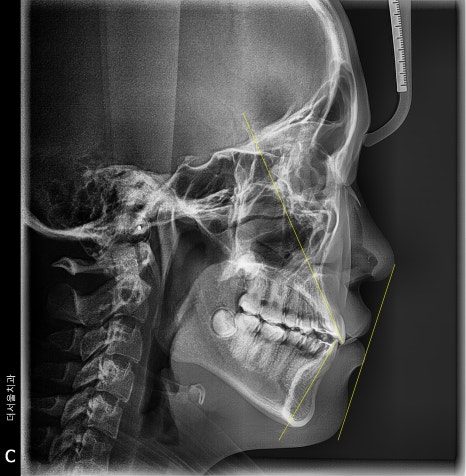
Measured against a line drawn from nose to chin, the lower lip sat forward of it.
On the radiograph the skeletal difference was not dramatic. The visible protrusion came largely from the soft tissue — the lips pushed forward by the teeth beneath them, which is what gives the face a heavy-set look.
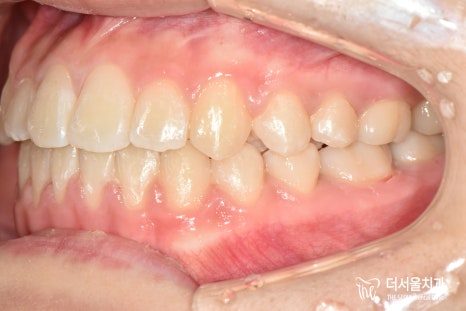
There was also a reverse bite at the front: the upper front teeth meeting behind the lower ones instead of in front.
How is it decided whether teeth must come out?
Whether to extract is judged from the arch and tooth relationships and from the predicted change to the face. It is a prediction made before treatment, and the whole plan follows from it.
Extracting in a case that did not need it retracts the mouth too far. The nasolabial folds deepen, the lips can turn inward, and the lower face collapses slightly. It reads as older.
Not extracting in a case that needed it means the crowding is resolved by pushing the teeth outward into the space that is not there — and the mouth ends up looking more protruded than it did at the start.
Two errors in opposite directions, both permanent enough to matter, and both visible in the face rather than only in the mouth.
This case was assessed as suitable for treatment without extractions.
What kind of braces were used?
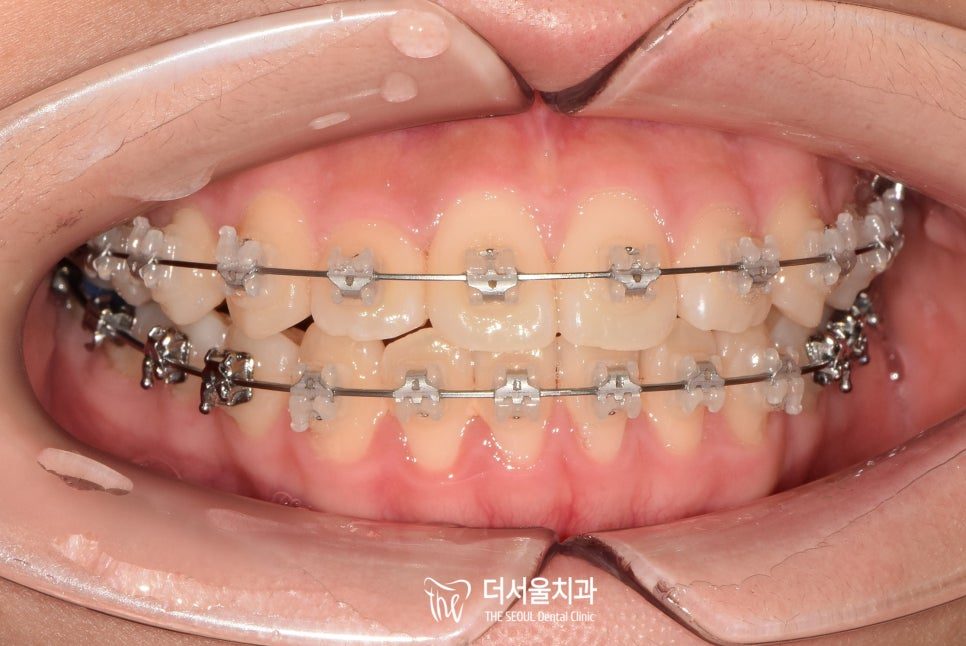
Self-ligating Clippy-C brackets were bonded and connected with a wire.
To bring the reverse-biting front teeth forward, bite raising was used — the bite propped open so the upper and lower front teeth are not in contact and can move past one another.
This is uncomfortable in a specific way that is worth being told about in advance. With the back teeth held apart, eating is genuinely difficult, and the advice is to stay on softer foods for the period. Forcing a normal diet through it leads to poor digestion or strain on the jaw joint.
How do you keep teeth clean with braces on?
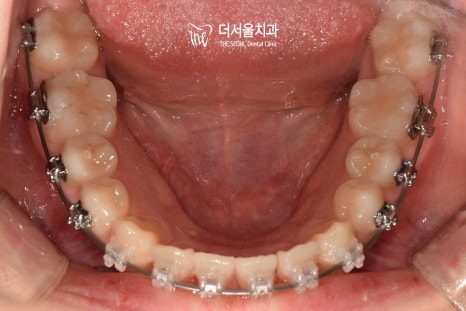
Fixed appliances make cleaning harder, and orthodontic patients therefore develop decay and gum problems more readily than they otherwise would.
At each adjustment appointment the teeth were scaled, checked for decay, and given fluoride where needed. This is unglamorous and it is the difference between finishing with a corrected bite and finishing with a corrected bite plus fillings.
What had changed after eighteen months?
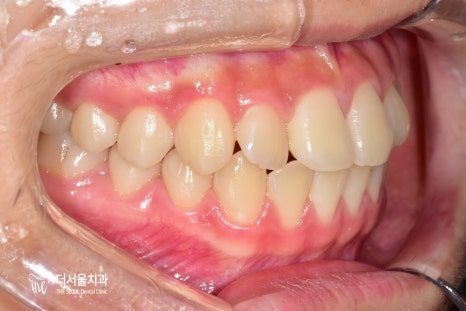
The reverse bite had been corrected to a normal relationship, and the protruding teeth were aligned.
On the lateral cephalometric radiograph, the change was in the axial angle of the incisors — the teeth uprighted rather than sitting forward — and the lip position had followed them back.
That is the mechanism, and it is worth understanding: the lips are not treated. They move because what was pushing them out has moved.
Retention
Teeth try to return to where they came from. That tendency — relapse — is not a complication; it is the default.
A fixed retainer wire was bonded to the inner surfaces of the teeth to hold the result. If that wire ever comes loose, it needs re-attaching quickly rather than at the next convenient appointment, because the teeth begin moving as soon as it stops holding them.
Treatment ran from 11 February 2021 to 23 August 2022 — about eighteen months.
Frequently asked questions
Can a protruding mouth be corrected without extractions?
Sometimes. It depends on the arch and tooth relationships and on what the predicted facial change is. Non-extraction is not automatically the gentler option — in a case that needed extractions, it leaves the mouth looking more protruded than before.
What happens if teeth are extracted unnecessarily?
The mouth is retracted too far. The nasolabial folds deepen and the lower face can look sunken, which tends to read as older. It is the mirror-image error to not extracting when you should.
What is bite raising and why does it make eating hard?
The bite is propped open so the upper and lower front teeth clear each other and can be moved past one another. While it is in place the back teeth do not meet, so chewing is difficult and softer foods are advised for the period.
Do braces cause cavities?
Not directly, but they make thorough cleaning much harder, which raises the risk. Scaling, decay checks and fluoride at each adjustment appointment are the standard countermeasure, along with more careful brushing at home.
Will my teeth move back after braces?
They will try to. A retainer — here a fixed wire bonded behind the teeth — is what holds the result. If it comes loose, have it re-attached promptly; the movement starts as soon as it stops working.
Read more: braces · Invisalign and clear aligners · children’s orthodontics