
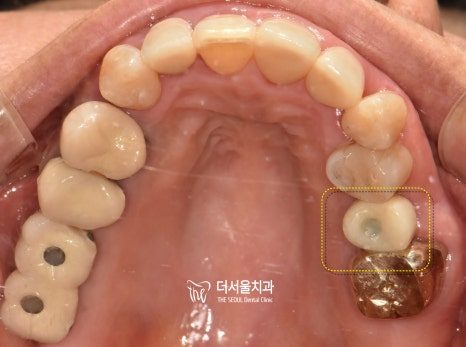
Digital implant. Computer analysis. Navigation. Simulation. Flapless. If you have been researching implant treatment you have met all of these words, and quite reasonably wondered whether any of it matters — surely a good surgeon is a good surgeon? Here is what the technology changes, shown through an actual case.
Why the patient came in
A long-standing patient of ours arrived with two complaints: an abscess on the gum and a loose molar.
A gum abscess usually means inflammation inside, and a high likelihood that bone resorption has already progressed some way. The X-ray confirmed it: around the root apex of the upper left second premolar, the bone had darkened and resorbed.
Had this been caught at an early inflammatory stage during a routine check-up, an apicoectomy might have been an option. By this point bone destruction extended beyond the root tip, and removing the infection meant extraction.
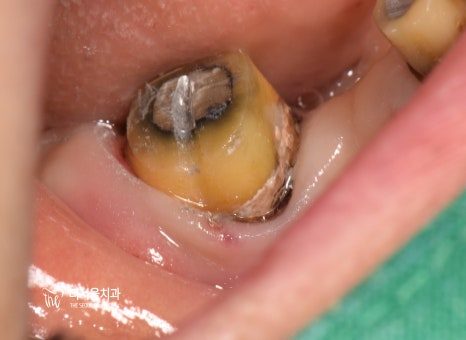
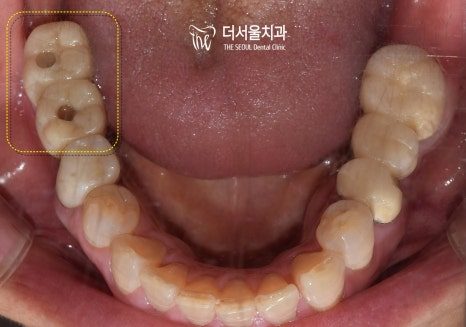
The loose tooth was a lower right molar restored years earlier as part of a bridge. It too had apical inflammation, which had progressed until the bone holding the tooth dissolved and the rear root was exposed outside bone. On examination the bridge itself was lifting.
Why remove the bridge before deciding?
Old restorations lose their internal cement over time. Food debris and bacteria get into the gap, and decay develops underneath where nothing is visible.
The radiographs alone justified extraction. We removed the bridge anyway, for a reason that is not purely clinical: it would have been quicker to cut the bridge and extract the loose tooth with it, but a patient told without warning that a tooth must come out deserves to see why. Removing the bridge let us check whether anything could be saved, and show the patient what we were looking at.
Decay and discoloration had indeed spread through the gap left by dissolved cement. The premolar could be rebuilt and crowned. The larger molar, its root surface covered in inflammation and decay, could not.
The plan
- Extract the two teeth with severe inflammation.
- Re-treat and crown the salvageable premolar.
- Place implants in the three resulting gaps.
So what is a “digital” implant?
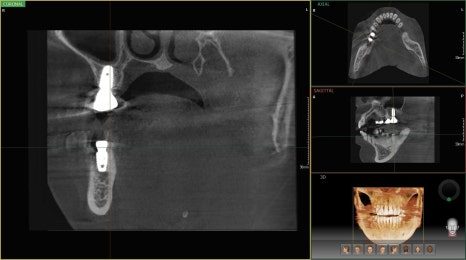
The patient’s oral condition is reproduced inside a computer program, and the surgery is analysed and simulated before it happens. It is sometimes called navigation implant surgery, and the analogy holds: you are following a route worked out in advance rather than reading the road as you go.
What that changes:
- Measurement instead of estimation. Bone density, the size of an inflammatory lesion and the position of structures to avoid are established as data, down to fine increments — not judged by feel.
- The position, size and depth of each fixture are planned before surgery.
- A custom surgical guide is made from that plan, so placement follows it without deviation.
- Flapless placement becomes possible. Rather than incising the gum to find the position, the guide locates it and the site is punched through. Where the bone outline has collapsed and grafting or contouring is needed, we still make a minimal incision — it is not universal.
The practical consequences are less post-operative pain, swelling and bleeding, and a meaningful reduction in both treatment time and the number of visits. That last point matters most to patients travelling from overseas.
What was the result?
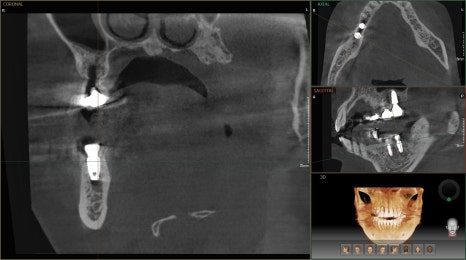
The fixtures were placed clear of the nerve canal and the maxillary sinus, aligned properly with the dental arch. Because the simulation included the position of the final prosthetic, very little occlusal adjustment was needed in the mouth afterwards — the crowns fitted the bite they were designed for.
Treatment ran from February to June 2023, and ended with the same agreement we make with every implant patient: come in for check-ups before something goes wrong.
Frequently asked questions
Is a digital implant different from a normal implant?
The implant is the same. What differs is planning and placement: the position, angle and depth are decided from CT and scan data in software, and a custom guide transfers that plan into the mouth. The gain is accuracy and predictability, not a different product.
Does flapless placement mean no cutting at all?
It means the gum is punched at a position established by the guide rather than incised to expose the bone. It is not available in every case — where the bone outline has collapsed and grafting or contouring is required, a minimal incision is still made.
Does guided surgery reduce the number of appointments?
Generally yes. Reduced surgical time and less post-operative swelling shorten the overall course, and because prosthetic position is planned in advance there is less adjustment at the fitting stage. If you are scheduling treatment around international travel, tell us at consultation and we will plan the stages around your dates.
My gum has an abscess. Will I lose the tooth?
Not necessarily — it depends how far bone loss has progressed. Caught early, an apicoectomy may resolve it. Once destruction extends past the root tip, as here, extraction is usually the only way to remove the infection. A CT scan settles which situation you are in.
Read more: digital guided implants · dental implants overview · crowns and veneers